Angora Rabbit Eyes: Anatomy, Eye Colors, Health Conditions, and the English Angora Wool Risk
How we researched this guide: In October 2026 we checked the facts in this article against Veterinary Information Network, PDSA, MSD Veterinary Manual, American Rabbit Breeders Association and IAGARB, and corrected or removed anything we could not verify. Our sources are listed at the end. See our editorial policy. Last reviewed: October 2026.
Quick answer: Healthy Angora eyes are bright, clear and free of discharge. Eye color depends on coat color, and Ruby-Eyed White is a recognized variety in the ARBA Angora breeds. English Angoras need their facial wool kept away from the eyes. See a vet for any squinting, swelling or discharge.
Rabbit eyes are among the most functionally remarkable features of the species — large, laterally positioned, capable of near-360-degree vision, and adapted for crepuscular low-light activity that evolved under sustained predation pressure. For Angora rabbit owners, there is a second layer of eye-related knowledge that is specific to the breed group: the English Angora’s facial wool grows continuously and, without regular trimming, makes direct contact with the cornea — causing chronic irritation, infection, and in neglected cases, permanent corneal damage.
This article covers rabbit eye anatomy and color genetics, the full list of eye conditions relevant to Angora rabbits with their clinical signs, the English Angora facial wool risk, and the daily monitoring and care practices that keep eyes healthy across all Angora breeds.
Rabbit Eye Anatomy: What Makes Rabbit Eyes Different
The position and structure of rabbit eyes is shaped entirely by the species’ role as a prey animal. Understanding the anatomy explains the behaviors owners observe and the vulnerabilities owners need to monitor.
Lateral Eye Placement and Field of View
Rabbit eyes are positioned on the sides of the skull rather than facing forward, as in predators. This lateral placement produces a visual field of approximately 360 degrees — near-panoramic coverage that allows a rabbit to monitor for approaching threats from virtually any direction without moving its head. The tradeoff is a small binocular overlap zone directly in front of the nose, creating a frontal blind spot. Rabbits tip or bob their heads slightly to assess objects at close range in front of them, compensating for this blind spot through parallax motion.
Eye Size and Low-Light Adaptation
Rabbit eyes are proportionally large relative to skull size. Large eyes capture more ambient light, supporting the rod-dominant retina that enables effective vision in the dim conditions of dawn and dusk — the rabbit’s primary activity periods. Unlike cats and dogs, rabbits do not have a reflective tapetum lucidum behind the retina, so their low-light vision comes mainly from their large eyes and rod-rich retina. For the complete explanation of rabbit vision and crepuscular behavior, see our Can Rabbits See in the Dark? guide.
The Third Eyelid
Rabbits have a third eyelid — the nictitating membrane — that moves horizontally across the eye from the inner corner. This membrane provides additional protection for the cornea and is normally not visible in a healthy rabbit. When the third eyelid is visibly protruding or covering part of the eye at rest, it indicates illness, pain, severe stress, or another eye problem, so it should be checked by a vet.

Angora Rabbit Eye Colors: Genetics and Breed Associations
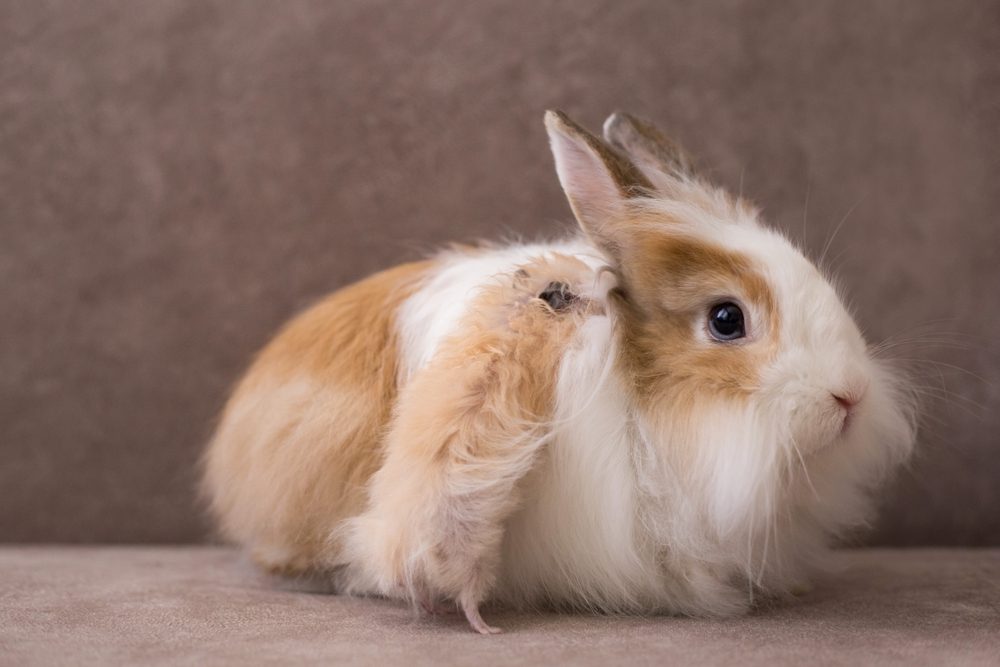
Eye color in rabbits is determined by pigmentation genes that operate in combination with coat color genetics. The most common eye colors in Angora rabbits and their genetic associations:
| Eye Color | Genetic Association | Breeds Where Common |
|---|---|---|
| Brown (dark) | Standard pigmented eye — most common | All Angora breeds |
| Blue-gray | Dilute pigmentation — blue coat genes | French, English, German Angoras |
| Ruby red (REW) | Albino — complete absence of pigment | Giant Angora (ARBA-recognized color only) |
| Blue-eyed white | Vienna gene (vv) — distinct from albino | English Angora; some French |
| Marbled / odd-eyed | Combined Vienna and pigment genes | Occasionally in English Angora |
Ruby-eyed white (REW) Angoras are true albinos — the red appearance of the eye is the blood vessels of the retina visible through the unpigmented iris. ARBA now recognizes Giant Angoras in ruby-eyed white and chestnut. REW rabbits have no visual disadvantage relative to pigmented rabbits under normal lighting conditions, though they may be more sensitive to very bright light due to the absence of iris pigment that would otherwise limit light entry.
Blue-eyed white (BEW) rabbits carry the Vienna gene (vv) in homozygous form. Unlike REW rabbits, BEW rabbits have blue eyes because the Vienna gene produces a dilution effect on the iris rather than complete pigment absence. Some breeders report a possible link between blue eyes and deafness, but good evidence in rabbits is limited — a consideration for breeders selecting for this characteristic. For the complete genetics of blue-eyed white rabbits across breeds, see our Blue-Eyed White Bunny guide.
The English Angora Facial Wool Risk: The Most Important Eye Issue for Angora Owners
Of all the eye-related considerations for Angora rabbit owners, the one unique to the breed group — and specific within it to the English Angora — is the most consequential for daily care.
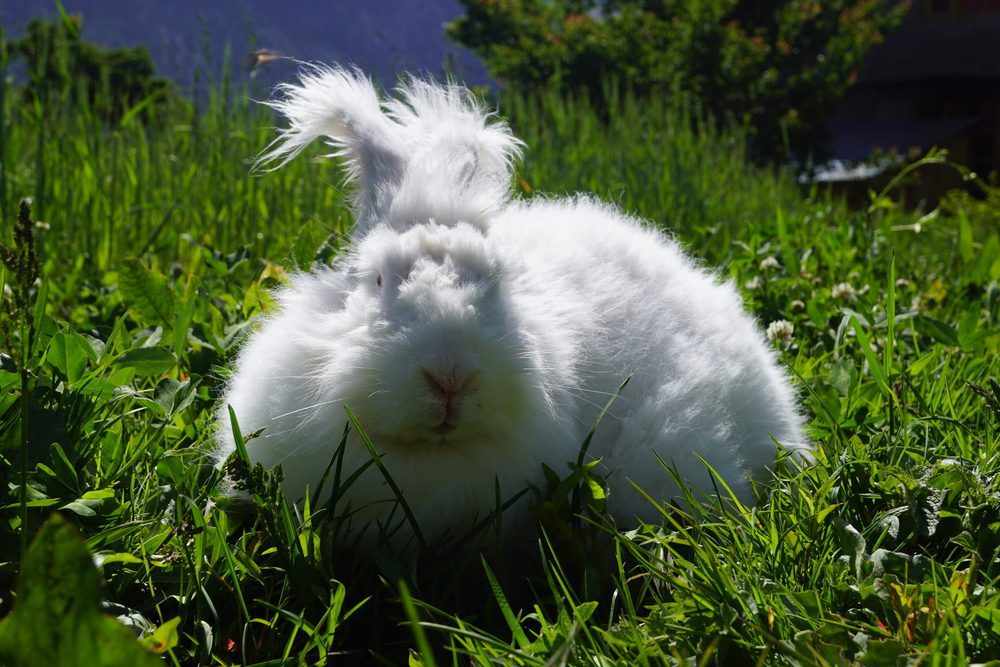
The English Angora has the fullest facial wool of the Angora breeds, including the area around the eyes. This wool grows at approximately 1 inch (2.5 cm) per month, continuously, without self-limiting. Without regular trimming, the facial wool grows long enough to contact the cornea directly.
What Wool-Eye Contact Does
When wool fiber contacts the cornea:
Immediate effect: Mechanical irritation. The fiber abrades the corneal surface with each blink, producing the same sensation as a foreign body in the eye. The rabbit responds by blinking repeatedly, tearing excessively, and rubbing its face against surfaces.
Short-term effect: Conjunctivitis and periocular inflammation. Chronic mechanical irritation inflames the conjunctiva (the membrane lining the eyelid interior) and the surrounding tissue. Discharge accumulates at the inner corner of the eye and in the surrounding facial wool. This discharge-soaked wool is warm and moist — ideal conditions for bacterial colonization.
Progressive effect: Bacterial conjunctivitis and corneal ulceration. Bacteria establish in the discharge-soaked facial wool and migrate to the eye. The cornea, already abraded by fiber contact, is vulnerable to infection. Corneal ulcers — painful erosions of the corneal surface — require veterinary treatment with antibiotic and anti-inflammatory eye drops. Untreated, corneal ulceration progresses to corneal scarring and permanent vision impairment.
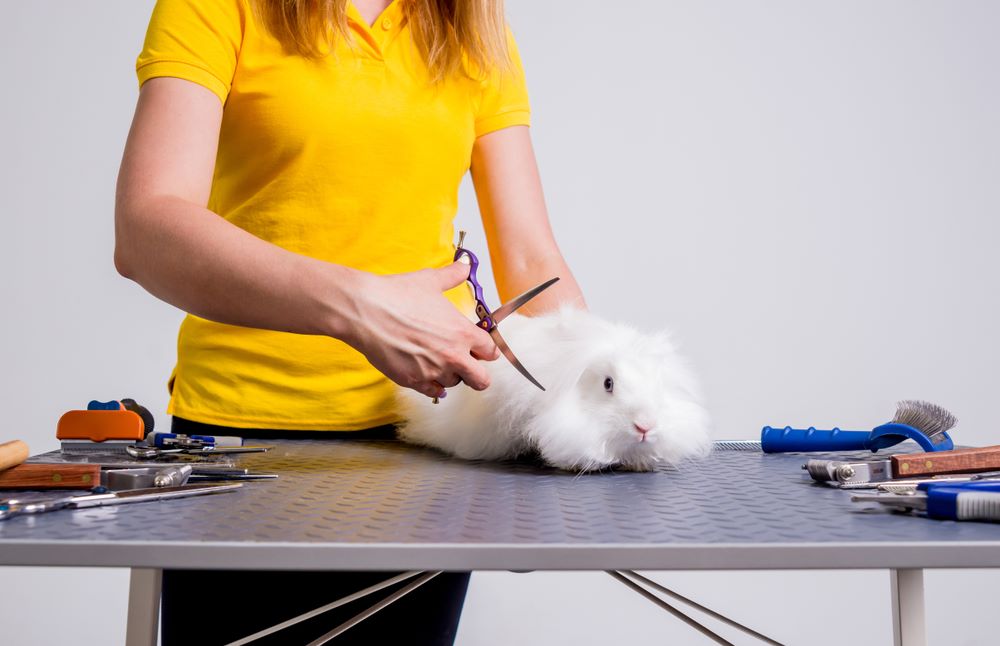
The care standard: The facial wool around the eyes of every English Angora rabbit must be trimmed at every grooming session, two to three times per week minimum. This is not a cosmetic task. It is a health maintenance requirement that belongs in the grooming routine without exception. Any facial wool that reaches the eyeball surface must be removed immediately. Use small blunt-nosed scissors for precision trimming around the eye area.
French and Satin Angoras have clean faces. Giant and German Angoras have lighter head furnishings, so check that this wool stays clear of their eyes too.
Common Eye Conditions in Angora Rabbits
Conjunctivitis
Inflammation of the conjunctiva — the mucous membrane lining the inner surface of the eyelids and covering the white of the eye. Presents as redness, swelling, and discharge at the eye’s inner corner. In Angora rabbits, the most common causes are facial wool contact (English Angora), dental disease (tooth root abscesses pressing on the nasolacrimal duct), and bacterial or viral infection.
Signs: Redness of the conjunctival tissue; watery or mucoid discharge; matting of periocular fur; squinting or repeated blinking.
Treatment: Veterinary assessment is required to identify the cause. Bacterial conjunctivitis is treated with antibiotic eye drops or ointment. If a blocked nasolacrimal duct is the cause, flushing the duct under sedation may be necessary.
Epiphora (Excessive Tearing)
Overflow of tears onto the face below the eye, caused by overproduction of tears or, more commonly, blockage of the nasolacrimal duct — the drainage channel that carries tear fluid from the eye to the nasal cavity. In rabbits, nasolacrimal duct blockage is frequently secondary to dental disease: the tooth roots of the upper incisors and premolars lie in close anatomical proximity to the duct, and tooth root overgrowth or infection can compress or obstruct it.
Signs: Persistent wet fur below the inner corner of the eye; brown or rust-colored staining of periocular fur from tear pigments; fur loss or skin irritation in the affected area.
Treatment: Veterinary dental assessment is the priority when epiphora is present in an adult rabbit. The nasolacrimal duct can be flushed under sedation to confirm and relieve blockage. Treating the underlying dental cause is required for resolution.
Corneal Ulceration
A breach in the corneal epithelium — the outer surface layer of the eye. In Angora rabbits, the most common cause is chronic mechanical abrasion from facial wool contact (English Angora) or trauma. Corneal ulcers are painful and progress rapidly if untreated.
Signs: Squinting (blepharospasm) — the rabbit holds the affected eye partially or fully closed; pawing at the eye; excessive tearing; visible haziness or opacity on the corneal surface; avoidance of bright light.
Treatment: Veterinary examination using fluorescein dye (which fluoresces under blue light at areas of corneal ulceration) confirms the diagnosis. Treatment involves antibiotic eye drops to prevent secondary infection, anti-inflammatory medication for pain relief, and removal of the cause (facial wool trimming).
Uveitis
Inflammation of the uveal tract — the pigmented, vascular middle layer of the eye, including the iris, ciliary body, and choroid. In rabbits, uveitis is frequently associated with Encephalitozoon cuniculi (E. cuniculi) infection — a microsporidian parasite that is common in domestic rabbit populations and can cause a characteristic lens rupture uveitis (phacoclastic uveitis) that presents as a white or opaque material visible within the eye.
Signs: Eye appears cloudy or has white material visible inside; iris color changes; pupil asymmetry; eye pain; in some cases, the affected eye appears smaller than the other.
Treatment: Veterinary diagnosis is required. E. cuniculi-associated uveitis is usually treated with anti-parasitic and anti-inflammatory medicines prescribed by your vet. In severe cases, surgical removal of the affected eye (enucleation) may be necessary if the eye is painful and non-visual.
Glaucoma
Elevated intraocular pressure that damages the optic nerve and retina. In rabbits, glaucoma can be primary (genetic) or secondary to other conditions, including uveitis or lens subluxation. The New Zealand White rabbit has a known genetic predisposition to primary glaucoma, but glaucoma can occur in any rabbit breed, including Angoras.
Signs: Enlarged, protruding eye (buphthalmos) in chronic cases; cloudiness of the cornea; apparent discomfort; reduced response to light.
Treatment: Veterinary diagnosis using tonometry (intraocular pressure measurement). Medical management with pressure-reducing eye drops may slow progression. Enucleation is considered when the eye is painful and vision is lost.
Cataracts
Opacity of the lens that reduces or eliminates light transmission to the retina. In rabbits, cataracts can result from E. cuniculi infection (the parasite can invade the lens), aging, or trauma. Angora rabbits are not specifically predisposed to cataracts beyond the general rabbit population risk.
Signs: White or gray opacity visible within the pupil area; reduced responsiveness to visual stimuli; apparent disorientation in unfamiliar environments.
Treatment: Surgical cataract removal is possible in rabbits, but it is a specialist veterinary surgery. Many rabbits adapt well to monocular vision or progressive vision loss with appropriate environmental modification.
Daily Eye Monitoring: What to Check at Every Grooming Session
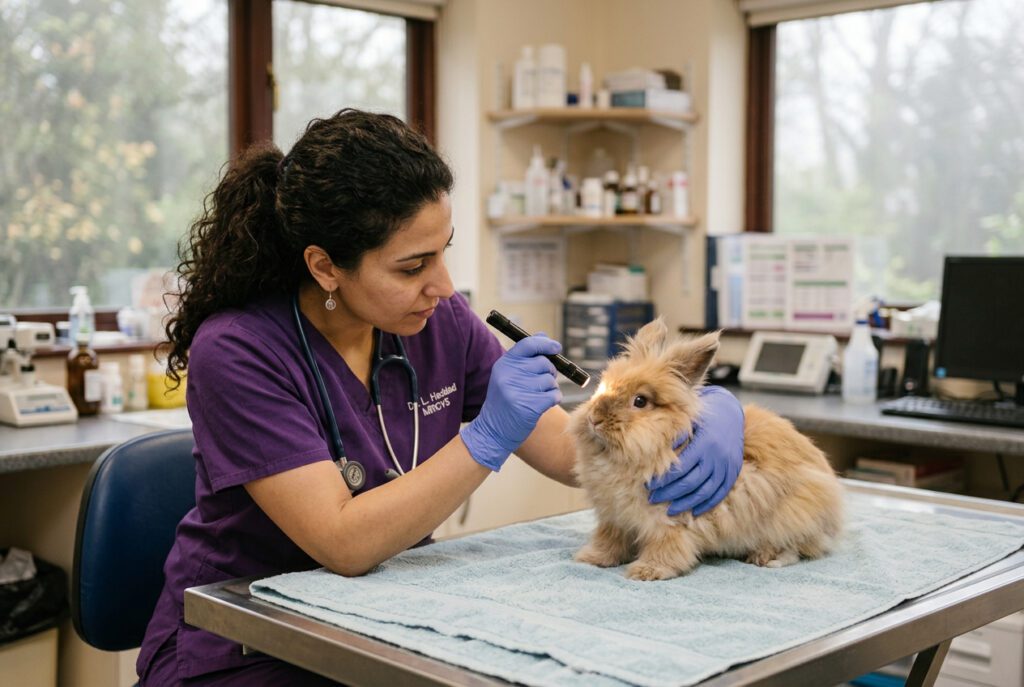
Each grooming session is an opportunity to assess eye health. The following checks take less than a minute and catch problems early when they are most treatable:
For English Angoras — facial wool check first: Assess the facial wool around both eyes before any other grooming work. Any fiber making contact with the eyeball surface must be trimmed immediately. Work through the entire facial fringe systematically, ensuring clear visual access to both eyes.
For all Angora breeds:
- Discharge — any accumulation at the inner corner of the eye beyond very minimal clear tearing warrants monitoring and veterinary consultation if persisting beyond 24 hours
- Redness — conjunctival redness visible on the white of the eye or around the eyelid margin indicates irritation or infection
- Squinting — partial or complete closure of one eye is a pain indicator; assess whether facial wool is the cause in English Angoras; if not, veterinary assessment is needed promptly
- Cloudiness or opacity — any haze, white material, or change in the normal clarity of the cornea or lens warrants same-day veterinary contact
- Asymmetry — one eye appearing larger or smaller than the other, or one pupil appearing different from the other, indicates a condition requiring veterinary assessment
- Third eyelid visibility — the nictitating membrane visible at rest across the inner portion of the eye indicates illness or pain
The House Rabbit Society maintains a state-by-state directory of rabbit-experienced veterinarians in the United States, which is the appropriate resource for identifying a practice with rabbit ophthalmology experience.
Related reading: Angora rabbit ear care and are rabbits blind.
FAQs
Why does my English Angora rabbit have discharge around its eyes?
The most common cause in English Angoras is facial wool contact with the cornea, causing chronic irritation and secondary bacterial infection. Trim the facial wool clear of the eyes immediately and monitor over the next 24 to 48 hours. If the discharge does not resolve after the wool is trimmed and kept clear, consult a rabbit-experienced veterinarian to rule out nasolacrimal duct blockage or primary infection.
What eye colors do Angora rabbits have?
Angora rabbits can have brown, blue-gray, ruby-red (in albino REW animals), blue-eyed white (BEW, carrying the Vienna gene), and occasionally marbled or odd-eyed coloring depending on breed and coat color genetics. ARBA recognizes Giant Angoras in ruby-eyed white and chestnut.
Is my Angora rabbit’s eye problem an emergency?
Squinting — partial or complete closure of one eye — in a rabbit indicates eye pain and should be assessed by a veterinarian within 24 hours. Corneal ulceration progresses rapidly and causes significant pain. Cloudiness or opacity appearing within the eye, protruding or asymmetric eyes, or sudden behavioral change suggesting disorientation are same-day veterinary concerns.
Do French, Giant, Satin, and German Angoras have the same facial wool eye risk as English Angoras?
No. The facial wool eye contact risk is specific to the English Angora, which has the fullest facial wool coverage, including the eye area. French and Satin Angoras have clean faces. Giant and German Angoras have lighter head furnishings, so their risk is lower but not zero. They are still subject to the general rabbit eye conditions described in this article.
How do I clean discharge from around my Angora rabbit’s eyes?
Use a clean cotton ball or soft gauze moistened with sterile saline or clean warm water. Gently wipe outward from the inner corner of the eye. Do not rub or apply pressure directly to the eye. In Angora breeds with periocular wool, clean carefully through the wool to reach the skin, and dry the area thoroughly after cleaning to prevent moisture accumulation that encourages bacterial growth.
What is the white material visible inside my rabbit’s eye?
White or opaque material visible within the eye — particularly within the pupil — in a rabbit most commonly indicates phacoclastic uveitis associated with Encephalitozoon cuniculi (E. cuniculi) infection. This requires veterinary assessment and is not a condition that resolves without treatment. Contact a rabbit-experienced veterinarian promptly.
Conclusion
Angora rabbit eye health encompasses two distinct areas of knowledge: the general rabbit eye conditions that any owner must recognize and respond to, and the English Angora-specific facial wool risk that makes eye monitoring a mandatory component of every grooming session.
For English Angora owners specifically, the facial wool trimming that keeps the eyes clear is not optional, seasonal, or cosmetic — it is a health requirement that directly prevents a cascade of worsening conditions from mechanical irritation through corneal ulceration. Two to three grooming sessions per week means two to three facial wool checks per week, each of which takes thirty seconds and catches problems before they become serious.
For all Angora breeds, the eye monitoring checklist embedded in the grooming routine provides the early detection that gives treatable conditions the best possible outcome.
For the complete Angora rabbit grooming technique, including facial wool management in detail, see our Angora Rabbit Grooming guide. For eye health in the context of the English Angora’s overall lifespan and care demands, see our English Angora Rabbit Lifespan guide.
The information in this article is for general educational purposes and does not constitute veterinary advice. For any eye health concern relating to your rabbit, contact a rabbit-experienced veterinarian promptly. See our disclaimer for full details.
Sources
- Veterinary Information Network. Rabbit ophthalmology (Veterinary Teaching Hospital, University of Murcia), VIN proceedings, checked October 2026.
- PDSA. Eye problems in rabbits: an overview, checked October 2026.
- MSD Veterinary Manual. Parasitic Diseases of Rabbits, checked October 2026.
- American Rabbit Breeders Association. Breed ID Guide (updated January 2026), checked October 2026.
- IAGARB. Breed Standard (German Angora), checked October 2026.
- National Angora Rabbit Breeders Club. English Angora Rabbits, checked October 2026.
This guide is for general information and is not a substitute for advice from a vet. Read our disclaimer.