Breeding Angora Rabbits: A Complete Guide for US Breeders
How we researched this guide: In October 2026 we checked the facts in this article against LafeberVet, International Association of German Angora Rabbit Breeders, legislation.gov.uk, NARBC and American Rabbit Breeders Association, and corrected or removed anything we could not verify. Our sources are listed at the end. See our editorial policy. Last reviewed: October 2026.
Quick answer: Breeding Angoras takes planning. Pregnancy lasts about a month, and kits are weaned by around six weeks but should stay with the doe until at least eight weeks. Limit does to a few litters a year, use healthy unrelated stock, and line up homes before you breed.
Breeding Angora rabbits is a rewarding pursuit when approached with the knowledge, preparation, and commitment the breed requires. It is also a serious undertaking — more so than breeding short-haired rabbit breeds — because the Angora’s wool coat introduces care demands for both the breeding doe and her kits that do not apply to other rabbit types.
This guide covers everything a US breeder needs to know: how to select breeding pairs for both health and wool quality, the reproductive biology specific to Angora rabbits, caring for the pregnant doe, kit development and weaning, and the ethical and practical standards that distinguish responsible Angora breeding from overproduction.
Choosing Breeding Stock: What to Look For
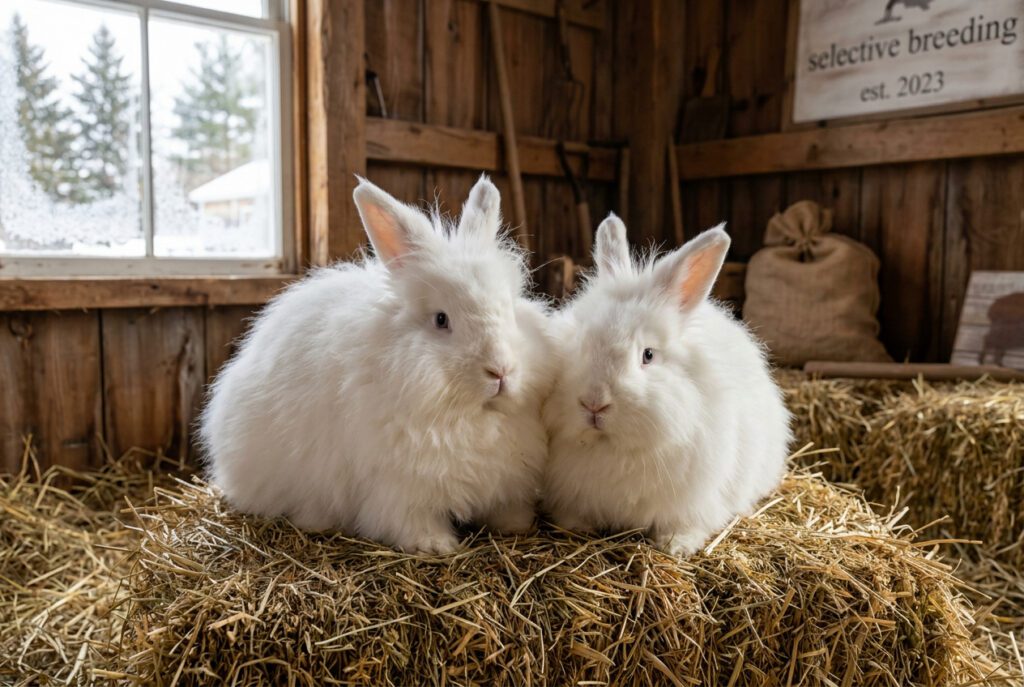
The quality of your breeding program is determined almost entirely by the quality of the animals you start with. Selecting breeding stock requires evaluating each candidate across four dimensions: health, wool quality, conformation, and temperament.
Health
Both the buck (male) and the doe (female) must be in excellent health before any breeding attempt. An underweight rabbit, recovering from illness, showing signs of dental disease, or carrying a coat in poor condition from neglect should not be bred until these issues are resolved. Breeding a rabbit in compromised health produces stressed litters and risks the doe’s life during pregnancy and kindling.
Specific health checks before breeding:
- Weight and body condition — ribs palpable but not prominent; no visible hip bones
- Teeth — incisors correctly aligned; no signs of malocclusion
- Eyes and nose — clear, no discharge
- Coat — free of mats, parasites, and wool mites
- Vent area — clean and free of any soiling or inflammation
- Droppings — round, uniform, abundant — indicating healthy gut motility
Wool Quality
For breeders producing Angora wool for spinning or show, wool quality in the breeding pair directly determines the quality of future harvests. Evaluate:
- Fiber fineness — finer fiber (measured in micrometers) produces softer, more valuable wool
- Density — a dense underwool structure produces a higher yield per harvest
- Staple length — fiber should grow evenly and maintain length without breaking
- Texture — free of coarseness, excessive guard hair in English/French/Satin breeds, or matting tendency
- Harvest yield — for German Angoras, IAGARB registration requires a minimum annual yield of 1,300 grams (about 2.9 lbs); for Giant Angoras, ARBA standards guide conformation and coat type
Conformation
Conformation refers to the physical structure of the rabbit’s body beneath the coat. For ARBA show breeding, conformation standards vary by breed and are published in the ARBA Standard of Perfection. At a minimum, breeding animals should have:
- Good overall body proportion for their breed
- Correct ear carriage
- Sound bone structure with no evidence of skeletal abnormality
- For Giant Angoras — the commercial body type specified in the ARBA standard
Temperament
Temperament is hereditary in rabbits to a meaningful degree. A doe with a calm, handleable temperament is significantly easier to breed, monitor during pregnancy, and assist during kindling than an aggressive or fearful animal. An aggressive buck may injure a doe during introduction. Select for animals that tolerate handling without biting, lunging, or sustained freezing — the stress response that predicts difficulty during the breeding process.
Minimum Breeding Age by Breed
| Breed | Minimum Breeding Age (Doe) | Minimum Breeding Age (Buck) |
|---|---|---|
| English Angora | 6 months | 6 months |
| French Angora | 6 to 7 months | 6 months |
| Satin Angora | 6 to 7 months | 6 months |
| Giant Angora | 9 to 12 months | 9 months |
| German Angora | 7 to 9 months | 6 to 7 months |
Giant Angoras mature significantly more slowly than the other breeds. Breeding a Giant Angora doe before 9 months risks compromising her own development and producing smaller, weaker litters. Do not use the 6-month standard applied to smaller breeds as a guideline for Giant Angoras.
Reproductive Biology of Angora Rabbits
Induced Ovulation
Rabbits do not have a fixed ovulation cycle. Does are induced ovulators — the physical stimulus of mating triggers the hormonal cascade that releases eggs from the ovaries. This means a doe can theoretically be bred at almost any time, though behavioral and physical cues indicate peak receptivity.
Signs of Receptivity in the Doe
A receptive doe will show some or all of the following:
- Restlessness and increased activity
- Chin rubbing on enclosure surfaces (territory marking)
- Lordosis posture — the doe holds her hindquarters elevated when the perineal area is stroked
- Reddened, slightly swollen vulva — the most reliable physical indicator; a pale or bluish vulva suggests the doe is not currently receptive
A doe that is not receptive will reject the buck — running from him, sitting flat to prevent mounting, or turning and growling. Forced breeding of a non-receptive doe rarely succeeds and stresses both animals.
The Mating Process
Always bring the doe to the buck’s enclosure — never the reverse. They are territorial and will often attack an unfamiliar rabbit introduced to their space. In the buck’s enclosure, he controls the environment, and the process proceeds more naturally.
Observe the pair for several minutes. A receptive doe will allow the buck to mount and will raise her hindquarters. Successful mating ends with the buck falling to one side — a behavior that reliably indicates ejaculation has occurred. Remove the doe immediately after a confirmed mating. A second mating, 8 to 12 hours later from the same buck, or a second buck if colony genetics allow, is a common breeder practice that may improve the chance of conception.
Gestation
Angora rabbit gestation lasts 28 to 32 days, with most does kindling between days 30 and 31. Note the mating date immediately and prepare the nest box to be in place by day 26 — does often begin pulling fur to line the nest in the 24 to 48 hours before kindling.
Litter Size
Typical litter sizes for Angora breeds range from 4 to 8 kits, with variation by breed and individual doe:
| Breed | Typical Litter Size |
|---|---|
| English Angora | 4 to 6 kits |
| French Angora | 5 to 8 kits |
| Satin Angora | 4 to 7 kits |
| Giant Angora | 4 to 7 kits |
| German Angora | 5 to 8 kits |
First litters are commonly smaller than subsequent litters. A doe’s peak reproductive performance is typically reached in her second and third litters.
Caring for the Pregnant Doe
Nutrition During Pregnancy
A pregnant doe’s nutritional requirements increase progressively through the 28 to 32-day gestation period. The increase is modest in the first two weeks and accelerates significantly in the final week as the kits undergo rapid fetal development.
Practical adjustments:
- Hay — unlimited at all times, no change required
- Pellets — increase the daily ration by approximately 20 to 30% from day 14 onward; for Angora does, keep feeding higher-protein pellets throughout pregnancy and lactation
- Fresh water — monitor closely; pregnant does drink significantly more water than non-pregnant adults
- Treats — reduce or eliminate during pregnancy; high-sugar treats compete for appetite space that should be occupied by nutritionally dense pellets and hay
Do not introduce new foods during pregnancy. Digestive disruption in a pregnant doe is significantly more consequential than in a non-pregnant rabbit.
The Nest Box
Provide a wooden or solid-sided nest box large enough for the doe to enter, turn around, and lie down. Line it with clean straw or hay. Place it in the enclosure by day 26.
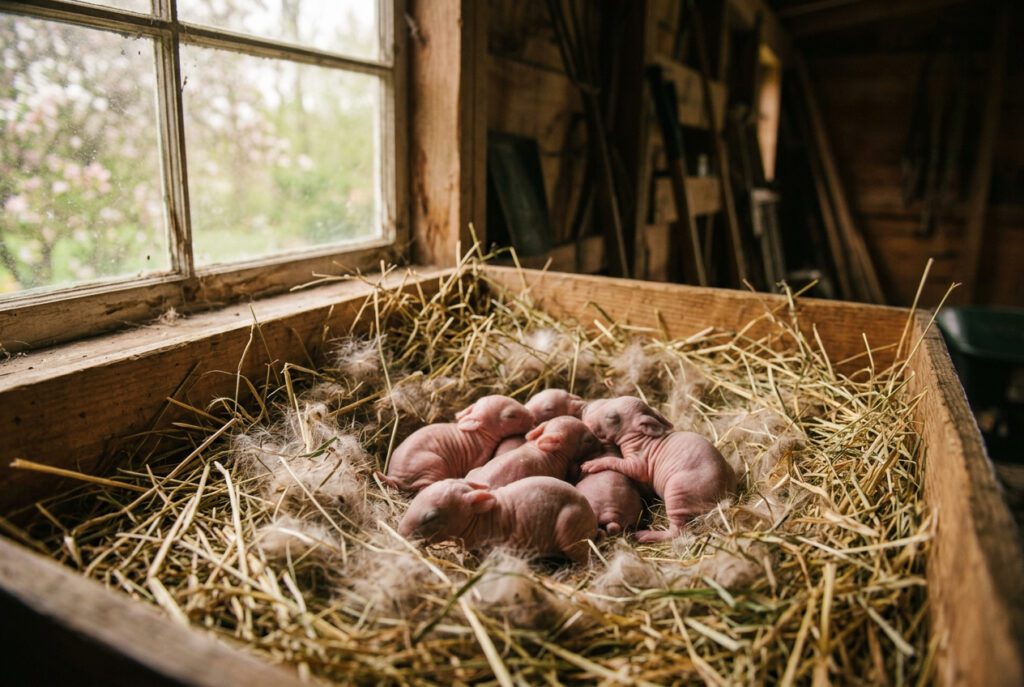
Most does will begin pulling fur from their dewlap and belly to line the nest in the 24 to 48 hours before kindling. This is normal and should not be prevented. The fur lining serves as thermal insulation for the kits — essential, as kits are born hairless and cannot thermoregulate.
Coat Management During Late Pregnancy
For Angora does in full coat, trim the wool around the vent area, belly, and nipples in the final week of pregnancy. This prevents kits from being unable to locate nipples due to dense wool coverage and reduces the risk of soiling and flystrike in the vent area as the doe becomes less mobile.
Kindling and Kit Care
What to Expect at Kindling
Rabbit births typically occur at night or in the early morning hours. The doe handles the birth without assistance in the vast majority of cases. Check the nest box once daily — do not disturb the doe repeatedly, as this causes stress that can result in the doe scattering or injuring the kits.
A normal litter will be found in the nest box, alive, and with rounded bellies from nursing. Count the kits and note the date. Remove any kits that did not survive — this is a normal occurrence in any litter and does not indicate a problem with the doe.
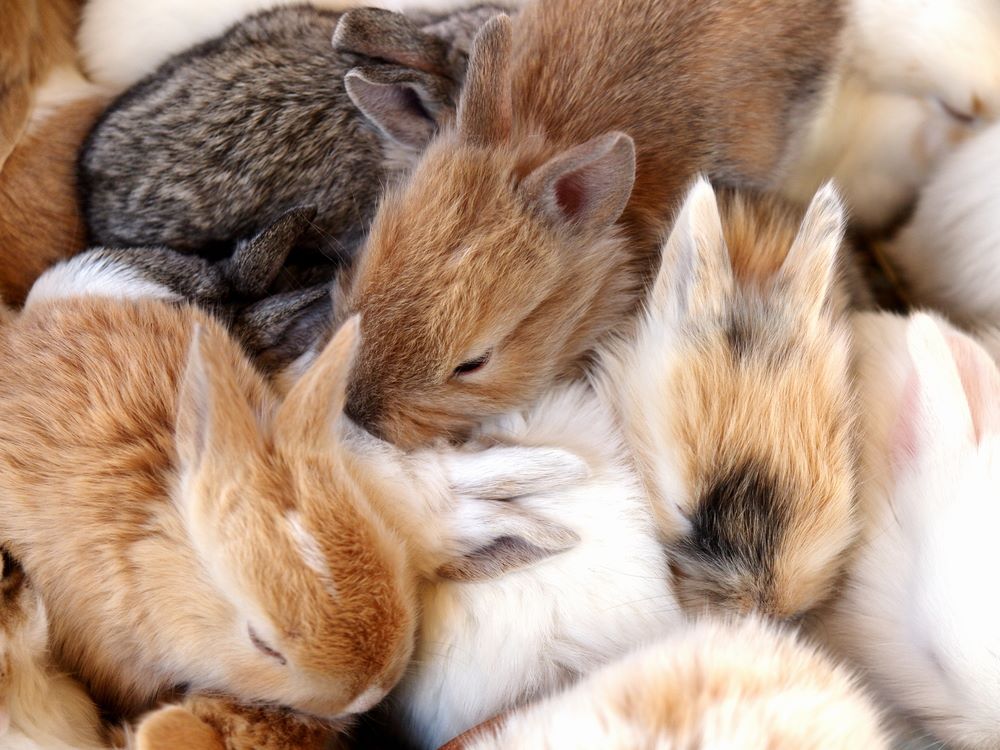
Kit Development Timeline
| Weaning — kits are fully independent from the mother’s milk | Development Stage |
|---|---|
| Birth | Hairless, eyes closed, ears folded |
| Day 7 to 10 | Fine fur visible; beginning of the characteristic Angora wool pattern |
| Day 10 to 12 | Eyes begin to open |
| Day 14 to 18 | Kits beginning to explore nest box (ears open around day 12) |
| Day 18 to 21 | Kits leaving nest box; nibbling hay and pellets |
| Day 28 to 35 | Weaning begins; most kits are fully weaned by about day 42 |
| Day 60 to 90 | Safe age for rehoming to new owners |
Nursing and Doe Behavior
Rabbit does nurse their kits once or twice daily, typically at night, for only a few minutes per session. This brief nursing schedule is normal lagomorph maternal behavior — not neglect. A doe that appears to be ignoring her nest during the day is almost certainly nursing nocturnally on a normal schedule.
Verify kits are being fed by checking that their bellies appear rounded and slightly distended after the overnight period. Flat, shrunken bellies by midday indicate the kits are not being fed and require intervention.
Angora Kit Coat Development
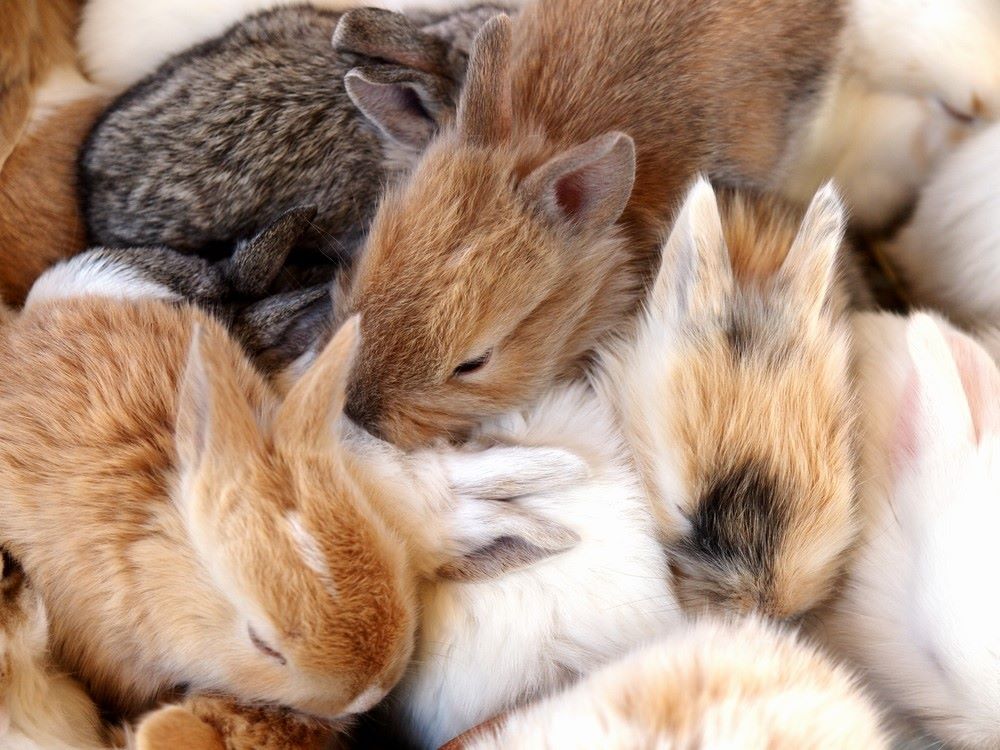
Angora kits develop their characteristic wool coat noticeably later and more gradually than shorthaired rabbit kits. The fine underwool structure that defines Angora fiber begins to differentiate from day 10 onward. By the time of weaning, the wool coat will be short but clearly distinct from a shorthaired kit’s flyback or rollback fur.
First-coat Angora wool is typically less dense and somewhat different in texture than subsequent adult coats. This is normal and does not indicate poor fiber genetics in the breeding pair.
Weaning and Juvenile Care
Kits start eating solid food at about 3 weeks and are usually fully weaned by about 6 weeks — and kits should stay with the doe until at least 8 weeks to allow immune transfer through the doe’s milk and reduce the stress of early weaning.
At weaning, separate kits by sex to prevent accidental breeding. Rabbits reach sexual maturity earlier than their adult breeding age — does as early as 4 months in smaller breeds. Keep sexes housed separately from weaning onward.
Juvenile Angora rabbits require their first proper grooming session at approximately 8 to 10 weeks, when the coat has grown enough to require intervention. Introduce the grooming tools gently — sessions of only 5 to 10 minutes at first — to habituate kits to handling and grooming before the coat demands increase at 3 to 4 months.
Breeding Frequency and Ethical Standards
Breeding Intervals
A doe should not be rebred immediately after kindling. Allowing a 6 to 8 week rest period between litters — from kindling to next mating — protects the doe’s body condition, prevents nutritional depletion during overlapping pregnancy and lactation, and results in stronger subsequent litters.
The maximum sustainable breeding frequency for most Angora does is 3 to 4 litters per year. Breeding more often than this can wear down the doe’s body condition and coat. Overbreeding a doe shortens her productive life and ultimately reduces total output from the breeding program.
Genetic Diversity
Never breed closely related animals. First-degree relatives (parent-offspring or siblings) should never be paired. Second-degree relationships (half-siblings, grandparent-grandkid) carry a significant inbreeding risk that accumulates across generations. Maintain records of each animal’s lineage and cross-reference before pairing.
The National Angora Rabbit Breeders Club and the ARBA can help: the NARBC keeps a breeders listing, and ARBA registration records pedigrees, which helps you find unrelated stock.
Responsible Placement
Every kit produced in a breeding program is a rabbit that will live for 7 to 12 years and require daily care, regular grooming, and veterinary attention. Responsible breeders:
- Vet potential buyers before placing kits
- Provide written care information at the time of sale
- Remain available to answer questions from buyers after placement
- Accept returns of animals from buyers who can no longer keep them
Do not breed more kits than you have identified homes for. The Angora rabbit’s high grooming demands make it unsuitable for inexperienced owners who have not been accurately informed of the time commitment involved. Setting accurate expectations at the point of sale is part of responsible Angora rabbit breeding.
Related reading: our directory of breeders, rescues and vets, baby Angora rabbit care and the best food for Angora rabbits.
FAQs
At what age can Angora rabbits be bred?
Most Angora breeds can be bred from 6 to 7 months of age for does and 6 months for bucks. Giant Angoras are an exception — does should not be bred before 9 months, and bucks before 9 months, as the breed matures significantly more slowly than other Angora types.
How long is the gestation period for Angora rabbits?
Angora rabbit gestation lasts 28 to 32 days, with most does kindling between days 30 and 31. Prepare the nest box by day 26 to allow the doe to begin lining it before birth.
How many kits does an Angora rabbit typically have?
Litter sizes range from 4 to 8 kits, depending on breed and individual doe. Litter size varies a lot from doe to doe. Breed-by-breed figures are rough guides only. First litters are often smaller than subsequent ones.
How do I know if my doe is receptive to breeding?
A receptive doe shows restlessness, chin rubbing, and will assume the lordosis posture — raising her hindquarters — when the perineal area is stroked. The most reliable physical indicator is a reddened, slightly swollen vulva. A pale or bluish vulva indicates the doe is not currently receptive.
How often should I breed my Angora doe?
No more than 3 to 4 litters per year, with a minimum 6 to 8 week rest period between kindling and the next mating. More frequent breeding depletes the doe’s body condition, reduces coat quality, and shortens her productive life.
When can Angora kits be rehomed?
No earlier than 8 weeks, and 10 to 12 weeks is preferable for Angora breeds, as the longer time with the litter allows immune system development and socialization. Ensure buyers are fully informed of the grooming requirements before placement.
Conclusion
Breeding Angora rabbits responsibly requires a working knowledge of reproductive biology, breed-specific development timelines, wool quality selection, and the commitment to place every kit produced into an appropriate home. The does and bucks in a well-managed breeding program receive the same level of grooming care, health monitoring, and veterinary attention as any pet Angora rabbit — because they are.
The reward is proportional to the investment. A carefully selected breeding pair producing well-socialized, healthy kits with excellent wool genetics contributes genuinely to the quality of the US Angora rabbit population — and provides new owners with rabbits capable of a full, healthy life.
For the foundational care standards that apply to every Angora rabbit in a breeding program, see our Angora Rabbit Care Guide. For health conditions relevant to breeding does and growing kits, see our Angora Rabbit Health guide.
The information in this article is for general educational purposes and does not constitute veterinary advice. For breeding health concerns, consult a rabbit-experienced veterinarian. See our disclaimer for full details.
Sources
- LafeberVet. Rabbit Reproduction Basics, checked October 2026.
- International Association of German Angora Rabbit Breeders. IAGARB Testing and Registration, checked October 2026.
- legislation.gov.uk. Animal Welfare (Licensing of Activities Involving Animals) (Scotland) Regulations 2021, Schedule 8, checked October 2026.
- NARBC. National Angora Rabbit Breeders Club, checked October 2026.
- American Rabbit Breeders Association. Breed ID Guide (January 2026), checked October 2026.
This guide is for general information and is not a substitute for advice from a vet. Read our disclaimer.