Angora Rabbit Lifespan: How Long They Live and How to Maximize Every Year
Angora rabbits live, on average, 7 to 12 years — a range confirmed across veterinary and breed authority sources, including PetMD and the Wikipedia article on Angora rabbits. Where on that range any individual rabbit lands depends on a combination of genetics, breed size, the consistency of care provided, and whether specific health risks — particularly wool block — are actively managed throughout the rabbit’s life.
This guide covers what the lifespan range means for each Angora breed, what life stages look like and what they require, the factors that most consistently determine longevity, and how to care for an Angora rabbit in its senior years. This phase receives very little specific attention in most rabbit care resources.
Angora Rabbit Lifespan by Breed
The 7 to 12 year range applies broadly to all Angora breeds, but there is meaningful variation within that range by breed size. As PetMD notes, larger rabbits typically live toward the lower end of the lifespan range, while smaller breeds tend toward the upper end — a pattern consistent across domestic rabbit breeds generally.
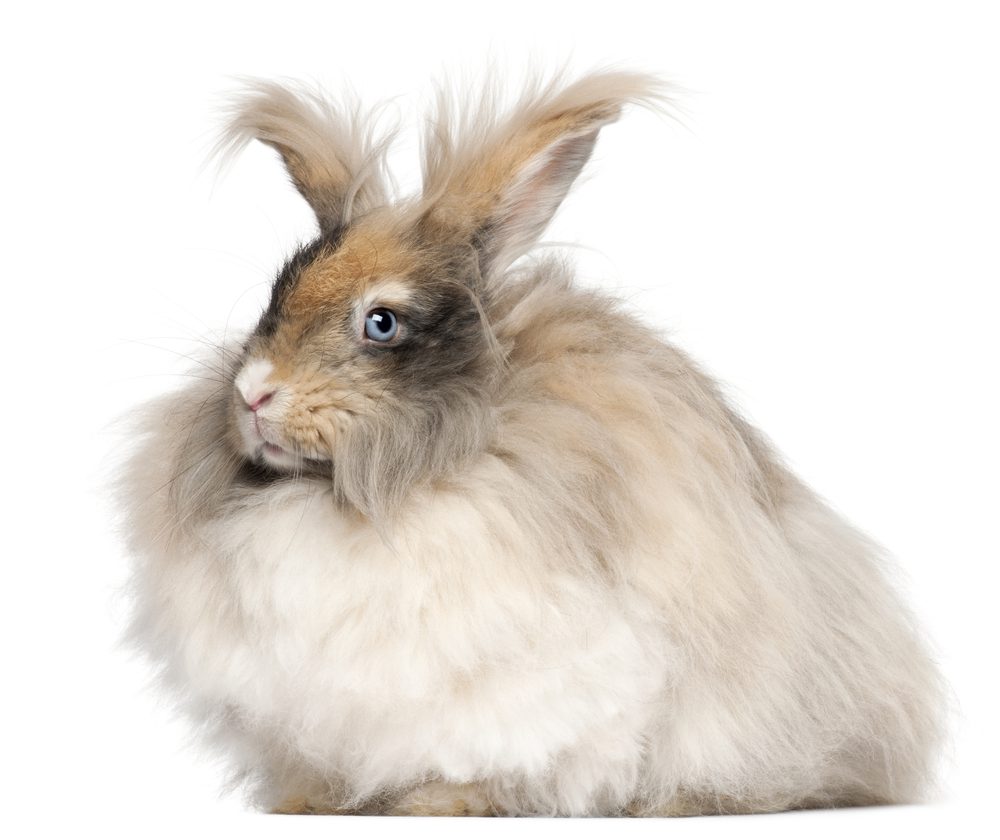
English Angora (5 to 7.5 lb): 7 to 10 years. The smallest of the ARBA-recognized Angora breeds, the English Angora is capable of reaching the upper portion of the lifespan range with attentive care. Its high grooming demands mean the quality of coat management directly influences health outcomes — and therefore longevity.
French Angora (7.5 to 10.5 lb): 7 to 12 years. The most beginner-accessible Angora breed with the broadest lifespan range. A well-managed French Angora in indoor housing with a good diet regularly reaches 10 years or beyond.
Satin Angora (6.5 to 9.5 lb): 7 to 12 years. Similar range to the French Angora. The higher grooming demands of the satin fiber coat mean that consistent management is even more critical to health outcomes.
Giant Angora (9.5 lb+): 7 to 10 years. The largest ARBA-recognized Angora breed, the Giant Angora, tends toward the lower end of the lifespan range, consistent with the general pattern of larger rabbit breeds aging more quickly. Its mandatory 90-day shearing schedule is a care requirement that cannot be negotiated — missing it consistently creates compound health risks that can shorten life significantly.
German Angora (5.5 to 12 lb): 7 to 11 years. Similar to the Giant Angora in care intensity but with a wider weight range. Well-bred German Angoras from established IAGARB-registered lines with low-mat coats and the 90-day shearing schedule maintained consistently often reach 10 years or beyond.
It is worth noting that indoor rabbits consistently outlive outdoor rabbits across all breeds. Protection from temperature extremes, predators, environmental parasites, and disease exposure from other animals all contribute to this difference. Indoor housing is the single most impactful environmental choice an Angora rabbit owner can make for longevity.
Life Stages of the Angora Rabbit
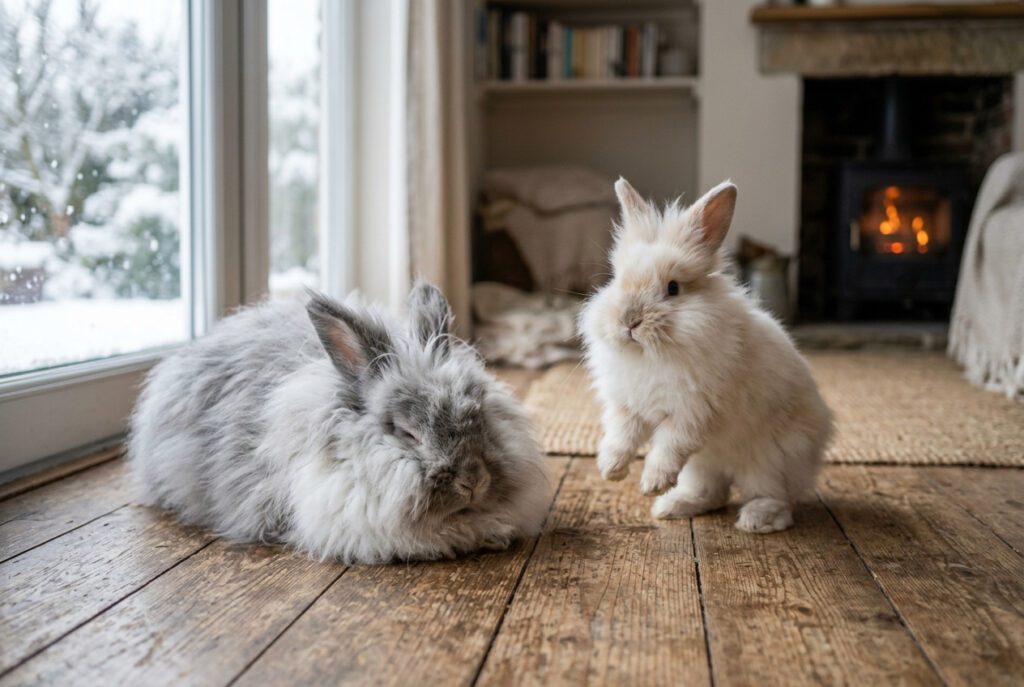
Rabbits move through five distinct life stages, each with different characteristics, behaviors, and care requirements. Understanding what each stage looks like helps owners provide appropriate care at the right time and recognize when a stage transition is occurring.
Stage 1 — Kit (Birth to 8 Weeks)
Kits are born hairless with closed eyes, entirely dependent on the mother for warmth and nutrition. Eyes open at approximately 10 days. The transition to solid food begins around three weeks, and kits are fully weaned by eight weeks. Eight weeks is the minimum age at which an Angora kit should be rehomed — kits separated before this age have a significantly higher risk of fatal digestive illness due to an incompletely developed digestive system.
Even at this stage, brief gentle handling from four to five weeks onward is important for socialization — kits that are handled calmly and regularly from this age accept grooming and human contact far more readily as adults.
Stage 2 — Juvenile and Adolescent (8 Weeks to 12 Months)
This is a period of rapid growth, high energy, and the onset of sexual maturity. Male rabbits reach sexual maturity at approximately three to four months; females slightly later at five to six months. Behavioral changes at this stage — including territorial behavior in bucks and nesting behavior in does — often catch new owners off guard.
This is the optimal window for spaying or neutering. Spaying dramatically reduces the risk of uterine cancer, which is otherwise common in unspayed female rabbits over three years of age. Both procedures reduce territorial aggression and urine spraying, and spayed or neutered rabbits consistently show longer lifespans across studies of domestic rabbit health.
For Giant Angoras, the juvenile stage extends longer — it typically takes over a year to reach full maturity, and bucks up to 18 months. Do not rush Giant Angora breeding — the breed matures slowly.
The coat at this stage is a developing juvenile coat, not the full adult fiber coat. Grooming sessions during this period are brief and primarily focused on building the rabbit’s tolerance for handling and the grooming routine — not on coat management.
Stage 3 — Young Adult (12 Months to 3 Years)
The rabbit reaches full body size, and the full adult coat develops. This is the peak physical condition period — highest energy, optimal body weight, and the point at which the complete grooming routine at full adult frequency should be established if it has not already been.
Diet transitions from junior pellets (higher protein, alfalfa-based in some lines) to adult pellets (timothy-based, minimum 17% protein for Angora breeds). Hay remains unlimited throughout all stages.
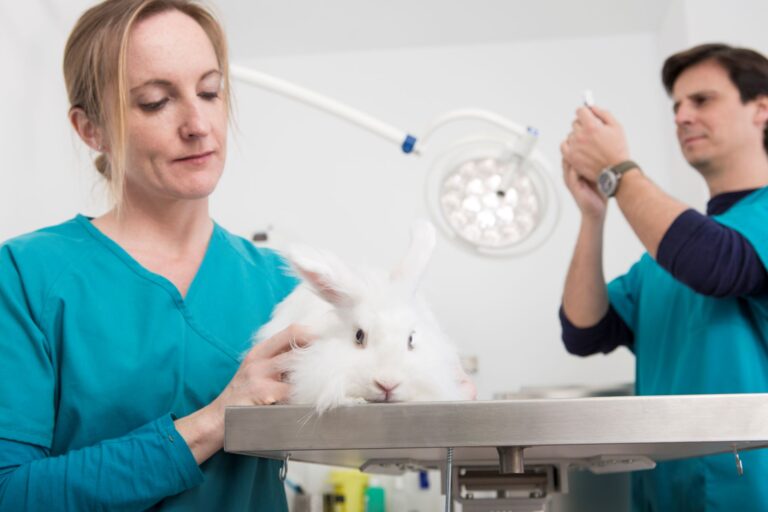
Annual veterinary wellness examinations begin in earnest here. Establishing a relationship with a rabbit-experienced veterinarian early — before any health problem develops — is one of the most practical decisions an owner can make for long-term care.
Stage 4 — Prime Adult (3 to 6 Years)
The period of greatest stability. A well-managed Angora rabbit at this stage is at peak condition — settled personality, established routines, and no significant age-related changes yet apparent. This is also when the cumulative benefit of consistent grooming, diet, and preventive care becomes visible: rabbits that have been well managed through stages 2 and 3 enter this stage in noticeably better condition than those whose care has been inconsistent.
Dental disease risk begins to increase as the rabbit ages through this stage. Annual dental examinations are important. Any reduction in hay consumption, reluctance to eat, or unexplained weight loss warrants veterinary assessment for dental involvement.
Stage 5 — Senior (6 to 7+ Years)
Rabbits are generally considered senior from six to eight years of age, though this varies by breed and individual. Larger breeds like the Giant Angora may begin showing signs of aging as early as five years. Smaller Angora breeds may not show clear senior signs until eight or nine years.
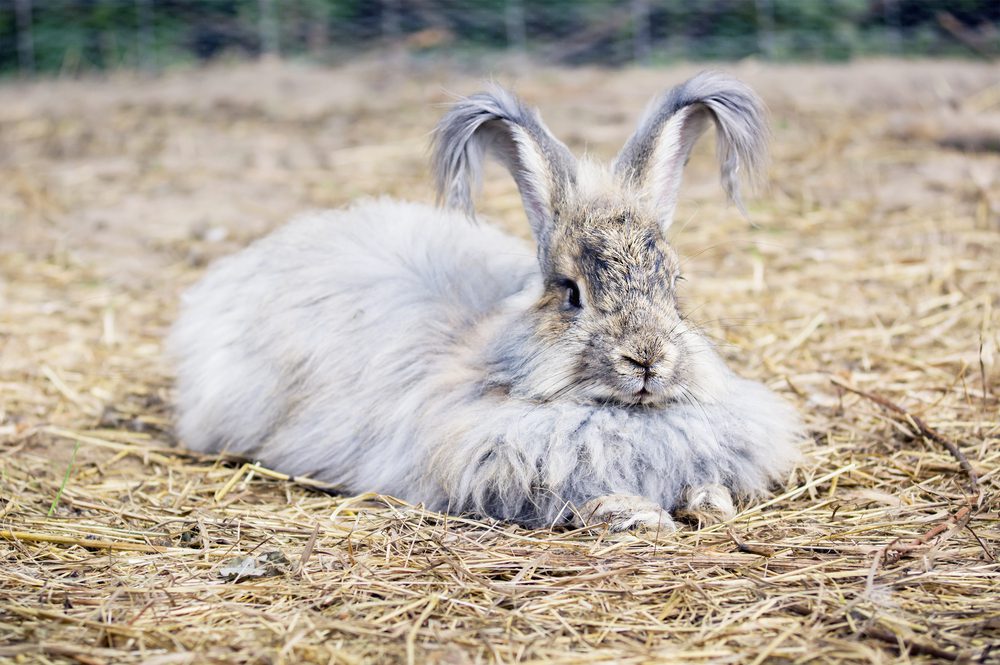
Signs of the senior stage include reduced activity and longer rest periods, coat changes (thinner wool, possible gray patches around the face and ears), reduced muscle mass, and increasing dependence on the owner for warmth and comfort. The Bunny Lady notes that senior rabbits often lose muscle mass, which makes it harder for them to move as freely as before.
Senior care is covered in detail in the section below.
Factors That Most Influence Lifespan
Wool Block Prevention
Wool block is the leading preventable cause of premature death in Angora rabbits. Every year of life in which a rabbit is well-groomed, regularly harvested, and consistently fed unlimited hay is a year in which the primary lifespan threat is actively mitigated. Owners who groom consistently and maintain the coat on schedule add measurable years to their rabbit’s life relative to those who groom sporadically.
Indoor Housing
Indoor rabbits outlive outdoor rabbits across all domestic rabbit breeds. Temperature stability, protection from predator stress, absence of environmental parasite exposure, and owner awareness of behavioral changes that indicate health problems all contribute to this difference. For Angora rabbits specifically, indoor housing also eliminates the coat contamination from outdoor conditions — debris, moisture, and humidity — that accelerate mat formation and flystrike risk.
Diet Quality and Consistency
Unlimited timothy hay forms the dietary foundation that supports gut motility throughout the rabbit’s entire life. Pellets with a minimum 17% protein support the continuous wool growth demand. A diet that consistently meets these requirements produces measurably better health outcomes than one that is variable or relies too heavily on pellets at the expense of hay.
Spay or Neuter Status
Spayed does are not subject to uterine cancer, which affects a high proportion of intact female rabbits after three years of age. Neutered bucks show reduced territorial stress behavior. Both procedures are associated with longer lifespans in domestic rabbit studies. The surgery must be performed by a veterinarian with rabbit anesthesia experience — rabbits have different anesthetic sensitivities from dogs and cats, and general practice veterinarians without rabbit experience have higher complication rates with rabbit procedures.
Regular Veterinary Care
Annual wellness examinations catch dental disease, weight changes, coat conditions, and early-stage health problems before they become serious. Senior rabbits benefit from examination every six months. The House Rabbit Society maintains a state-by-state directory of rabbit-experienced veterinarians across the United States.
Genetics and Breeder Quality
A rabbit purchased from a breeder who selects for health, temperament, and manageable coat type has a significant advantage over one from a breeder who selects primarily for show coat density or fiber yield without health screening. Ask any breeder about the typical lifespan of their breeding lines and the health history of the parents.
Senior Angora Rabbit Care
Senior Angora rabbits — those seven years of age and older — present a specific set of care challenges that deserve dedicated attention. Most Angora rabbit care content focuses on the adult stage. The senior stage is equally important and requires meaningful adjustments.
Grooming Adjustments
Senior rabbits groom themselves less effectively as muscle mass decreases and mobility becomes more limited. The consequence for Angora rabbits is accelerated mat formation — particularly in the vent area, under the armpits, and behind the ears — even if the grooming schedule has not changed.
Increase grooming frequency for any senior rabbit showing reduced self-grooming. Check the vent area daily. Keep the wool in the hindquarters trimmed shorter than on a prime adult — 0.5 to 1 inch — to reduce the mat accumulation risk and the flystrike risk that follows from reduced self-cleaning. A senior Angora’s coat often benefits from being kept shorter overall, even if this means more frequent clips.
Housing Modifications
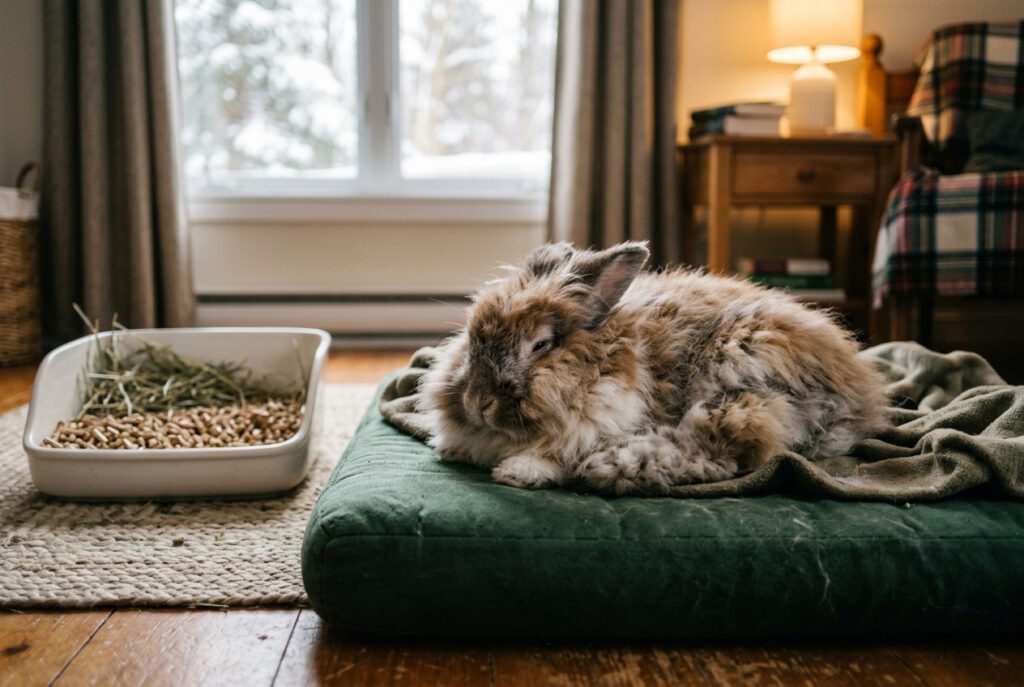
As rabbits age, their mobility declines gradually. Specific modifications that benefit senior Angora rabbits include: lower-sided litter boxes that do not require the rabbit to step over a high edge; ramps instead of steps to any elevated resting area; additional soft bedding and orthopedic resting pads to reduce pressure on aging joints and hocks; easy access to food, water, and hay without needing to cross the full enclosure. Remove any obstacle in the enclosure that the rabbit previously navigated easily — what was simple at three years may be difficult at nine.
Dietary Adjustments
Senior rabbits often shift toward one of two weight patterns — gradual weight loss from reduced muscle mass, or weight gain from reduced activity. Both require monitoring and response.
A rabbit losing weight despite eating normally warrants veterinary assessment for dental disease, organ function decline, or other underlying conditions. If cleared of disease, a gradual transition to a junior or young rabbit pellet (higher protein, sometimes alfalfa-based) mixed with the adult pellet can help maintain weight.
A rabbit gaining weight on an unchanged diet needs a reduced pellet ration and increased encouragement to exercise. Unlimited hay remains unchanged in both cases — it is never reduced in senior rabbits.
Veterinary Visit Frequency
Annual examinations are the minimum for healthy adults. Once a rabbit reaches seven years of age, increase to every six months. Senior wellness visits allow early identification of the conditions that most commonly affect aging rabbits: dental disease (which affects a significant proportion of rabbits over seven years of age), arthritis, kidney decline, and cardiac changes. Baseline blood work and radiographs at the start of the senior stage give the veterinarian reference data for comparison as the rabbit ages.
Warmth and Comfort
Older rabbits lose muscle mass and body fat, reducing their ability to retain warmth as efficiently as prime adults. Senior Angoras may need supplemental warmth in cool conditions — a snug resting area with deep, soft bedding, positioned away from drafts. Monitor behavior in cool weather; a senior rabbit that is reluctant to move from its resting spot may be cold.
Recognizing Decline
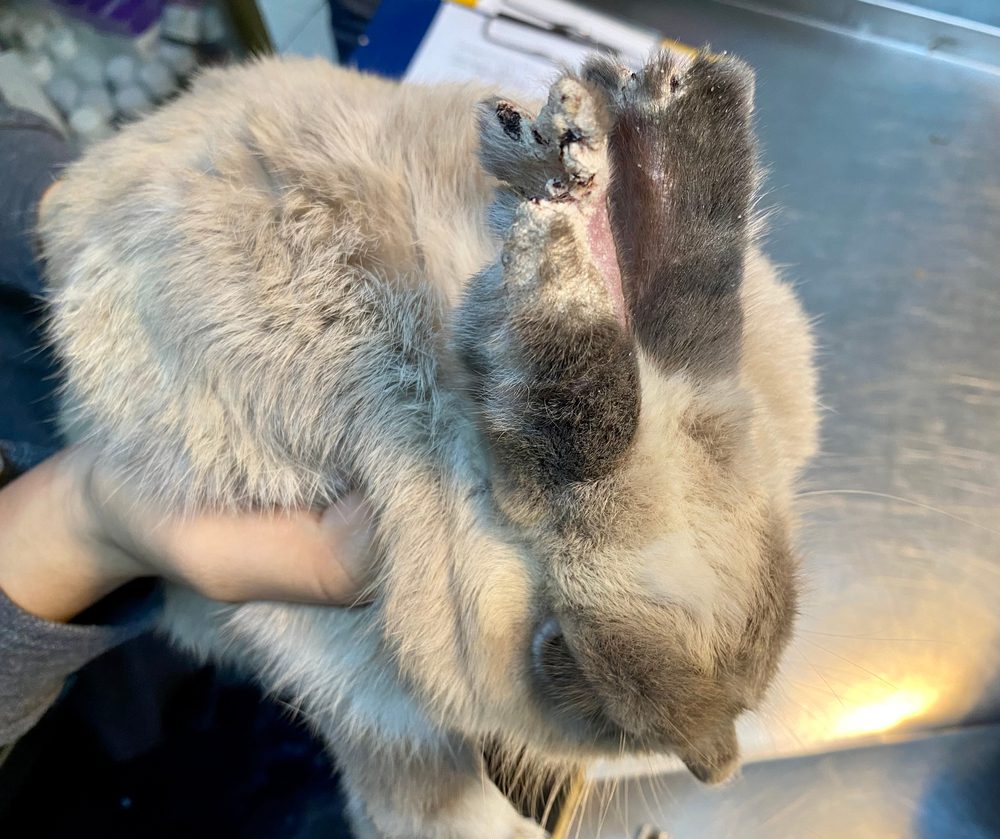
Healthy aging in an Angora rabbit looks like gradual, progressive slowing — more rest, less binkying and zooming, settling for longer periods. This is normal. What is not normal and requires veterinary assessment: sudden changes in behavior or activity, any loss of appetite, cessation of grooming activity, changes in droppings, difficulty walking or maintaining balance, or obvious pain signals (tooth grinding, hunched posture, reluctance to be touched).
The goal of senior care is comfort and quality of life. A rabbit that is eating, grooming within its capacity, engaging with its environment, and free from pain is thriving in its senior years — regardless of activity level.
FAQs
How long do Angora rabbits live on average?
The confirmed average lifespan range for Angora rabbits is 7 to 12 years, with meaningful variation by breed and care quality. English Angoras typically reach 7 to 10 years; French and Satin Angoras 7 to 12 years; Giant and German Angoras 7 to 10 years. Indoor housing, consistent grooming, wool block prevention, and regular veterinary care are the factors that most reliably push individual rabbits toward the upper end of their breed range.
At what age is an Angora rabbit considered a senior?
Most domestic rabbits are considered senior from approximately six to eight years of age. For Giant Angoras, the senior stage may begin as early as five years due to their larger body mass. Smaller Angora breeds like the English may not show clear senior signs until eight or nine years. The transition is gradual and individual — watch for the behavioral and physical signs described in the senior care section rather than using a fixed calendar age.
Does spaying or neutering affect lifespan?
Yes. Spayed female rabbits are not subject to uterine cancer, which is otherwise a common cause of death in intact does over three years of age. Both spayed and neutered rabbits show reduced stress-related behavioral issues and are consistently associated with longer lifespans in rabbit health studies. The procedure must be performed by a veterinarian with rabbit anesthesia experience.
Do indoor Angora rabbits live longer than outdoor ones?
Yes. Indoor rabbits of all breeds live longer than outdoor rabbits on average, due to stable temperature management, protection from predators and stress, reduced parasite exposure, and closer owner observation of early health changes. For Angora rabbits, indoor housing also reduces coat contamination and flystrike risk significantly.
What is the most common cause of premature death in Angora rabbits?
Wool block — the accumulation of ingested fiber in the digestive tract — is the leading cause of preventable premature death in Angora rabbits in US households. It is largely preventable through consistent grooming, regular coat harvest, unlimited timothy hay, and weekly papaya enzyme supplementation. See our Angora Rabbit Health guide for the full prevention and emergency protocol.
Can an Angora rabbit live past 12 years?
Yes, though uncommon. Individual rabbits do surpass the typical range with exceptional care. Genetics, the absence of major health events, and consistent management throughout life all contribute to reaching exceptional age. The record for domestic rabbit longevity is considerably beyond 12 years, though Angora-specific records are not tracked centrally. Focusing on the care foundations that push toward 10 to 12 years is more productive than targeting specific age records.
How do I know if my Angora rabbit is dying of old age or a treatable illness?
This distinction requires veterinary assessment. Many conditions that appear to be normal aging — weight loss, reduced activity, appetite changes — are actually treatable conditions, including dental disease, arthritis, and organ decline. Never assume a change in an older rabbit is simply age without a veterinary examination confirming no treatable cause. A rabbit that is genuinely at the end of life typically stops eating and becomes progressively unresponsive over a period of days. Contact your veterinarian to discuss quality of life and, if relevant, the option of humane euthanasia to prevent unnecessary suffering.
Conclusion
An Angora rabbit that lives 10 or more years is not an accident of luck. It is the result of consistent grooming that prevents wool block, a diet built on unlimited hay with adequate protein, indoor housing that maintains safe temperatures, regular veterinary care that catches problems early, and attentive observation of the daily signals that tell an owner whether the rabbit in front of them is thriving.
The senior years — often three to five years of the rabbit’s total life — reward every prior investment in care with a rabbit that is settled, trusting, and deeply bonded with its owner. Meeting the specific needs of a senior Angora rabbit with the same attentiveness as earlier stages is both the final care commitment and, for most owners, one of the most rewarding parts of the relationship.
For the complete framework of care that underpins longevity, see our Angora Rabbit Care Guide. For breed-specific care differences relevant to lifespan, see our Types of Angora Rabbits guide.
The information in this article is for general educational purposes. For any health concern relating to your rabbit, consult a licensed veterinarian with rabbit experience. See our disclaimer for full details.