Angora Rabbit Ears: Anatomy, Breed Differences, Health Conditions, and Care
How we researched this guide: In October 2026 we checked the facts in this article against MSD Veterinary Manual, Rabbit.org, Louisiana State University, IAGARB and National Angora Rabbit Breeders Club, and corrected or removed anything we could not verify. Our sources are listed at the end. See our editorial policy. Last reviewed: October 2026.
Quick answer: Angora ears should be clean, dry and free of crusts or smell. English Angoras have heavy ear furnishings that can hide early problems, so check and comb the ears at each grooming session. Head shaking, scratching or crusts can mean ear mites, so see a vet.
Rabbit ears are among the most functionally sophisticated structures in the domestic animal world. Mobile, highly sensitive, and serving simultaneously as sound-detection organs, thermoregulation tools, and behavioral communication signals, rabbit ears are integral to the animal’s survival physiology in ways that go well beyond simple hearing. For Angora rabbit owners, there is a breed-specific dimension to ear care that the existing care literature rarely addresses adequately: the wool that covers the ears and ear tufts of the English and Giant Angora breeds creates health risks — particularly ear mite infestation and bacterial ear infection — that clean-eared breeds do not face at the same level.
This article covers rabbit ear anatomy and function, the breed-specific differences in ear wool across all five Angora breeds, the ear health conditions Angora owners must recognize, and the grooming and monitoring practices that keep ears healthy.
Rabbit Ear Anatomy and Function
Structure
A rabbit’s ear consists of two main components visible externally: the pinna — the large, upright cartilaginous flap — and the ear canal, which leads downward and inward to the middle and inner ear structures. The pinna in domestic rabbits is substantially larger relative to body size than in most mammals, an evolutionary adaptation that serves both sound collection and thermoregulation.
The external ear canal of a rabbit is L-shaped — it runs vertically for some distance before turning horizontally toward the eardrum. This angle means that debris, wax, and wool fiber that enter the ear canal are not easily dislodged by normal movement and must be addressed through grooming and, if necessary, veterinary canal flushing.
Thermoregulation
The pinna contains an extensive network of blood vessels close to the skin surface. In warm conditions, blood flow to the ears increases, dissipating body heat through radiation from the large vascular surface area. In cold conditions, blood flow decreases to minimize heat loss. This makes the ears a primary thermoregulation organ in rabbits, which is why ear temperature and appearance can serve as a health indicator. Ears that feel significantly cooler than normal may indicate circulatory compromise; ears that appear excessively flushed or hot may indicate fever or heat stress.
For Angora rabbits — whose dense wool coats already impair overall heat dissipation — the ears represent an important heat exchange surface. This makes adequate ear ventilation particularly relevant for the wool-eared English and Giant Angora breeds, where dense ear tufts can partially insulate the pinna and reduce its thermoregulatory efficiency.
Hearing and Communication
Rabbits can rotate each ear independently through a wide arc, orienting the pinna toward a sound source without moving the head. This independent mobility allows a rabbit to monitor two separate sound sources simultaneously — a significant advantage for a prey animal under constant predation pressure. The hearing range of domestic rabbits extends from approximately 360 Hz to 42,000 Hz — well into the ultrasonic range, far beyond human hearing capacity.
Ear position is a primary behavioral communication signal in rabbits. Ears held erect and forward indicate alertness and focused attention. Ears relaxed and angled backward indicate calm contentment. Ears flattened tightly against the back of the head indicate fear or submission. One ear forward and one back suggests the rabbit is monitoring two different areas simultaneously. Understanding ear position communication allows owners to assess their rabbit’s emotional state quickly and accurately during handling and interaction.
Breed Differences: Ear Wool Across the Five Angora Breeds
The presence, distribution, and density of wool on and around the ears vary significantly between Angora breeds. This variation determines the ear-specific grooming requirements and health risk profile for each breed.
| Breed | Ear Wool Coverage | Ear Tufts | Grooming Implication |
|---|---|---|---|
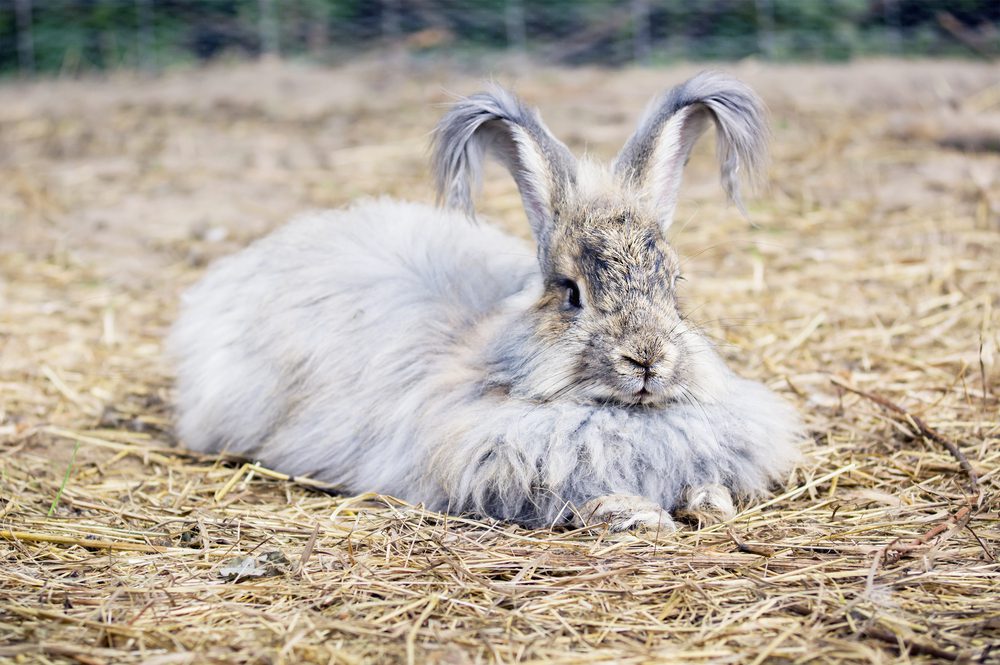
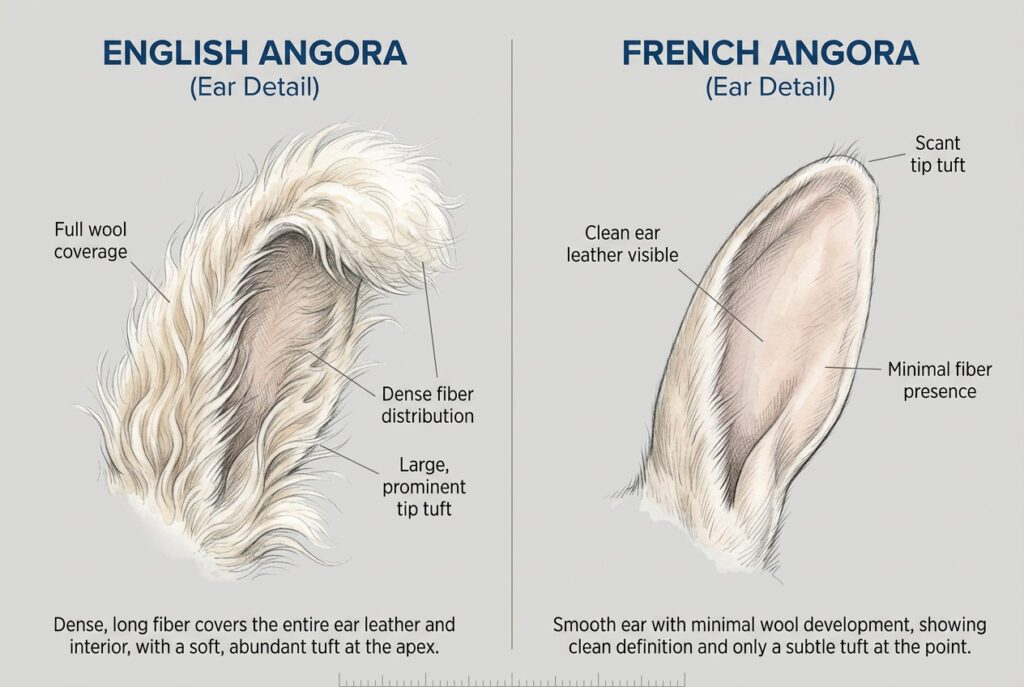
| English Angora | Full wool coverage of entire ear surface including interior | Prominent ear tufts extending well beyond ear tip | Highest ear grooming demand; wool traps debris and moisture in ear canal |
| French Angora | Clean ear with tufts at tip only | Small tufts at ear tip | Minimal ear wool grooming; tufts checked but rarely problematic |
| Satin Angora | Clean ear | Minimal to absent | Very low ear-specific grooming requirement |
| Giant Angora | Forehead furnishings and ear trimmings present | Head trimmings noticeable; lighter than English | Moderate ear grooming; furnishings require regular combing |
| German Angora | Clean ear | Minimal | Some ear tufting; comb and check at each session |
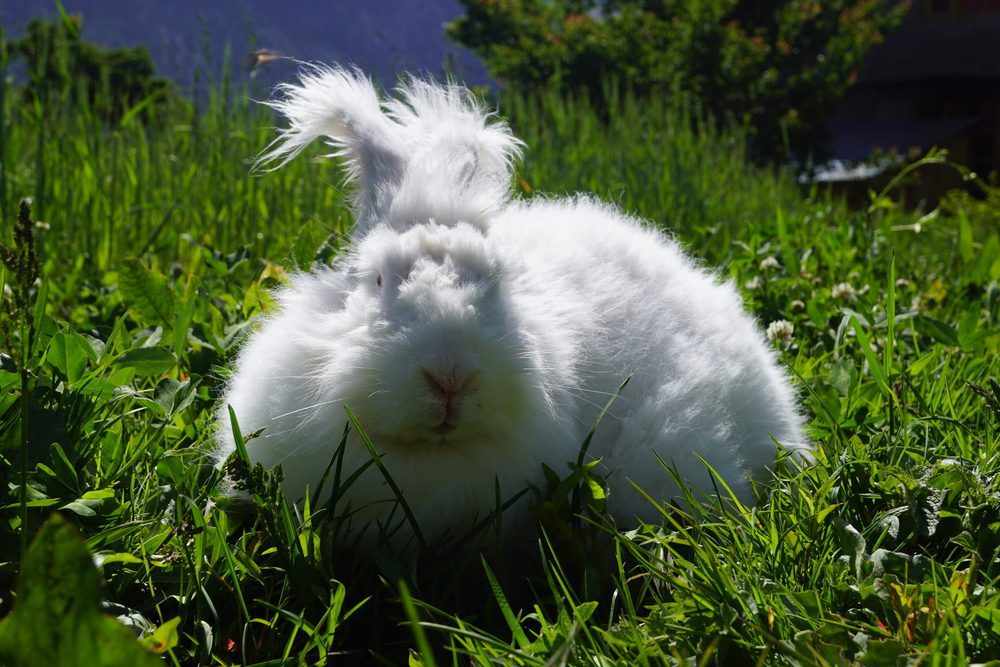
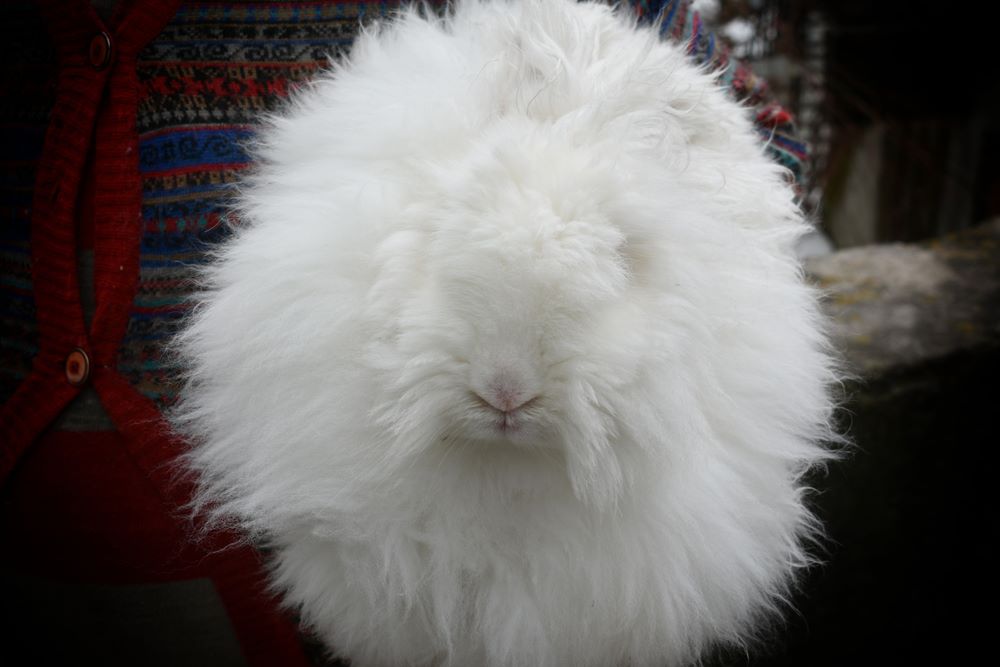
The English Angora presents the most demanding ear grooming situation of all five breeds. The complete wooling of the ear surface — including the interior of the pinna — creates conditions that no other Angora breed faces: wool that traps ear wax, debris, and moisture directly within the ear canal approach, creating ideal conditions for ear mite infestation and bacterial infection.
Ear Health Conditions in Angora Rabbits
Ear Mites (Psoroptes cuniculi)
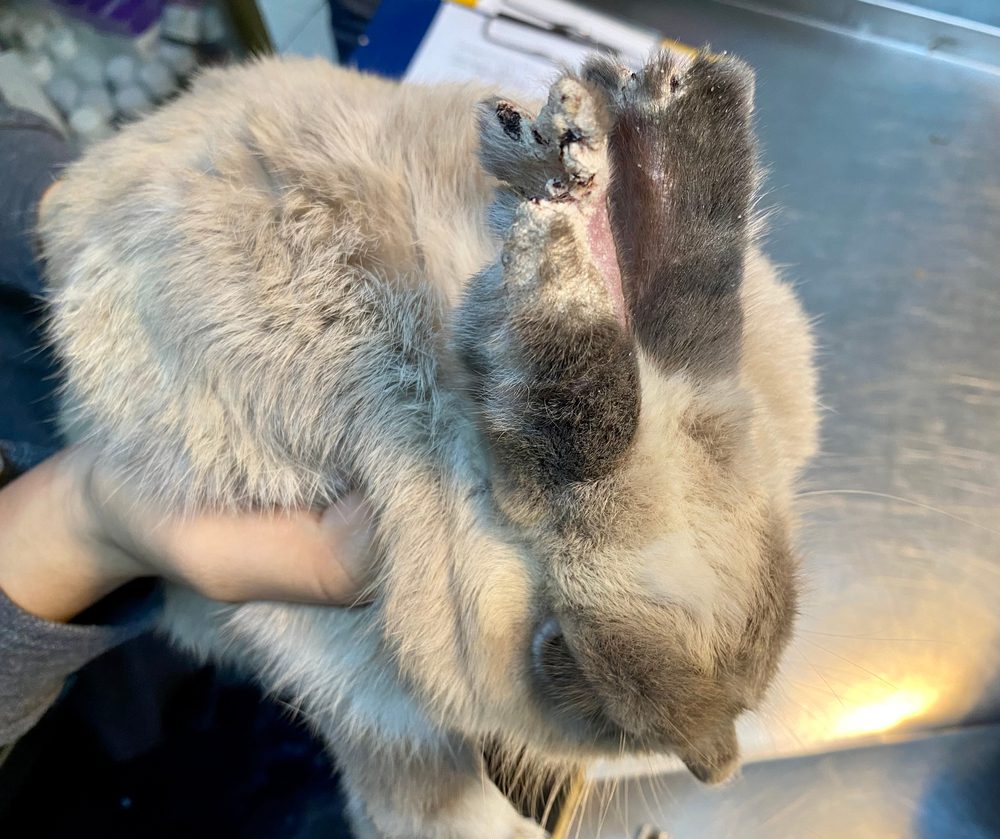
Ear mites are among the most common health conditions in domestic rabbits and are particularly relevant for Angora breeds, because dense ear wool can hide the early signs. Psoroptes cuniculi is a surface-feeding mite that lives in the ear canal and on the adjacent skin, feeding on skin debris and tissue fluid. It does not burrow into skin tissue — it lives on the ear surface — but its feeding activity causes intense irritation and, without treatment, progressive crust formation that can block the ear canal.
Presentation in Angora rabbits: The dense wool covering the English Angora’s ears can conceal early-stage infestation more effectively than in short-eared breeds. By the time external signs are visible in a heavily wooled ear, the infestation may already be advanced.
Signs of Ear Mite Infestation
- Head shaking — the most consistent early behavioral sign; the rabbit shakes its head repeatedly in an attempt to dislodge the irritation
- Ear scratching — repeated scratching at the base of the ear with the hind leg
- Head tilt — in more advanced cases, the rabbit holds the head tilted to the affected side
- Crusting within the ear — yellowish-brown to dark brown crust accumulates within the ear canal; in advanced infestations, this crust is thick and layered, sometimes filling the entire visible portion of the canal
- Wool loss around the ear base — in English Angoras, mite-related scratching causes progressive wool loss at the base of the ear
- Odor — advanced ear mite infestations produce a distinctive, unpleasant odor from the crusting material
Treatment: Veterinary diagnosis is required — ear mites are confirmed by microscopic examination of a swab sample. Treatment is effective and involves an anti-parasitic medicine that your vet chooses and doses. The ear canal should not be aggressively cleaned before veterinary assessment, because removing the crusts is very painful for the rabbit. After treatment begins, crusts loosen and fall away naturally — forced removal risks damaging the ear canal lining.
Bacterial Ear Infection (Otitis Externa and Otitis Media)
Bacterial infection of the outer ear canal (otitis externa) can occur independently or as a secondary consequence of ear mite infestation. In Angora rabbits, particularly the English Angora, the warm, moist, debris-trapping environment created by ear wool is a predisposing factor for bacterial colonization even in the absence of mites.
Otitis media — infection of the middle ear — is a more serious condition that typically results from progression of untreated otitis externa, or from ascending infection via the Eustachian tube connected to the throat. Middle ear infection frequently produces head tilt (vestibular syndrome) and is associated with Pasteurella multocida infection in domestic rabbits.
Signs of Bacterial Ear Infection
- Discharge from the ear canal — purulent (pus-containing), malodorous discharge distinct from normal wax
- Redness and swelling of the ear canal entrance or surrounding skin
- Pain on ear handling — the rabbit pulls away, vocalizes, or reacts strongly when the ear base is touched
- Head tilt — if the middle ear is involved, the rabbit holds the head persistently tilted to one side; in severe cases, the rabbit rolls or falls toward the affected side
- Loss of balance and nystagmus — rapid involuntary eye movement in cases of inner ear involvement (otitis interna)
- Reduced appetite — pain and vestibular disturbance suppress appetite
Treatment: Veterinary assessment and bacterial culture of any discharge guides antibiotic selection. Outer ear infections are treated with topical antibiotic preparations in the ear canal. Middle and inner ear infections require systemic antibiotics for extended periods and carry a more guarded prognosis for full recovery of vestibular function.
Wool Block in the Ear Canal
A possible but poorly documented problem in heavily wooled Angora breeds — particularly the English Angora — is the accumulation of shed wool fiber within the ear canal. As the ear tufts shed fiber during natural or seasonal wool release, loose fibers can fall into the external ear canal and accumulate with normal wax, forming a compacted fibrous mass.
Wool accumulation in the ear canal reduces hearing acuity, creates a substrate for bacterial growth, and can cause low-grade irritation. It is prevented through regular ear tuft grooming that removes loose fiber from the tuft before it can enter the canal, and through periodic inspection of the ear canal during grooming sessions.
Ear Grooming by Breed
English Angora — Highest Requirement
The English Angora’s wooled ear surface and prominent ear tufts require specific attention at every grooming session:
Ear tuft maintenance: Use a steel grooming comb to work through the ear tuft wool at each session, starting from the tip and working toward the base. Remove any loose fiber before it falls into the ear canal. The tufts should be free of mats, debris, and tangled fiber.
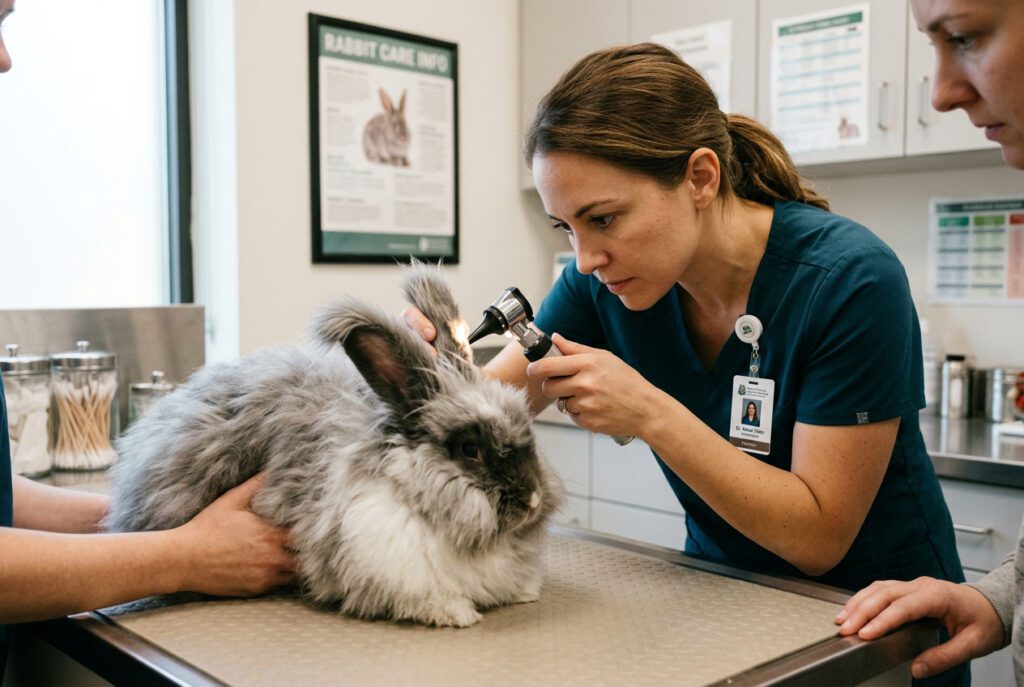
Ear interior inspection: Part the wool on the interior surface of the pinna and visually inspect the skin surface and the entrance to the ear canal at each session. Look for redness, unusual wax accumulation, any sign of discharge, or crusting at the canal entrance.
Ear canal inspection: Use a small penlight to illuminate the visible portion of the ear canal. In a healthy ear, the canal skin appears pale pink and clean. Any brown crust, dark debris, discharge, or strong odor warrants veterinary assessment.
Ear cleaning: Clean only what is visible and accessible — never insert cotton swabs, probes, or cleaning solutions into the ear canal without veterinary direction. To clean the visible ear canal entrance and the skin around it, use a cotton ball dampened with a rabbit-safe ear cleaner or plain warm water and wipe gently. Dry the area afterward.
French and Satin Angora — Low Requirement
The clean ears and minimal tufts of French and Satin Angoras require only a brief inspection at each grooming session. Check the ear canal entrance for unusual wax, debris, or discharge. Observe behavior for head shaking or scratching. The small ear tip tufts of French Angoras can be combed through briefly.
Giant Angora — Moderate Requirement
The Giant Angora’s head trimmings and cheek furnishings should be combed regularly to prevent debris accumulation and matting close to the ear base. Inspect the ear canal entrance at each session. The ear itself is clean-surfaced, significantly reducing the ear-specific grooming burden compared to the English Angora.
German Angora — Low Requirement
Clean ears with minimal tufting. That said, the IAGARB standard calls for some wool tufting on the ears, so comb it and check the ear at each grooming session. Monitor behavior for head shaking or scratching as early warning signs.
What Healthy Ears Look Like: The Monitoring Standard
Every Angora rabbit owner should be able to assess ear health at each grooming session. Healthy rabbit ears:
- Skin surface: Pale pink, smooth, with no redness, scaling, or visible irritation
- Ear canal entrance: Clean, no dark crust or debris buildup beyond minimal normal wax
- Odor: None — a healthy ear has no distinctive smell
- Behavior: No head shaking, no ear scratching, no head tilt
- Ear temperature: Warm but not hot; both ears feel similar in temperature
- Wool (English Angora): Tuft wool free of mats, loose fiber, and embedded debris; ear interior wool parted to show clean skin beneath
Any deviation from this baseline warrants closer monitoring and, if persisting or worsening over 24 to 48 hours, veterinary consultation. Head tilt is a veterinary emergency — contact a rabbit-experienced veterinarian the same day it is observed.
The House Rabbit Society maintains a US state-by-state directory of rabbit-experienced veterinarians.
Related reading: Wally the Angora rabbit.
FAQs
Do Angora rabbits need their ears cleaned regularly?
The cleaning requirement depends on the breed. English Angoras require ear inspection at every grooming session — two to three times per week — with gentle cleaning of the visible canal entrance and surrounding area as needed. French, Satin, and German Angoras need only a brief visual inspection at each session. Never insert anything into the ear canal without veterinary direction.
What does head shaking mean in an Angora rabbit?
Head shaking is the most consistent early behavioral sign of ear irritation — most commonly ear mites in domestic rabbits. It can also indicate a foreign body in the ear or an early-stage infection. Any rabbit shaking its head repeatedly should have its ears inspected carefully and assessed by a veterinarian if no obvious external cause (such as debris on the ear surface) is found.
How do I know if my Angora rabbit has ear mites?
Signs include head shaking, repeated ear scratching with the hind leg, dark brown crust accumulating within the ear canal, and sometimes a distinctive odor. In English Angoras, the wool may conceal early signs — part the ear tuft wool and inspect the ear canal entrance at each grooming session. Confirmed diagnosis requires microscopic examination by a veterinarian.
Can I clean my rabbit’s ears at home?
The visible outer surface of the pinna and the entrance to the ear canal can be gently wiped with a cotton ball dampened with warm water or a rabbit-safe ear cleaner. Never insert cotton swabs, probes, or solutions into the ear canal — the L-shaped anatomy means blind insertion risks damaging the ear canal or pushing debris deeper. Any concern about the ear canal itself requires veterinary assessment.
What is a head tilt in a rabbit, and is it serious?
Head tilt — the persistent tilting of the head to one side — indicates vestibular system involvement, most commonly middle ear infection (otitis media) or Encephalitozoon cuniculi infection affecting the brain or inner ear. It is a veterinary emergency. Contact a rabbit-experienced veterinarian the same day the head tilt appears. The condition is treatable if addressed promptly, but can become permanent if left untreated.
Do English Angora ear tufts need to be trimmed?
The ear tufts of English Angoras are part of the breed’s standard and are typically maintained for show purposes. They do not need to be trimmed for health reasons, provided they are groomed regularly — combed at every session to remove loose fiber, kept free of mats, and inspected for debris accumulation. If an owner is not exhibiting the rabbit and finds the tufts difficult to maintain, trimming them is a reasonable grooming choice that reduces the ear-specific grooming burden.
Conclusion
Angora rabbit ears are extraordinary structures — serving hearing, thermoregulation, and behavioral communication simultaneously while presenting breed-specific grooming demands that no other rabbit group faces in quite the same way. The English Angora’s wooled ear surface and prominent tufts require consistent inspection and grooming to prevent the conditions that wool-trapping creates: debris accumulation, ear mite infestation, and bacterial infection.
For all Angora breeds, the ears are part of the routine health monitoring that grooming sessions make possible. Two to three sessions per week means two to three ear checks per week — enough frequency to catch the early behavioral and visual signs of any developing condition before it progresses to a point requiring more intensive treatment.
For the complete Angora rabbit grooming technique guide, including the full session structure, see our Angora Rabbit Grooming guide. For a parallel article on Angora rabbit eye health and the related English Angora facial wool risk, see our Angora Rabbit Eyes guide.
The information in this article is for general educational purposes and does not constitute veterinary advice. For any ear health concern relating to your rabbit, contact a rabbit-experienced veterinarian promptly. See our disclaimer for full details.
Sources
- MSD Veterinary Manual. Parasitic Diseases of Rabbits, checked October 2026.
- Rabbit.org. Head Tilt in Rabbits: Don’t Give Up, checked October 2026.
- Louisiana State University. How Well Do Dogs and Other Animals Hear?, checked October 2026.
- IAGARB. Breed Standard (German Angora), checked October 2026.
- National Angora Rabbit Breeders Club. English Angora Rabbits, checked October 2026.
This guide is for general information and is not a substitute for advice from a vet. Read our disclaimer.