
Are Rabbits Blind? The Complete Answer About Rabbit Vision
How we researched this guide: In October 2026 we checked the facts in this article against Rabbit.org, VIN, Merck Veterinary Manual and WikiVet, and corrected or removed anything we could not verify. Our sources are listed at the end. See our editorial policy. Last reviewed: October 2026.
Quick answer: No. Adult rabbits are not blind. Kits are born with their eyes closed, and the eyes open at around 10 days old. Rabbits have a very wide field of view but a small blind spot right in front of the nose, and they see some colors, though not red well.
Rabbits are not blind as adults, but they are born blind — and their adult vision works very differently from human vision in ways that every rabbit owner should understand.
Adult rabbits have one of the widest visual fields of any domestic animal, can detect movement from nearly 360 degrees around them, see effectively in low-light conditions that would render a human nearly sightless, and possess a visual system finely calibrated for survival as a prey species. At the same time, they cannot see directly in front of their nose and have a limited ability to focus on objects at close range.
This article covers rabbit vision completely — from the biology of the newborn kit’s sealed eyes through the adult rabbit’s extraordinary panoramic vision, color perception, and the eye health conditions Angora rabbit owners must monitor.
Are Rabbits Born Blind?
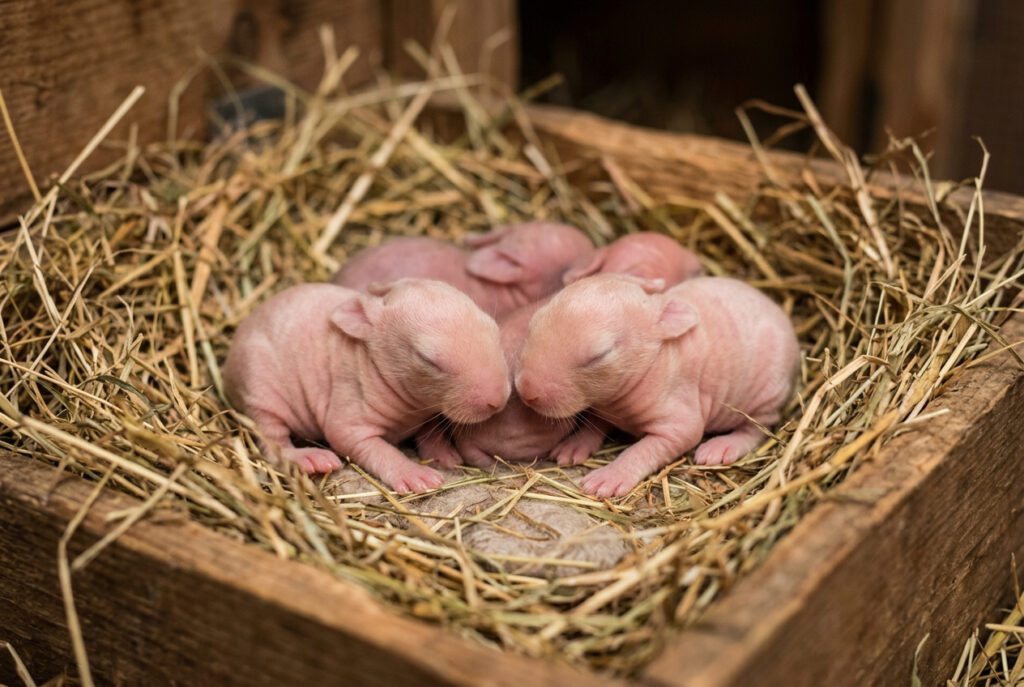
Yes. Rabbits are born with their eyelids fused shut — a developmental state called altricial birth. Newborn rabbit kits (Oryctolagus cuniculus) are born in an immature state compared to precocial species: they are hairless, deaf, and blind, entirely dependent on the doe for warmth, nutrition, and protection.
The biological reason for this is the rabbit’s short gestation period of 28 to 32 days. At the point of birth, the rabbit’s visual system — including the eyelids, retina, and optic nerve connections — has not yet completed its development. The eyelids remain fused as a protective mechanism while the underlying eye structures continue developing in the first weeks of postnatal life.
Kit Eye Development Timeline
| Age | Eye Development Stage |
|---|---|
| Birth | Eyes fused shut — completely blind and deaf |
| Days 2–3 | Fine fur begins growing |
| Days 10–12 | Eyes begin to open — vision initially blurry |
| Days 10–14 | Most kits have fully opened eyes |
| Day 21 | Kits leaving the nest; vision functional |
| Weeks 6–8 | Full adult visual acuity established; kits fully weaned |
One Critical Warning for Rabbit Owners
Never attempt to force a rabbit kit’s eyes open. The underlying structures are still developing, and the eyelids are delicate. Forced opening causes irreversible damage — laceration of the eyelid margins, trauma to the cornea, destruction of developing optic structures — any of which can result in permanent blindness. If a kit’s eyes have not opened by day 14, consult a rabbit-experienced veterinarian. Do not intervene yourself.
Adult Rabbit Vision: Extraordinary in Every Direction Except One
The 360-Degree Near-Panoramic Field
Adult rabbits have eyes positioned on the sides of the skull rather than facing forward. This lateral placement produces a visual field of approximately 340 to 360 degrees — near-total panoramic coverage that allows a rabbit to monitor for threats from virtually any direction simultaneously.
For comparison, a human’s visual field covers approximately 180 degrees, almost entirely forward-facing. A rabbit perceives almost the entire world around it at once.
This wide-angle vision evolved directly in response to predation pressure. The European rabbit (Oryctolagus cuniculus) is prey for foxes, birds of prey, stoats, ferrets, and numerous other predators. A visual system that provides near-total coverage of the surrounding environment — allowing threat detection without the rabbit needing to move its head — is a profound survival advantage.
The One Blind Spot: Directly in Front of the Nose
The same lateral eye placement that provides panoramic coverage creates one consistent blind spot: the area directly in front of the nose and below the chin. Rabbits cannot see what is immediately in front of their face.
This explains several behaviors that puzzle new rabbit owners:
- A rabbit sniffing at a treat held directly in front of it, rather than looking at it — it is using smell to locate something it cannot see
- A rabbit tipping or bobbing its head slightly when assessing a close object — it is using parallax motion to gather depth information that its limited binocular overlap cannot provide
- A rabbit that appears startled by a hand approaching directly from the front — the hand enters the blind spot and then suddenly appears in the peripheral field
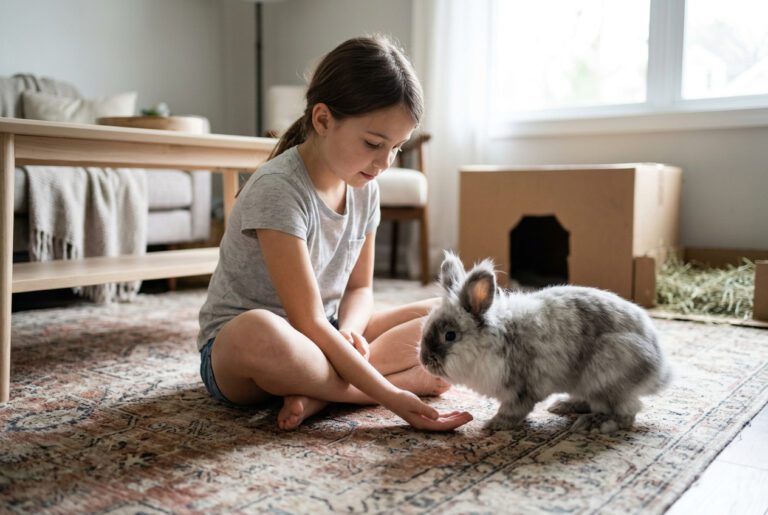
Practical implication for Angora rabbit owners: Always approach your rabbit from the side — not directly from the front or from above (which mimics an aerial predator approach). Hands entering from the side are visible to the rabbit before they arrive, reducing startle responses during handling and grooming.
Depth Perception and Binocular Vision
Rabbits have a very small binocular overlap zone — the area where both eyes’ visual fields overlap, and depth perception is available. This zone is narrow, giving the rabbit useful depth perception for judging the height of obstacles it needs to jump.
Humans have a wide binocular overlap zone (approximately 114 degrees) and excellent close-range depth perception. Rabbits sacrifice close-range depth perception for their panoramic coverage — a trade-off that serves survival rather than manipulation of nearby objects.
Low-Light Vision: Built for Dawn and Dusk
Rabbits are crepuscular — most active at dawn and dusk — and their visual system is optimized for these low-light transition periods.
Two structural features support this:
Rod-dominant retina: Rabbits have a much higher proportion of rod photoreceptors (which detect light intensity and motion in low light) relative to cone photoreceptors (which detect color in bright light) compared to humans. This rod dominance makes rabbit vision highly sensitive to movement and effective at low ambient light levels.
No tapetum lucidum: Unlike cats and dogs, rabbits do not have the reflective layer behind the retina that causes eye-shine in many night-active animals. Their low-light vision comes from large eyes and a rod-rich retina.
The practical result: a rabbit in a dimly lit room at dawn or dusk has functional, effective vision. A rabbit in complete darkness cannot see — no animal with eyes can see in the total absence of light — but the threshold at which rabbit vision becomes functional is much lower than the human threshold.
Color Vision: Limited but Present
Rabbits are not colorblind in the total sense — they can perceive some colors — but their color vision is substantially more limited than human color vision.
Humans have three types of cone photoreceptors detecting red, green, and blue wavelengths. Rabbits have two types (dichromatic vision) detecting green and blue wavelengths. They cannot tell red from green well, so reds likely look dull to them.
Practical implication: Toy and enrichment colors chosen to appeal to rabbit owners do not influence rabbit preference. Rabbits select and interact with objects based on texture, smell, and movement — not color.
Can Rabbits Go Blind?
Yes. While adult rabbits are not naturally blind, several conditions can cause vision loss:
Cataracts: Opacity of the lens reduces or eliminates light transmission to the retina. Associated with Encephalitozoon cuniculi (E. cuniculi) infection in rabbits, as well as aging and trauma. The white or opaque material sometimes visible within a rabbit’s eye is typically a cataract or E. cuniculi-related phacoclastic uveitis, both requiring veterinary assessment.
Glaucoma: Elevated intraocular pressure damages the retina and optic nerve. Presents as an enlarged, protruding eye in chronic cases.
Uveitis: Inflammation of the uveal tract, frequently associated with E. cuniculi infection. Left untreated, it can lead to vision loss.
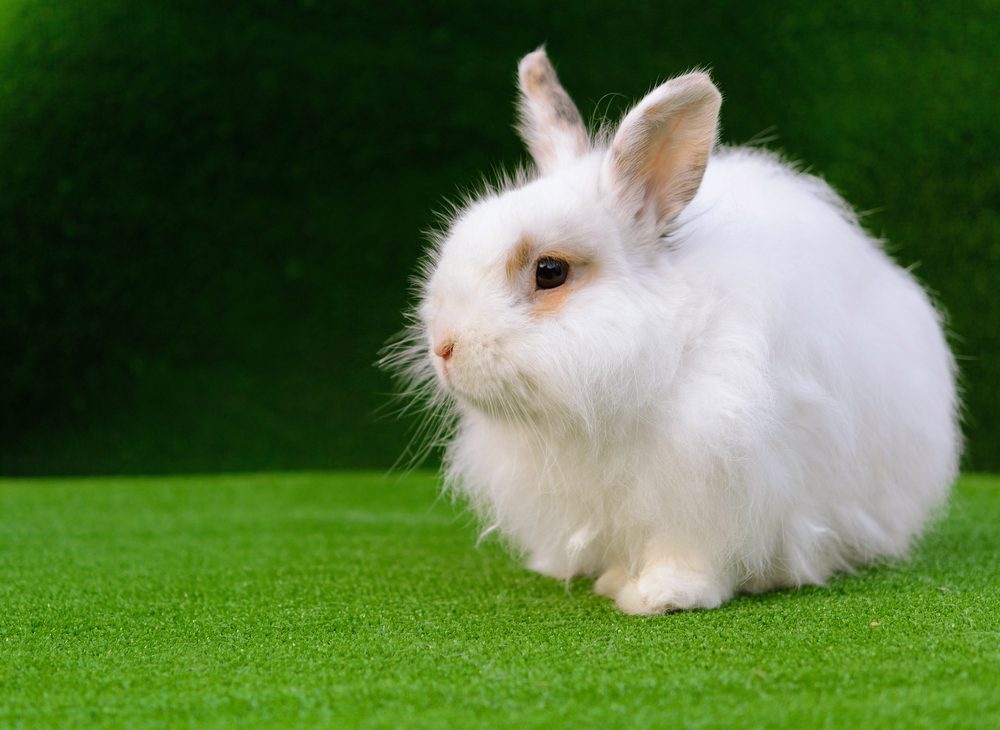
Corneal ulceration: In English Angora rabbits specifically, facial wool contact with the cornea causes progressive corneal damage that can result in corneal scarring and permanent vision impairment if untreated. Regular facial wool trimming at every grooming session helps prevent this.
Blind rabbits adapt well to their environment when kept in a stable, consistent layout. A rabbit that has lost its vision gradually — which is the common presentation with cataracts — has often developed compensatory behaviors using smell, whiskers, and spatial memory before the vision loss is even noticed.
For the complete guide to Angora rabbit eye health, see our Angora Rabbit Eyes article.
FAQs
Are rabbits born blind?
Yes. Rabbit kits are born with their eyelids fused shut and remain completely blind for the first 10 to 14 days of life. This is normal altricial development — the result of the short 28 to 32 day gestation period. Eyes open gradually, usually at around 10 to 14 days old.
Can rabbits see in the dark?
Rabbits cannot see in complete darkness — no animal with eyes can. But their large eyes and rod-dominant retina give them far better low-light vision than humans. They see effectively at dawn and dusk light levels that would be challenging for human vision. For the full explanation of rabbit low-light vision, see our Can Rabbits See in the Dark? guide.
Do rabbits have a blind spot?
Yes — directly in front of the nose and below the chin. This is the one area their near-panoramic lateral vision cannot cover. Rabbits compensate with their sense of smell and sensitive whiskers for close-range detection in this zone.
Are rabbits colorblind?
Not completely — rabbits have dichromatic vision and can perceive blue and green wavelengths. They cannot distinguish red from green. Their color perception is significantly more limited than human trichromatic color vision, but they are not colorblind in the total sense.
Why does my rabbit not look at me directly?
Because looking directly at something in front of them is not how rabbits see best. Their visual field is panoramic and side-oriented — they perceive you most clearly in their peripheral field, not by facing you directly. A rabbit turning its head slightly to view you with one eye is using its most effective visual field, not being evasive.
Can rabbits go blind from cataracts or infection?
Yes. Cataracts associated with aging or E. cuniculi infection, glaucoma, uveitis, and corneal damage from untreated eye conditions can all cause vision loss. For English Angora rabbits, facial wool contact with the cornea is a largely preventable cause of progressive corneal damage. Any cloudiness, opacity, or change in eye appearance warrants same-day veterinary contact.
Conclusion
Rabbits are born blind — a normal altricial developmental state that resolves within two weeks — and grow into adults with one of the most sophisticated wide-angle visual systems of any domestic animal. Their near-panoramic field of vision, low-light capability, and motion-detection sensitivity are all evolutionary adaptations to life as a prey species, calibrated over millions of years for survival rather than the close-range manipulation tasks that human eyes are designed for.
Understanding how rabbit vision works explains the behaviors owners observe — the head-tilting, the apparent startling from directly frontal approach, the preference for side-on observation — and informs better handling practices that reduce stress and improve the owner-animal relationship.
For Angora rabbit owners specifically, eye health monitoring is a weekly grooming session responsibility. The Angora Rabbit Eyes and Angora Rabbit Grooming guides cover the breed-specific eye care requirements in full.
This article is for general educational purposes and does not constitute veterinary advice. For any eye health concern, contact a rabbit-experienced veterinarian. See our disclaimer for full details.
Sources
- Rabbit.org. The Rabbit Eye: A Complete Guide, checked October 2026.
- Rabbit.org. What Do Rabbits See?, checked October 2026.
- VIN. Rabbit and ferret ophthalmology notes (University of Murcia), checked October 2026.
- Merck Veterinary Manual. Management of Rabbits, checked October 2026.
- WikiVet. Uveitis – Rabbit, checked October 2026.
This guide is for general information and is not a substitute for advice from a vet. Read our disclaimer.