Can Rabbits See in the Dark? Rabbit Vision Explained
How we researched this guide: In October 2026 we checked the facts in this article against Rabbit.org, VIN, American Rabbit Breeders Association and Wikipedia, and corrected or removed anything we could not verify. Our sources are listed at the end. See our editorial policy. Last reviewed: October 2026.
Quick answer: Not in total darkness. Rabbits see well in low light, such as at dawn and dusk, thanks to large eyes and a retina rich in rod cells. Unlike cats and dogs, they do not have a reflective tapetum lucidum behind the retina.
Rabbits cannot see in complete darkness. No animal with eyes can — some level of light is always required for vision. But rabbits are exceptionally well-adapted for low-light conditions, seeing far more effectively at dawn and dusk than humans do, and possessing a visual system shaped by tens of millions of years of evolution as a prey animal under constant predation pressure.
Understanding how rabbit vision actually works — what they see well, what they see poorly, and what is unique about the Angora rabbit’s visual experience — is genuinely useful for any rabbit owner. It explains behaviors that might otherwise seem strange, and it has direct implications for how you set up your rabbit’s living space.
How the Rabbit Eye Is Built for Low Light
The rabbit eye contains two types of photoreceptor cells: rods and cones. Rods detect light and motion but not color. Cones detect color but require more light to function. In human eyes, rods and cones are present in roughly equal balance, with a cone-dense central region (the fovea) that enables sharp color detail.
Rabbit eyes have a very different structure. According to the University of Miami rabbit vision research, the retina is densely packed with rods — rabbits have far more rods relative to cones than humans do. This rod-dominant retina is optimized for sensitivity to motion and shape in low-light conditions. It allows rabbits to detect the movement of a predator in near-darkness — the primary survival function their visual system evolved to serve.
Unlike cats and dogs, rabbits do not have a tapetum lucidum, the reflective layer behind the retina that causes eye-shine in many night-active animals. Rabbits are crepuscular — most active at dawn and dusk — and their large eyes and rod-rich retinas suit this low-light activity pattern.
The practical result: in the dim light of early morning or evening, rabbits see with considerably more sensitivity than humans. In brighter daylight, humans see more sharply and with more color detail. In complete darkness, neither humans nor rabbits can see.
The Wide Field of View and the Blind Spot
The position of rabbit eyes on the sides of the head — rather than facing forward as in predators — gives them a visual field of approximately 360 degrees. A rabbit can see almost everything around it simultaneously without moving its head, providing extraordinary awareness of approaching threats from any direction.
However, this panoramic peripheral vision comes with two trade-offs that owners should understand.
The frontal blind spot. Rabbits have a blind spot directly in front of their nose. The two monocular fields of view — one from each eye — overlap only slightly in the forward direction. This means a rabbit cannot see something held directly in front of its face at close range. It must tip its head slightly or rely on smell and whiskers to evaluate what is immediately in front of it. This is why rabbits often appear to sniff at food before eating it even when the food is in plain sight — they may literally be unable to see it clearly at that distance and angle.
Limited depth perception forward. Because the binocular overlap zone in rabbits is small, their depth perception in the forward direction is limited compared to predators with forward-facing eyes. Rabbits compensate by moving their heads in a slight bobbing or tilting motion when assessing something in front of them — this parallax motion helps the brain calculate distance from a monocular visual system.
What Colors Can Rabbits See?
Rabbits are dichromats — they have two types of cone cells rather than the three that humans possess. Rabbit cones are sensitive to blue-violet wavelengths and green wavelengths. They lack the red-sensitive cone type entirely. This means rabbits cannot distinguish red from green, and their color experience overall is less saturated than human color vision.
In practical terms: a rabbit sees the world primarily in shades of blue, blue-green, and yellow-green, with some grey. Red, orange, and red-toned materials appear to rabbits as shades of grey or muted yellow-green, not as distinct colors.
This matters for owners choosing enrichment items and toys. High-contrast items in blue, blue-green, or yellow-green are more visually stimulating for rabbits than items in red or orange, which appear essentially colorless to them.
Crepuscular Activity and the Rabbit Schedule
The word crepuscular describes animals most active at dawn and dusk — the transitional light periods between day and night. This is distinct from nocturnal (active primarily at night) and diurnal (active primarily during the day). Rabbits are crepuscular, and their visual system is precisely tuned for these low-light transition periods.
Domestic rabbits maintain this crepuscular activity pattern even in indoor environments. Most pet rabbits are most active in the early morning hours and again in the late evening. Owners who observe their rabbits seeming sluggish during the middle of the day and then suddenly active and energetic at dawn and dusk are observing the rabbit’s natural biological rhythm expressing itself in a domestic setting.
This rhythm also means that indoor rabbits benefit from a natural light cycle — periods of natural or simulated daylight followed by darkness — rather than constant artificial light. A rabbit kept under continuous bright lighting without access to dimmer periods or darkness cannot properly regulate its activity-rest cycle. This contributes to stress and disrupted behavior.
The Angora Rabbit’s Vision: The Facial Wool Factor
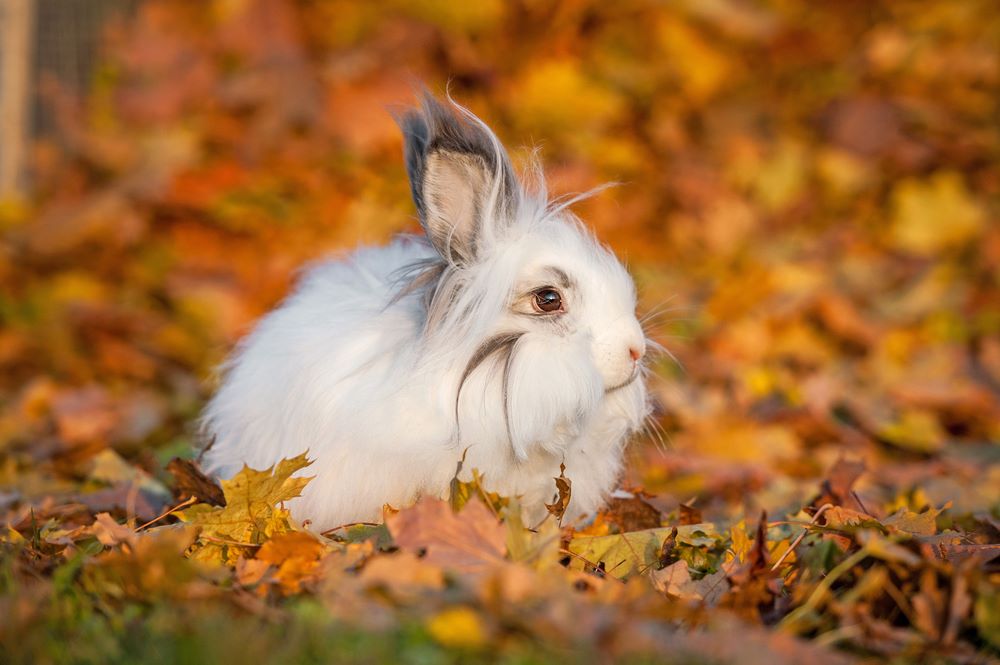
For Angora rabbit owners, there is a vision consideration that does not apply to any other breed group: the English Angora’s facial wool.
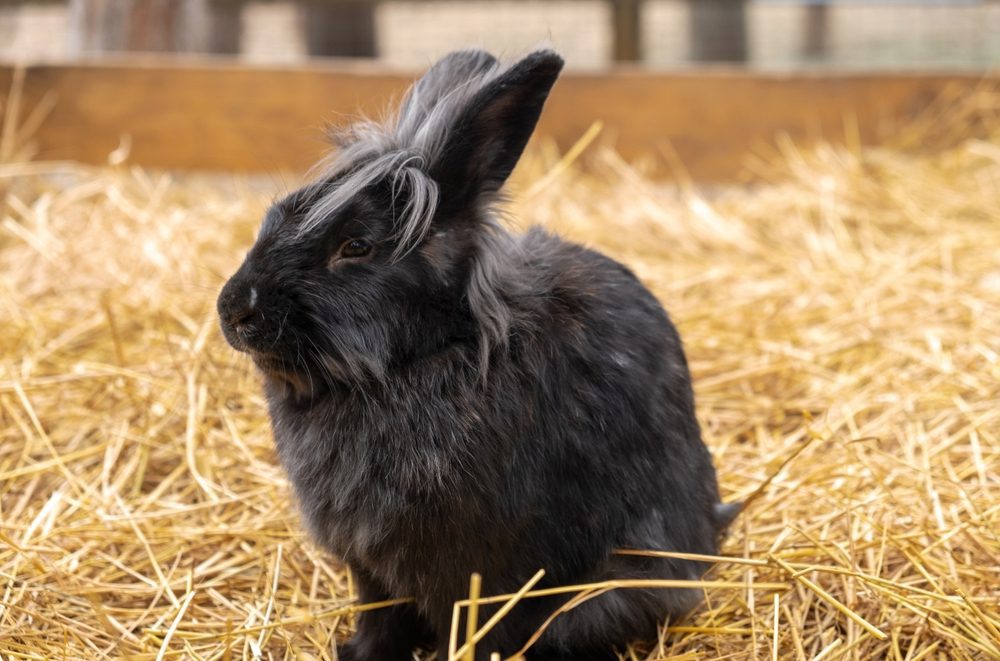
The English Angora has the fullest facial wool of the Angora breeds, including a prominent fringe over the face. When this facial wool is not maintained — trimmed away from the eyes and nose on a regular schedule — the wool physically contacts the cornea and obstructs the visual field. A rabbit whose vision is partially blocked by overgrown facial wool is functioning with a reduced ability to monitor its surroundings for danger. This is not a comfortable state for an animal whose entire threat-detection system depends on wide peripheral vision.
This is one of the reasons facial wool trimming in English Angora rabbits is a mandatory care task, not a cosmetic one. As covered in our Angora Rabbit Grooming guide, the facial wool around the eyes must be kept clear at every grooming session.
French and Satin Angoras have clean faces. Giant Angoras have some facial furnishings, so their eyes need checking too.
Lighting Requirements for Pet Rabbits
Rabbit eye health and behavioral well-being both benefit from a natural light cycle. The practical guidelines for domestic rabbit lighting:
Natural light is ideal. A room with natural daylight that cycles to dimness and darkness in the evening is the best environment for a domestic rabbit. The natural variation in light intensity supports the rabbit’s crepuscular rhythm and provides appropriate visual stimulation.
Avoid constant bright artificial lighting. Prolonged exposure to bright artificial light without dark periods is stressful for rabbits and disrupts their sleep-activity cycle. If a rabbit’s enclosure is in a room with lights on throughout the evening, ensure the rabbit has a covered hide box or enclosed sleeping area where it can rest in darkness.
Avoid complete darkness for extended periods. Rabbits in complete darkness cannot see at all and may become disoriented and stressed. A small amount of ambient light — equivalent to moonlight or a dim lamp in another room — is sufficient to allow the rabbit to orient itself at night without disrupting its rest.
Do not use bright flash photography close to a rabbit’s face. Sudden bright light can startle a rabbit, and close-range flash can be startling and temporarily disorienting.
FAQs
Can rabbits see in the dark?
Rabbits cannot see in complete darkness — some level of ambient light is always required. However, their large eyes and rod-dense retinas make them highly effective in low-light conditions such as dawn and dusk, seeing considerably better than humans in dim light.
Do rabbits have good eyesight?
Rabbit vision is specialized rather than uniformly good. Their wide field of view — nearly 360 degrees — and excellent low-light sensitivity are exceptional. Their color vision is limited to blue-green tones (dichromatic), their depth perception directly forward is modest, and they have a blind spot immediately in front of their nose.
Why does my rabbit seem to look sideways at things?
Rabbits have a frontal blind spot directly in front of their nose. To assess something at close range in front of them, they turn their head slightly to align one eye — this is normal visual behavior, not a sign of eye problems.
Are rabbits colorblind?
Rabbits are dichromats — they see blue-violet and green wavelengths but lack red-sensitive cone cells. They cannot distinguish red from green and experience less color saturation overall than humans. They are not totally colorblind but have significantly more limited color vision than humans.
Do rabbits need a light on at night?
No. Rabbits do not need a light on at night and benefit from periods of darkness that support their natural sleep-activity cycle. A small amount of ambient light is sufficient for orientation — equivalent to moonlight through a window. Prolonged bright artificial lighting without dark periods is stressful.
Does the Angora rabbit’s wool affect its vision?
For the English Angora specifically, yes. The facial wool of this breed grows continuously and can contact the cornea and obstruct the visual field if not trimmed regularly. This is a mandatory care requirement for English Angora owners, not a cosmetic choice. Other Angora breeds with clean faces are not affected.
Conclusion
Rabbit vision is a precisely evolved system shaped by the demands of being a prey animal that must detect approaching threats across a wide field of view, often in low-light conditions. The rod-dominant retina and panoramic eye placement give rabbits exceptional peripheral and low-light sensitivity. The trade-offs — limited color range, modest forward depth perception, and a frontal blind spot — reflect the survival priorities of a crepuscular prey species.
For Angora rabbit owners, the English Angora’s facial wool introduces a breed-specific vision consideration that requires consistent management. For all rabbit owners, providing a natural light cycle with appropriate dark periods supports both the rabbit’s visual health and its behavioral well-being.
For the full care guide covering all aspects of English Angora maintenance, including facial wool management, see our Angora Rabbit Grooming guide. For a parallel article on Angora rabbit physical anatomy, see our Angora Rabbit Eyes guide.
Sources
- Rabbit.org. The Rabbit Eye: A Complete Guide, checked October 2026.
- Rabbit.org. What Do Rabbits See?, checked October 2026.
- VIN. Rabbit and ferret ophthalmology notes (Dept. of Animal Medicine and Surgery, University of Murcia), checked October 2026.
- American Rabbit Breeders Association. Recognized Breeds, checked October 2026.
- Wikipedia. Angora rabbit, checked October 2026.
This guide is for general information and is not a substitute for advice from a vet. Read our disclaimer.