Angora Rabbit Habitat: Origins, Natural Environment, and What It Means for Domestic Care
Angora rabbits are a domestic breed of the European rabbit, Oryctolagus cuniculus — the same species as all other domestic rabbit breeds. Understanding the natural habitat and environmental preferences of this species is not simply academic. The behavioral patterns, temperature sensitivities, light cycle requirements, and social needs that Angora rabbits display today are direct expressions of adaptations that evolved over millions of years in specific environmental conditions. Knowing where rabbits come from helps explain why they behave the way they do and what domestic habitat conditions actually serve their well-being.
Geographic Origins: Where Angora Rabbits Come From
The European rabbit (Oryctolagus cuniculus) originated in the Iberian Peninsula — present-day Spain and Portugal — and parts of northwestern Africa. This is the native range of the wild ancestor shared by all domestic rabbit breeds. The species spread through Europe, first naturally and then through deliberate human introduction, over several thousand years.
The Angora rabbit, as a distinct breed with its characteristic long wool coat, is believed to have originated in Ankara, Turkey — historically known as Angora — from which it takes its name. The breed was brought to France in 1723 and became a favored pet of the French royal court. By the end of the 18th century, it had spread across Europe, and it arrived in the United States in the early 20th century. Today, all five Angora breeds recognized by the American Rabbit Breeders Association (ARBA) and the IAGARB are kept exclusively as domestic animals — there are no wild Angora rabbit populations.
The Natural Habitat of the European Rabbit
Understanding the natural habitat of Oryctolagus cuniculus explains much about what domestic rabbits — including Angora breeds — need in captivity.
Climate and Temperature
The European rabbit’s native Iberian habitat is characterized by a Mediterranean climate — warm, dry summers and mild, wet winters. Temperatures in this range rarely reach the extremes of continental climates. Wild rabbits are well adapted to these conditions but have limited physiological tolerance for temperature extremes in either direction.
The safe temperature range for domestic rabbits reflects this evolutionary baseline: 50 to 75 degrees Fahrenheit (10 to 24°C) is the broadly accepted comfortable range. Above 80°F (27°C), any rabbit is at heat stress risk. For Angora rabbits specifically, the dense wool coat significantly impairs heat dissipation, lowering the effective upper threshold. This is why climate-controlled indoor housing is the standard for Angora rabbit keeping — not preference, but physiology rooted in the breed’s evolutionary temperature tolerance.
Terrain and Shelter
Wild European rabbits are burrowing animals. They live in extensive underground tunnel systems called warrens, which provide stable temperature, protection from predators, and shelter from weather. The warren environment is dark, quiet, temperature-stable, and physically secure — the opposite of an exposed outdoor hutch.
This burrowing heritage explains several consistent domestic rabbit behaviors: the preference for enclosed, covered resting areas over open spaces; the comfort response to dark, den-like hide boxes; the stress response to sudden noise, bright light, and open exposure; and the importance of providing a solid-sided shelter area within any enclosure.
Light Cycle
Wild rabbits are crepuscular — most active at dawn and dusk when light levels are low. This activity pattern evolved in response to predation pressure: the transition periods of early morning and late evening offer lower visibility to predators than full daylight while providing enough ambient light for the rabbit’s low-light-adapted visual system to function.
Domestic Angora rabbits maintain this crepuscular rhythm regardless of breed or generations of domestication. Owners who observe their rabbits seemingly inactive during the middle of the day and suddenly energetic at dawn and dusk are observing this deeply embedded behavioral pattern. It has direct implications for habitat design: indoor rabbits benefit from exposure to a natural light cycle — periods of natural or simulated daylight followed by darkness — rather than constant artificial illumination. For a full explanation of rabbit vision and light requirements, see our Can Rabbits See in the Dark? guide.
Social Structure
Wild European rabbits are highly social, living in groups of 2 to 10 individuals within a shared warren. This social structure provides predator detection through collective vigilance, thermoregulation through body contact during rest, and social bonding through allogrooming — mutual grooming that strengthens group cohesion.
Domestic rabbits retain this social orientation. A single rabbit kept without social contact — from humans or a bonded companion rabbit — experiences measurable behavioral stress. This is not sentiment; it reflects the species’ evolutionary dependence on group living. For Angora rabbit owners keeping a single rabbit, consistent daily interaction and handling time partially compensate for the absence of a companion. For owners keeping multiple rabbits, the social dynamics of the group require careful management, as rabbits are also territorial.
What the Natural Habitat Tells Us About Domestic Housing
The gap between a wild rabbit’s natural environment and a typical domestic housing setup is instructive. The wild rabbit’s habitat provides:
- Stable, moderate temperatures year-round
- Darkness and physical enclosure for resting
- Consistent natural light cycles
- Social contact with conspecifics
- Physical security from predators
- Unlimited access to fibrous vegetation
A well-designed domestic habitat replicates these conditions as closely as possible within an indoor environment. This is not difficult — it simply requires understanding what the conditions mean and why they matter.
Domestic Habitat Requirements for Angora Rabbits
Indoor Housing
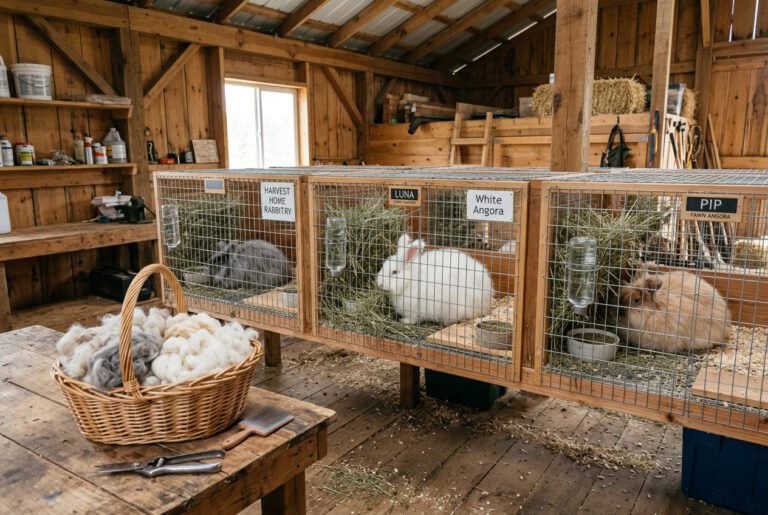
Indoor housing with climate control is the standard for all Angora rabbit breeds. The wool coat that makes Angora rabbits extraordinary fiber animals is the same coat that makes outdoor housing genuinely impractical: it felts in rain and moisture, traps debris that accelerates mat formation, impairs heat dissipation in warm weather, and creates flystrike risk in warm months that indoor monitoring prevents. For the full evidence-based explanation, see our Can Angora Rabbits Live Outside? guide.
Enclosure Specifications
Minimum indoor enclosure dimensions by breed:
| Breed | Minimum Floor Space | Minimum Height |
|---|---|---|
| English Angora | 24 × 30 inches (61 × 76 cm) | 18 inches (46 cm) |
| Satin Angora | 24 × 30 inches (61 × 76 cm) | 18 inches (46 cm) |
| French Angora | 30 × 36 inches (76 × 91 cm) | 18 inches (46 cm) |
| Giant Angora | 36 × 30 inches (91 × 76 cm) minimum | 24 inches (61 cm) |
| German Angora | 30 × 36 inches (76 × 91 cm) | 24 inches (61 cm) |
All enclosures require a solid resting board covering at least one-third of the floor area. Wire flooring alone causes sore hocks — painful pressure ulcers on the hind feet. A wooden board, rubber mat, or fleece pad must be present at all times.
Temperature
Maintain indoor temperatures between 60 and 72°F (16 to 22°C). Below 50°F (10°C) or above 80°F (27°C) constitute a risk condition requiring active management. Angora rabbits, with their insulating wool coats, are particularly vulnerable to the upper end of this range and should never be housed in unventilated spaces during warm months.
Hide Box and Den Area
Every Angora rabbit enclosure should include a solid-sided hide box or enclosed shelter area large enough for the rabbit to enter, turn around, and lie down comfortably. This replicates the warren entrance function — a private, enclosed space where the rabbit can retreat when stressed, resting, or seeking darkness. Rabbits that lack a hide box show measurably higher stress indicators in enclosure settings.
Light Cycle
Provide a natural or simulated light cycle — approximately 12 to 14 hours of ambient light followed by darkness. Avoid placing enclosures under permanent bright artificial lighting with no dark period. If the enclosure is in a room with lights on throughout the evening, ensure the hide box provides a dark retreat for the rabbit’s rest period.
Free-Roam Time
Daily free-roam time in a rabbit-proofed room or area is essential for physical health, muscle maintenance, and behavioral well-being. A rabbit that lives exclusively within its enclosure without daily exercise time is at elevated risk of obesity, reduced bone density, and behavioral stereotypies. During free-roam, supervise the rabbit to prevent access to electrical cords, toxic plants, and areas that cannot be monitored for hazards to the coat.

FAQs
Where do Angora rabbits come from originally?
The Angora rabbit, as a breed, originated in Ankara, Turkey, and was brought to France in 1723. All Angora breeds are domestic varieties of the European rabbit (Oryctolagus cuniculus), whose wild ancestor originated in the Iberian Peninsula — present-day Spain and Portugal.
What is the natural habitat of wild rabbits?
Wild European rabbits live in underground burrow systems called warrens, preferring open grassland, meadows, and scrubland with well-drained soil for burrowing. They are most active at dawn and dusk and maintain stable warren temperatures year-round. Their native climate range is temperate to Mediterranean — mild, with limited temperature extremes.
Can Angora rabbits live outside?
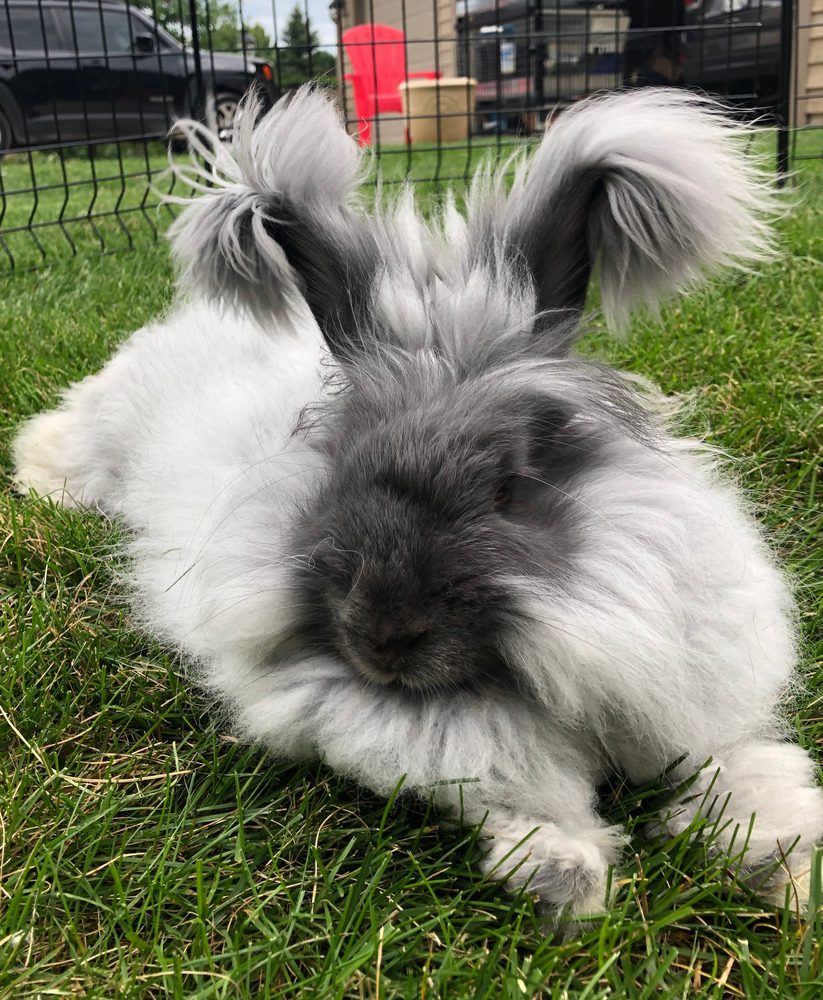
Outdoor housing is not recommended for Angora rabbits. The wool coat feels in rain and moisture, flystrike risk is dramatically elevated outdoors, heat stress is accelerated by the insulating coat, and grooming frequency requirements are incompatible with outdoor debris accumulation. Supervised outdoor time in a secure exercise pen on dry, mild days is appropriate — full outdoor housing is not. See our full Can Angora Rabbits Live Outside? guide.
What temperature do Angora rabbits need?
The comfortable indoor temperature range for all Angora breeds is 60 to 72°F (16 to 22°C). Above 80°F (27°C), heat stress risk increases significantly, more rapidly for Angora breeds than for short-haired rabbits due to the insulating wool coat. Below 50°F (10°C), cold stress risk increases, particularly for recently shorn rabbits.
Do Angora rabbits need a hide box?
es. A solid-sided hide box or enclosed shelter area within the enclosure is a welfare necessity, not an optional accessory. Wild rabbits spend much of their resting time in the darkness and physical security of a burrow. A domestic rabbit without an enclosed retreat space experiences chronic low-level stress that affects both behavior and health.
Do Angora rabbits need social interaction?
Yes. European rabbits are highly social animals that evolved in group living situations. A domestic Angora rabbit kept without regular social contact — from daily human interaction or a bonded companion rabbit — experiences behavioral stress. Regular handling and interaction sessions are part of meeting the breed’s social needs in a domestic setting.
Conclusion
The Angora rabbit’s natural habitat roots — the burrow systems of Oryctolagus cuniculus in its Iberian homeland — explain the behavioral and physiological needs that domestic Angora rabbit housing must address. The preference for enclosed, dark resting spaces, the crepuscular activity rhythm, the social orientation, and the temperature sensitivity are not quirks of individual animals. They are species-level adaptations expressed consistently across every domestic rabbit breed.
For Angora rabbits specifically, the additional layer of wool coat biology — its felting risk in moisture, its heat retention, its debris accumulation — makes the indoor habitat standard not merely comfortable but necessary. Indoor housing with climate control, a proper enclosure with a solid resting board and a hide box, daily free-roam time, and consistent social interaction replicates what the natural habitat provided — and adds the coat monitoring that only a domestic environment makes possible.
For complete Angora rabbit care guidance, including diet, grooming, and health monitoring, see our Angora Rabbit Care Guide.