Wool Rabbit Breeds: The Complete Guide to Every Fiber-Producing Rabbit
Wool rabbits are kept for one purpose that no other pet animal offers: a continuously renewable, soft, warm, natural fiber that can be harvested several times per year and spun into luxury yarn. Angora rabbit fiber — at 12 to 16 microns in diameter — is among the finest natural fibers in the world, comparable to cashmere in softness and significantly finer than standard sheep’s wool. Its hollow fiber structure makes it exceptionally warm for its weight and produces the characteristic “halo” effect that distinguishes Angora yarn from any other.
But not all wool rabbits are created equal. The five main breeds kept for fiber production in the United States differ significantly in wool yield, coat structure, grooming demands, fiber quality, and suitability for different types of owners. Understanding those differences is the foundation of making the right choice — whether you are a fiber enthusiast looking for a spinning source, a homesteader evaluating production animals, or a rabbit owner drawn to wool-producing breeds.
This guide covers every wool rabbit breed kept in the United States, their fiber properties, care requirements, and which type of owner each breed suits best. All weight data and ARBA recognition status are sourced from the American Rabbit Breeders Association.
What Makes Angora Wool Exceptional
Before comparing breeds, it is worth understanding why Angora rabbit fiber is in a different category from the wool of most other fiber animals.
According to the Wikipedia article on Angora wool, good quality Angora fiber measures approximately 12 to 16 microns in diameter — finer than cashmere (approximately 18 microns) and significantly finer than standard sheep’s wool (approximately 20 to 30 microns for fine breeds). This fineness makes it exceptionally soft against the skin.
The fiber is also hollow. Each Angora fiber has a hollow core that traps air, providing insulation that is significantly more efficient per unit of weight than solid-core wool fibers. This is what makes Angora garments feel both lightweight and warm simultaneously.
The characteristic “halo” of Angora yarn — the soft, fuzzy cloud of fiber that surrounds each strand — results from the same fine, smooth fiber surface. Because Angora fiber has a smooth scale structure, it reflects light more readily than sheep’s wool and projects outward from the yarn, creating the halo effect prized by knitters and fiber artists.
Angora fiber does have limitations. It lacks natural elasticity, which means pure Angora yarn does not spring back after stretching. For this reason, most commercial and handspun Angora yarns blend the fiber with sheep’s wool, alpaca, or similar elastic fibers — typically at 30% to 50% Angora in the blend — to add structure, durability, and elasticity while preserving the halo and softness.
The Five Main Wool Rabbit Breeds
1. English Angora
- Weight: 5 to 7.5 pounds (2.3 to 3.4 kg)
- ARBA recognized: Yes
- Wool yield: 10 to 16 oz (280 to 450 g) per year
- Fiber diameter: 12 to 16 microns — finest of all Angora breeds
- Harvesting method: Hand-plucking or combing during natural molts
- Grooming: High — two to three times per week minimum, daily during molting
- Best for: Fiber artists who prioritize softness above all else, experienced rabbit owners, and show breeders
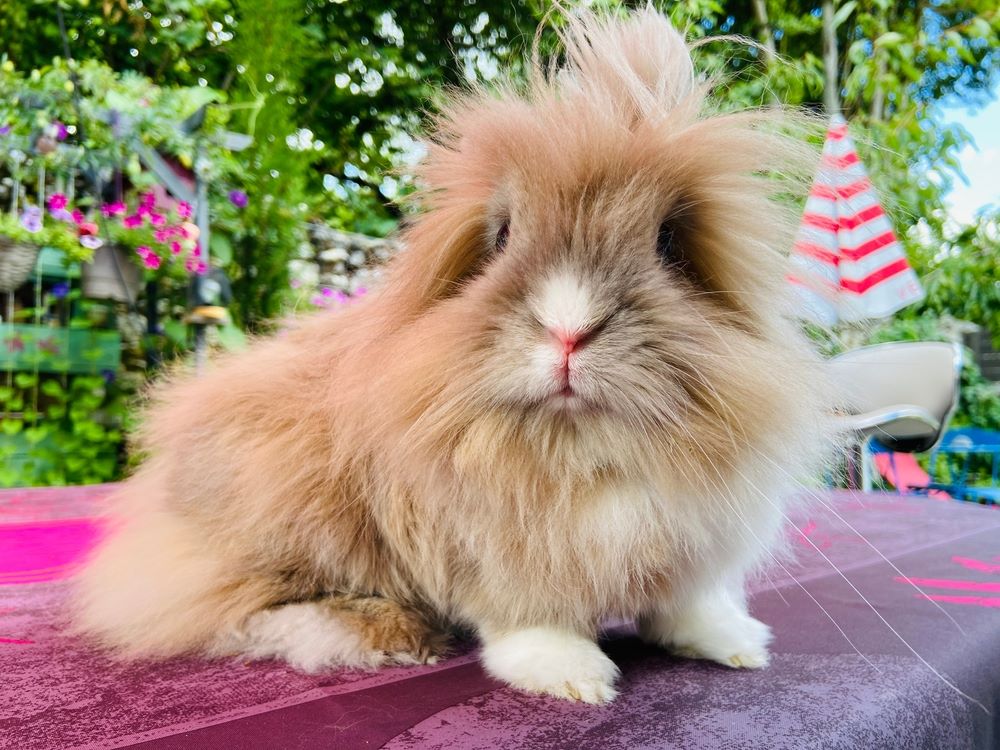
The English Angora produces the finest, softest fiber of any domestic rabbit breed. Its coat has very few guard hairs — almost entirely fine underwool — giving it a cashmere-like texture that is unmatched by any other Angora variety. Spin Off magazine describes the English Angora’s fiber as “the most like cashmere” of all the Angora breeds, precisely because of this low guard hair count.
The trade-off is management intensity. The same lack of guard hair that makes the fiber so soft also makes the coat prone to matting. The English Angora’s full-body wool coverage — including the face, ears, and feet — creates more surface area requiring regular attention than any other Angora breed. The facial wool must be kept trimmed away from the eyes to prevent irritation.
The English Angora suits a fiber enthusiast who wants the highest quality raw material and is prepared to commit to the grooming demands that quality requires.
For a full breed profile, see our English Angora Rabbits page and our Types of Angora Rabbits guide.
2. French Angora
- Weight: 7.5 to 10.5 pounds (3.4 to 4.8 kg)
- ARBA recognized: Yes
- Wool yield: 16 to 20 oz (450 to 570 g) per year
- Fiber character: More guard hair than English — slightly coarser, more structured
- Harvesting method: Hand-plucking or combing during natural molts
- Grooming: Moderate — two to three times per week
- Best for: Beginner fiber rabbit owners, handspinners who prefer structured fiber, and anyone who wants good production with manageable grooming
The French Angora is the recommended starting breed for anyone new to fiber rabbits. Its clean face, ears, and front feet eliminate the grooming complexity of the English Angora’s facial wool. The body coat has more guard hairs than the English Angora — which makes it more resistant to matting and easier to maintain — while still producing excellent quality fiber.
The additional guard hair gives French Angora fiber more structure than English fiber. Spin Off magazine notes that French Angora fiber is “more fur-like” and produces a yarn with a slightly different character than the English — one that many handspinners find easier to control. The finished yarn has excellent warmth and a good halo, though slightly less extreme than English Angora yarn.
French Angora wool yield is higher than that of English due to the larger body size. The breed also produces more wool per year than the Satin Angora, making it a good balance of quality, quantity, and manageability.
For a full breed profile, see our French Angora Rabbits page.
3. Satin Angora
- Weight: 6.5 to 9.5 pounds (3 to 4.3 kg)
- ARBA recognized: Yes
- Wool yield: 10 to 16 oz (280 to 450 g) per year
- Fiber character: Satin gene produces a semi-transparent fiber shaft with exceptional luster
- Harvesting method: Hand-plucking or combing during natural molts
- Grooming: High — daily combing recommended
- Best for: Fiber artists who value aesthetic quality and luster over yield, experienced groomers
The Satin Angora produces fiber unlike any other Angora breed. The satin gene — inherited from the Satin rabbit parent in the breed’s development — causes each fiber shaft to be semi-transparent, reflecting light in a way that gives the finished yarn an unmistakable high-sheen luster. The color depth of Satin Angora fiber is also exceptional: the transparent fiber shaft allows dye to penetrate more fully, producing richer, more saturated color than standard Angora fiber.
The limitations are yield and coat management. The Satin Angora produces less wool per year than either the French or English Angora. Its low guard hair count and slippery satin fiber texture make the coat mat more readily than the French Angora — daily combing is the standard recommendation. The fiber is also more challenging to spin than French Angora fiber for many handspinners due to its smooth, slippery surface.
The Satin Angora suits a fiber artist who values the unique visual quality of luster fiber and is prepared to manage the coat maintenance that comes with it.
For a full breed profile, see our Satin Angora Rabbits page.
4. Giant Angora
- Weight: No maximum — bucks minimum 9.5 lb (4.3 kg), does minimum 10 lb (4.5 kg)
- ARBA recognized: Yes — only 6-class Angora breed
- Wool yield: 28 to 40 oz (790 to 1,130 g) per year
- Fiber character: Three-component coat — underwool, awn fluff, awn hair
- Harvesting method: Clipping only — does not naturally molt
- Grooming: Moderate — two to three times per week, strict 90-day clip schedule
- ARBA recognized colors: Ruby-Eyed White and Chestnut (Chestnut accepted 2023)
- Best for: Serious fiber producers, experienced owners with adequate space, ARBA show breeders
The Giant Angora is the highest-producing wool rabbit among the four ARBA-recognized breeds. Its three-component coat — underwool, awn fluff, and awn hair — is shared only with the German Angora among domestic rabbit breeds, and its large body mass means significantly more fiber per shearing than any other ARBA breed.
Unlike the English, French, and Satin Angoras, the Giant Angora does not naturally molt. Its coat grows continuously and must be clipped every 90 days without exception. This means the owner controls the harvest entirely — there is no molting window and no hand-plucking opportunity. Failing to clip on schedule causes the fiber to break down, mat severely, and significantly elevate the wool block risk.
The Giant Angora was developed by Louise Walsh of Taunton, Massachusetts, using German Angoras, French Lops, and Flemish Giants, and received ARBA recognition in 1988.
For a full breed profile, see our Giant Angora Rabbits page and our Huge Angora Rabbit guide.
5. German Angora
- Weight: 5.5 to 12 pounds (2.5 to 5.5 kg)
- ARBA recognized: No — governed by the International Association of German Angora Rabbit Breeders (IAGARB)
- Wool yield: 32 to 70+ oz (900 to 2,000+ g) per year
- Fiber character: Three-component coat, firm crimp, non-matting in well-bred lines
- Harvesting method: Clipping only — does not naturally molt
- Grooming: Low to moderate between shearings if breed standard is met — strict 90-day clip schedule required
- Best for: Maximum fiber production, fiber farmers, homesteaders who do not require ARBA show eligibility
The German Angora is the highest-producing wool rabbit in the world — significantly exceeding even the Giant Angora in annual yield. A well-bred individual from established IAGARB-registered lines regularly produces more than 2,000 grams (70 oz) per year — more than three times the annual output of a productive French Angora.
The breed was developed in Germany through systematic performance testing beginning in 1920, with breeders selecting exclusively for animals that produced the most usable wool with the least grooming intervention between shearings. The result is a breed whose coat — in well-bred lines — requires no grooming at all between 90-day shearing cycles. The IAGARB specifies that a well-bred German Angora coat should remain free-falling and mat-free for the full 90 days without owner intervention. Rabbits whose coats mat before the 90-day mark are considered unsuitable for breeding.
The German Angora does not hold ARBA recognition and cannot be shown at ARBA-sanctioned events. It is evaluated through the IAGARB’s own performance-based registration system, which requires both a minimum physical type score and a minimum wool production of 1,300 grams (45 oz) per year to qualify for registration.
For a full breed profile, see our German Angora Rabbit guide.
Wool Rabbit Breed Comparison
| Feature | English Angora | French Angora | Satin Angora | Giant Angora | German Angora |
|---|---|---|---|---|---|
| ARBA recognized | Yes | Yes | Yes | Yes | No |
| Weight | 5–7.5 lb | 7.5–10.5 lb | 6.5–9.5 lb | 9.5 lb+ | 5.5–12 lb |
| Annual wool yield | 10–16 oz | 16–20 oz | 10–16 oz | 28–40 oz | 32–70+ oz |
| Molts naturally | Yes | Yes | Yes | No | No |
| Must be clipped | No* | No* | No* | Yes | Yes |
| Grooming level | High | Moderate | High | Moderate | Low–Moderate† |
| Fiber fineness | Finest | Moderate | Moderate + luster | Good | Good, some coarser guard hair |
| Best for beginners | No | Yes | No | No | No |
| Show eligibility (ARBA) | Yes | Yes | Yes | Yes | No |
*Molting breeds can also be clipped by preference †German Angora grooming is low between shearings in well-bred lines — the 90-day clip itself is non-negotiable
Small Wool Rabbit Breeds
Two additional ARBA-recognized breeds carry Angora wool genes but are kept primarily as companion animals rather than fiber producers. They deserve mention for completeness.
Jersey Wooly (maximum 3.5 lb) — Developed by Bonnie Seeley from Netherland Dwarf and French Angora crosses, recognized by ARBA in 1988. The Jersey Wooly’s coat requires only weekly brushing and does not need shearing. It does not produce fiber in sufficient quantities for meaningful spinning. It is the lowest-maintenance wool-type rabbit available and suits owners who want the aesthetic appeal of a wooled rabbit without the production commitment.
American Fuzzy Lop (maximum 4 lb) — Developed from Holland Lops into which the Angora wool gene was introduced via French Angora crosses, recognized by ARBA in 1988 (as noted on the ARBA recognized breeds page). The American Fuzzy Lop has lop ears, a compact wooled body, and moderate grooming needs. Like the Jersey Wooly, it does not produce spinnable fiber in practical quantities.
Both breeds are discussed in greater detail in our Fluffy Rabbit Breeds guide.
Choosing the Right Wool Rabbit for Your Goals
If you want the softest fiber: English Angora. No other breed produces fiber as fine or as cashmere-like. Accept the grooming commitment that comes with it.
If you are new to fiber rabbits: French Angora. Manageable grooming, good production, excellent fiber quality, and the most beginner-friendly coat structure of all the wool breeds.
If you want the most beautiful, unique fiber: Satin Angora. Its luster is unmatched by any other breed. Accept the lower yield and the daily grooming requirement.
If you want maximum yield from an ARBA-recognized breed: Giant Angora. The highest annual output of any breed you can show at ARBA. Accept the space requirements, 90-day mandatory clip, and heat sensitivity.
If your primary goal is maximum fiber production and you do not need ARBA show eligibility: German Angora. The highest-producing wool animal available in the domestic rabbit world. Accept the 90-day mandatory clip, the heat sensitivity, and the lack of ARBA show access.
Essential Care for All Wool Rabbits
Regardless of breed, all wool rabbits share the following non-negotiable care requirements.
Wool block prevention is the primary health priority. All wool rabbits ingest fiber during self-grooming, and unlike cats, rabbits cannot vomit. Accumulated fiber in the digestive tract causes a wool block — a potentially fatal obstruction. Prevention requires consistent grooming to remove loose fiber, unlimited hay to maintain gut motility, and daily monitoring of food intake and droppings. Any wool rabbit that stops eating or producing droppings requires immediate veterinary attention.
Coat harvest on schedule. All wool rabbits must have their coats harvested regularly — by hand-plucking during natural molts for molting breeds, or by clipping every 90 days for non-molting breeds. Neglecting the harvest causes severe matting, discomfort, and dangerously elevated wool block risk.
High-protein diet. Continuous wool growth places significant nutritional demands on the animal. Rabbit pellets with at least 17% protein are recommended for all Angora breeds in full coat. Unlimited Timothy hay forms the dietary foundation.
For the full care guide applicable to all Angora breeds, see our Angora Rabbit Care Guide. For health information specific to wool rabbits, see our Angora Rabbit Health guide. For guidance on harvesting and using Angora fiber, see our Raising Angora Rabbits for Wool guide.
FAQs
Which wool rabbit produces the most fiber?
The German Angora produces the most fiber of any domestic rabbit breed — up to 70 oz (2,000 g) or more per year from well-bred individuals. Among ARBA-recognized breeds, the Giant Angora produces the most at 28 to 40 oz (790 to 1,130 g) per year.
Which wool rabbit is best for beginners?
The French Angora. Its clean face and moderate grooming requirements make it far more manageable than the English or Satin Angora, while still producing excellent quality fiber in good annual quantities.
What is Angora rabbit fiber used for?
Angora fiber is used primarily for handspun and commercial knitting yarns, producing sweaters, scarves, hats, mittens, and other knitwear. It is typically blended with sheep’s wool, alpaca, or similar elastic fibers at 30% to 50% Angora content to improve elasticity and durability while preserving the characteristic halo and softness.
How is Angora fiber harvested ethically?
For molting breeds — English, French, and Satin Angoras — fiber is harvested by hand-plucking, loosening fiber during the natural molt or by combing. No cutting is required. For non-molting breeds — Giant and German Angoras — the coat must be clipped with scissors or electric clippers every 90 days. Ethical harvesting is calm, unhurried, uses appropriate tools, and never causes injury or significant distress to the animal. Clipping should always feel controlled and safe for the rabbit.
Can you spin 100% Angora rabbit fiber?
Yes, but it requires some practice. Pure Angora fiber is fine and slippery, which makes drafting challenging for beginners. Most handspinners begin with an Angora blend — typically 50% Angora and 50% merino or similar wool — before working with pure Angora. The addition of wool provides structure and elasticity that makes the spinning process more forgiving.
How much does Angora rabbit fiber sell for?
According to the Wikipedia article on Angora wool, good quality Angora fiber can sell for US $0.35 to $0.56 per gram (approximately $10 to $16 per oz) in raw form. Prices vary by quality, fiber fineness, cleanliness, and whether the fiber is prime, second-grade, or third-grade.
Do wool rabbits require more veterinary care than short-haired breeds?
Not necessarily more frequent veterinary care, but veterinary visits require a practitioner experienced with rabbits who understands wool block risk and the breed-specific health considerations of Angora coats. The House Rabbit Society maintains a state-by-state directory of rabbit-savvy veterinarians across the United States.
Conclusion
Wool rabbit breeds occupy a unique position in the domestic animal world. They are fiber-producing animals and companion animals simultaneously — animals whose care commitment is driven by the same characteristic that makes them remarkable. The coat that produces luxury fiber is also the coat that demands consistent grooming, regular harvest, and attentive health monitoring.
Understanding the differences between the five main wool rabbit breeds — English, French, Satin, Giant, and German Angora — is the foundation of a successful fiber rabbit practice. Each breed excels at something specific. The right choice depends on your fiber goals, your available time, your space, and your experience level.
For a side-by-side comparison of all Angora breeds, including full breed profiles, see our Types of Angora Rabbits guide. For guidance on finding a reputable breeder for any Angora breed, see our Where to Buy an Angora Rabbit guide.