Angora Rabbit Behavior: A Complete Guide to What Your Rabbit Is Telling You
How we researched this guide: In October 2026 we checked the facts in this article against House Rabbit Society, University of Michigan and PDSA, and corrected or removed anything we could not verify. Our sources are listed at the end. See our editorial policy. Last reviewed: October 2026.
Quick answer: Angoras use the same body language as other rabbits. Binkies and flops usually mean happiness, thumping usually means alarm, and a hunched, still rabbit may be in pain. Their wool can hide some of these signals, so learn what is normal for your rabbit.
Angora rabbits communicate entirely through body language, posture, movement, and sound. They do not use vocalizations the way dogs and cats do — most of what a rabbit communicates happens silently, through the position of its ears, the tension in its body, the speed and pattern of its movement, and a vocabulary of specific behaviors that have consistent, identifiable meanings.
Understanding this behavioral vocabulary is not optional for Angora rabbit owners — it is how you recognize contentment, detect the early signs of stress or illness, respond correctly when your rabbit is communicating a boundary, and build the trust that makes an Angora rabbit handleable, groomable, and genuinely bonded to its owner.
This guide covers every primary Angora rabbit behavior with its correct name, what it means, and what the owner should do in response.
Contentment and Happy Behaviors
These behaviors indicate a rabbit that feels safe, comfortable, and at ease in its environment. Seeing them regularly is confirmation that the rabbit’s housing, diet, and social needs are being met.
The Binky
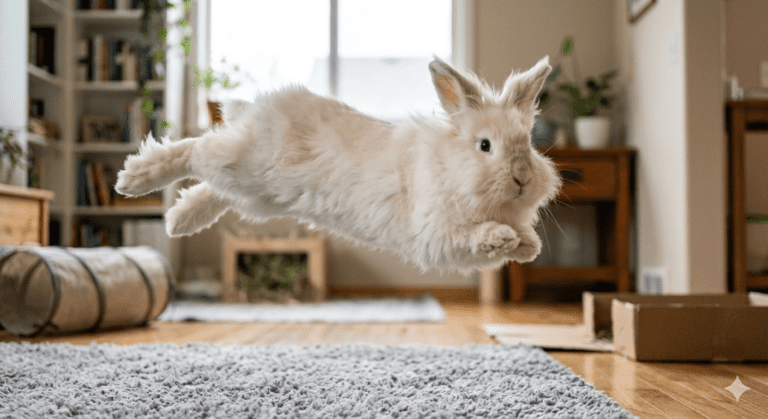
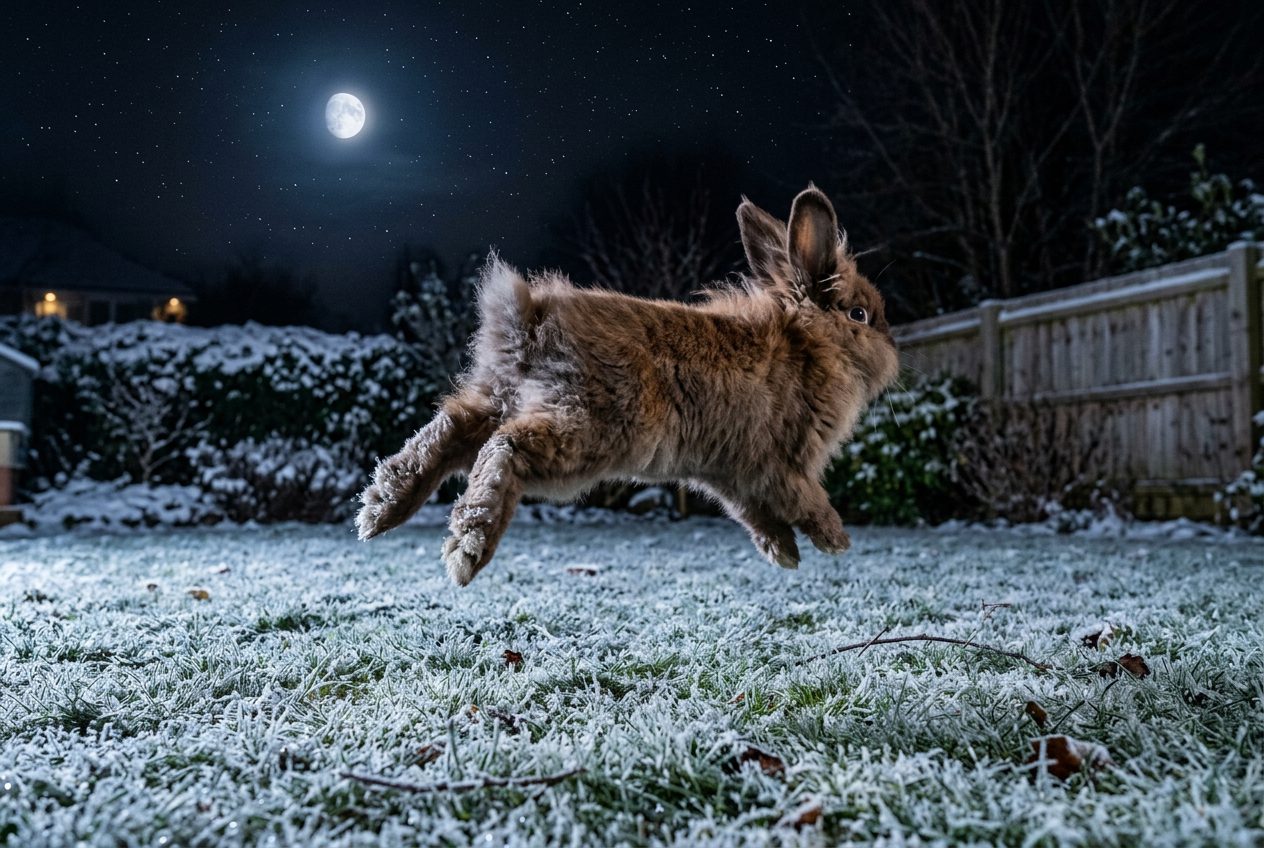
A binky is a sudden, explosive leap into the air accompanied by a mid-air twist of the body, a kick of the hind legs, or both. It is the most unambiguous expression of happiness and excitement in the rabbit behavioral repertoire. A rabbit that binkies is not startled or distressed — it is experiencing a surge of positive energy in a moment of play, freedom, or pleasurable anticipation.
Binkies are most commonly seen during free-roam time when the rabbit has space to run and express itself. Some rabbits binky frequently; others do so rarely, even when fully content. Frequency is individual — the presence of binkies matters more than their regularity.
The Flop
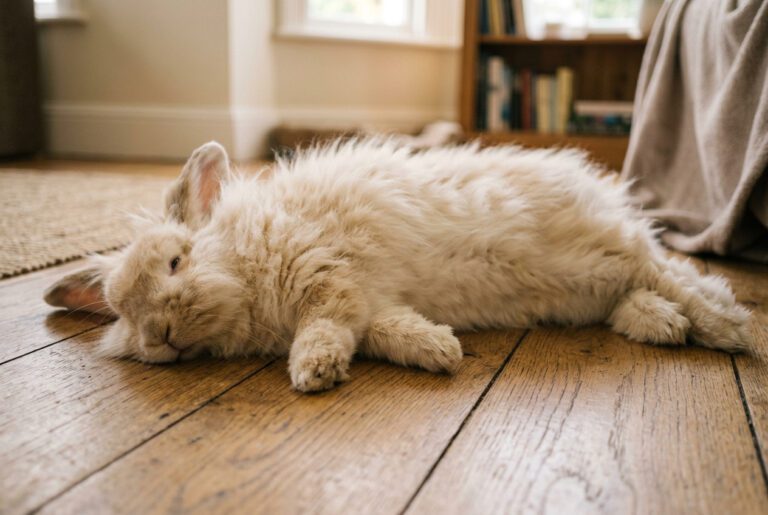
A flop is when a rabbit suddenly throws itself onto its side from a standing or sitting position, sometimes with apparent violence, landing motionless. New owners frequently panic at the first flop, believing the rabbit has collapsed. It has not — a flopped rabbit is completely relaxed and comfortable. The abruptness of the movement is simply a reflection of how thoroughly the rabbit has released muscular tension.
A flopped rabbit lying on its side with eyes open or slowly closing, body loose and sprawled, is expressing deep contentment. Do not disturb it unless necessary.
Tooth Purring (Soft Tooth Grinding)
Soft, rapid teeth grinding — sometimes called tooth purring or bruxism — produced while being petted or held is a contentment signal. It is distinctly different from the loud, grinding tooth chattering associated with pain. Tooth purring is quiet, regular, and accompanied by a relaxed body posture. It indicates the rabbit is calm and enjoying the contact.
Important distinction: Loud, irregular tooth grinding with a hunched posture and reluctance to move indicates pain — most commonly dental pain or GI discomfort. This requires a veterinary assessment. The two sounds are different enough in volume and context to be distinguished reliably with practice.
Nose Nudging
A rabbit that pushes its nose firmly against your hand, arm, or leg is requesting attention or petting. It is a direct, intentional social contact signal. In some individuals, it escalates to persistent nudging or light pawing if the request is ignored — the rabbit equivalent of tapping someone on the shoulder.
Chinning
Rabbits have scent glands under the chin and mark objects — and sometimes people — by pressing the chin firmly against a surface. Chinning is a territorial marking behavior that means “this belongs to me” in the rabbit’s social landscape. A rabbit that chins its enclosure furniture, its toys, and its owner is not being aggressive — it is incorporating these objects and individuals into its established territory. It is a sign of ownership and, when directed at the owner, a form of social bonding.
Grooming the Owner (Allogrooming)
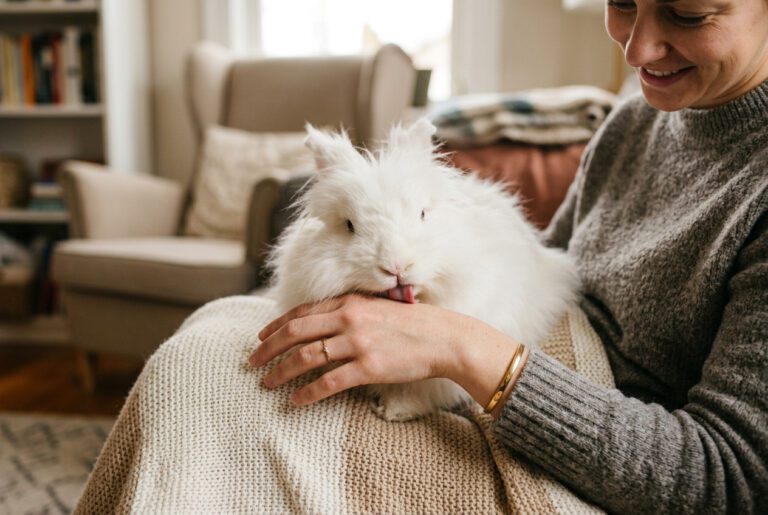
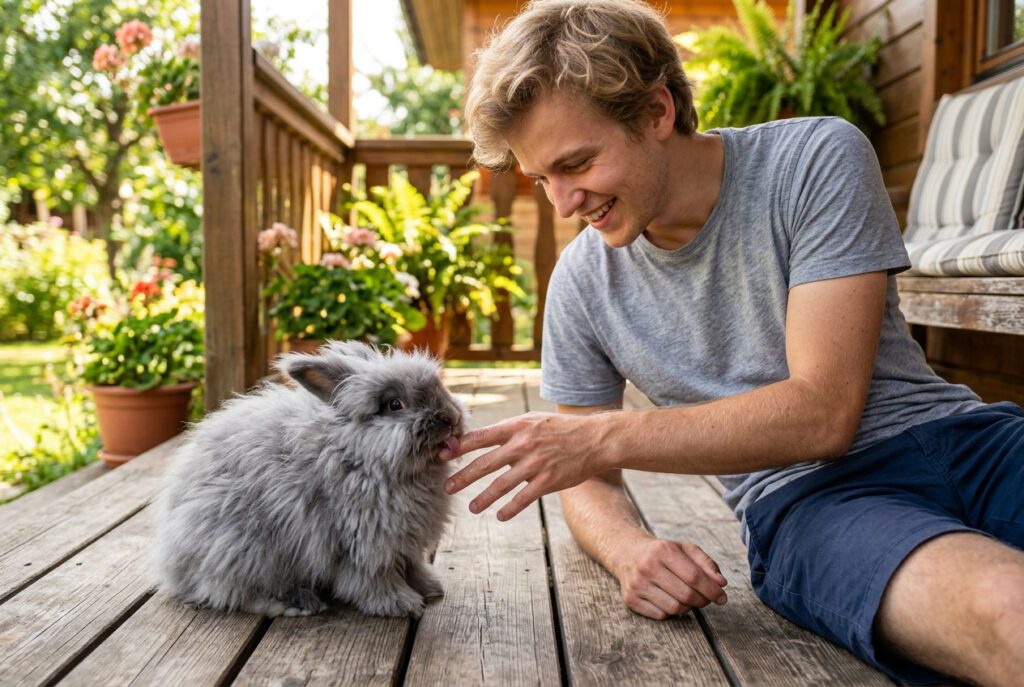
When a rabbit licks a person’s hand, wrist, or face, it is performing allogrooming — the mutual grooming behavior that rabbit groups use to reinforce social bonds. A rabbit that grooms its owner has accepted that person as a member of its social group. It is one of the strongest positive social signals a domestic rabbit can direct at a human.
Alert and Investigative Behaviors
These behaviors indicate a rabbit that is actively assessing its environment — neither distressed nor relaxed, but engaged and watchful.
The Periscope
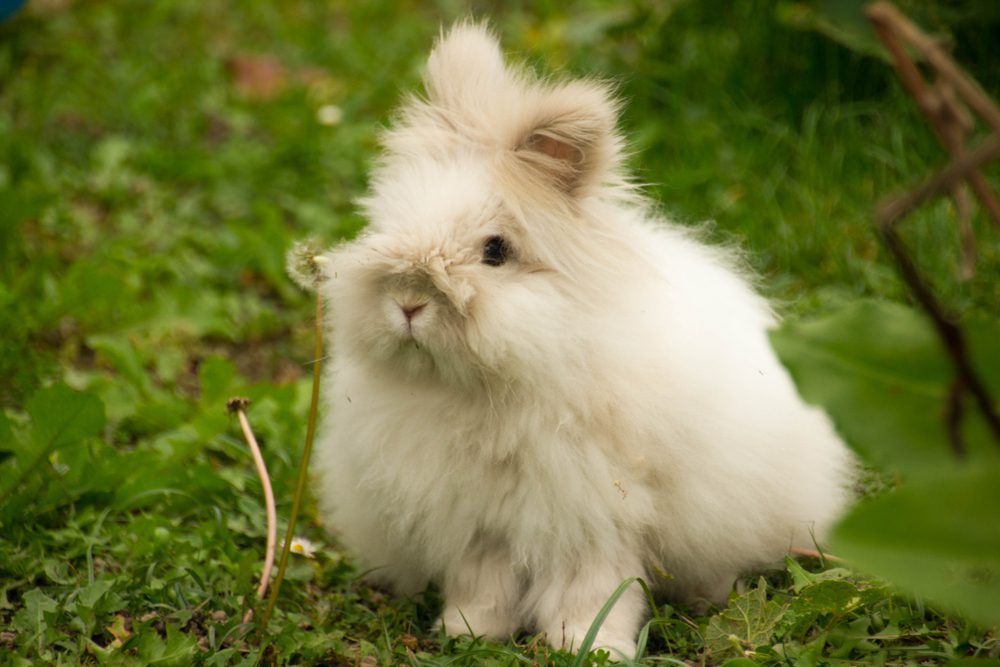
A rabbit that sits upright on its haunches with front legs off the ground and ears fully erect is in periscope posture — maximizing its height to extend its field of view and ear range. This behavior indicates heightened alertness in response to a new sound, smell, or movement. It is not fear — it is active investigation. The rabbit has detected something that requires assessment.
If the periscope is followed by relaxation and a return to normal behavior, the stimulus was assessed as non-threatening. If it is followed by thumping or flight, the assessment was negative.
Thumping
A thump is a single or repeated hard strike of both hind feet against the floor, producing a loud, resonant impact. In wild rabbits, thumping is a warning signal to other group members — it communicates “I have detected a threat.” In domestic rabbits, thumping is triggered by anything the rabbit perceives as alarming: a sudden loud noise, an unfamiliar smell, the presence of another animal, or a handler approaching in a way that feels threatening.
Thumping can also be a behavioral expression of displeasure — some rabbits thump in response to being returned to their enclosure, having their litter box cleaned in a way that disrupts their scent marking, or any change they find objectionable. In this context, it is communication of disapproval rather than alarm.
Owner response: Identify and address the trigger if possible. Do not punish thumping — it is communication, not misbehavior.
Freezing
A rabbit that stops all movement and holds completely still — sometimes for extended periods — has entered a threat assessment state. Freezing is an anti-predator response rooted in the prey animal’s instinct to avoid detection through stillness. In a domestic context, freezing can be triggered by an unfamiliar sound, a sudden movement, or being placed in an unfamiliar environment.
A frozen rabbit should not be forced to move, picked up abruptly, or approached rapidly. Speak in a low, calm voice and allow the rabbit to self-resolve. Most freezes end within a few minutes as the rabbit determines the stimulus is not an active threat.
Stress, Fear, and Pain Signals
These behaviors indicate a rabbit in a negative emotional or physical state. Recognizing them promptly is critical — chronic stress impairs immune function and digestive motility in rabbits, and changes in behavior are often the first sign of pain or illness.
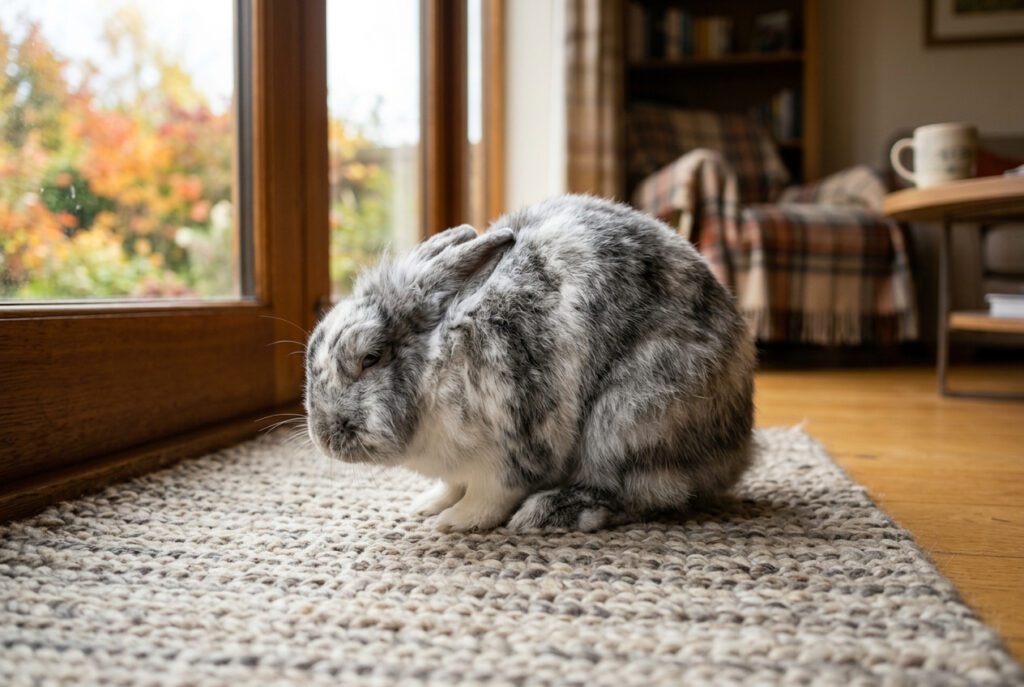
Hunching
A rabbit that sits hunched in a tight ball with its spine rounded, weight on its front feet, eyes half-closed or wide, and ears back is in pain or significant discomfort. This is one of the most important pain postures to recognize. A hunched rabbit is not resting — the posture is tense, not relaxed. The difference between a comfortable sitting rabbit and a hunched rabbit is the tension in the back and the positioning of the weight.
A rabbit in a hunched posture that also shows reduced appetite, reduced droppings, or does not respond to normally interesting stimuli requires veterinary assessment the same day.
Pressing the Head Against a Surface (Head Pressing)
A rabbit that presses the top of its head against a wall, corner, or floor surface persistently is displaying a neurological warning sign. Head pressing is associated with Encephalitozoon cuniculi (E. cuniculi) infection or other conditions affecting the central nervous system. It is not a normal behavior under any circumstances. Contact a rabbit-experienced veterinarian the same day this behavior is observed.
Tooth Chattering (Pain Grinding)
Loud, irregular grinding of the teeth — distinguishable from the quiet tooth purring of contentment — indicates pain. It is commonly associated with dental disease, GI stasis, bladder sludge, and post-surgical discomfort. A rabbit grinding its teeth loudly while sitting hunched is a veterinary emergency.
Aggression: Lunging, Biting, and Growling
A rabbit that lunges at a hand or person approaching its enclosure, growls, grunts, or bites is communicating a territorial boundary. This behavior is significantly more common in intact (unspayed/unneutered) rabbits and typically reduces dramatically after spay or neuter surgery. In spayed or neutered rabbits, persistent aggression usually has an identifiable trigger: enclosure intrusion during a perceived vulnerable moment, rough or sudden handling, or pain-related defensive behavior.
Owner response: Do not respond to a lunge or growl by withdrawing suddenly — this reinforces the behavior. Approach calmly and consistently, establish trust through positive handling sessions on the rabbit’s terms, and consult a veterinarian if aggression in a spayed or neutered adult is sudden-onset — pain is frequently the underlying cause.
Excessive Grooming or Self-Barbering
A rabbit that grooms excessively — particularly one that removes its own wool, leaving bald patches on accessible areas of the body — is displaying a stress-related stereotypy. Self-barbering in Angora rabbits indicates chronic stress from housing conditions, social isolation, insufficient environmental enrichment, or chronic pain. It is not a normal variation of grooming behavior.
Owner response: Assess housing for space, enrichment, and social contact adequacy. If self-barbering continues after environmental improvements, consult a veterinarian to rule out pain and a rabbit behavior specialist for additional assessment.
Social and Bonding Behaviors
Circling
A rabbit that runs rapid circles around a person’s feet is displaying a combination of excitement, attention-seeking, and, in intact rabbits, courtship behavior directed at the owner. In spayed and neutered rabbits, it is primarily attention-seeking and excitement — the rabbit wants engagement. In intact rabbits, it is frequently accompanied by honking vocalizations and may transition to mounting behavior.
Mounting
Mounting — the attempt to ride another rabbit or a person’s arm or foot — is performed by both bucks and does and is primarily a dominance behavior rather than exclusively a sexual one. In intact rabbits, it is driven by hormonal impulses. In spayed and neutered rabbits, it indicates an attempt to establish social hierarchy. It is not a cause for alarm, but should be redirected consistently to avoid reinforcement as a default social interaction.
The Tooth Purr During Grooming Sessions
Angora rabbits that have been consistently and gently groomed from a young age frequently produce the soft tooth-purring sound during grooming sessions, particularly when working on areas they find comfortable — typically the back and sides. This is among the most rewarding behavioral feedback available to an Angora rabbit owner: it indicates the rabbit has associated the grooming process with positive experience rather than restraint and stress. Building toward this outcome requires gradual habituation starting from the rabbit’s first weeks.
Environmental Enrichment and Behavioral Health
A rabbit with insufficient environmental enrichment develops behavioral problems regardless of how attentively its other needs are met. Boredom in domestic rabbits manifests as destructive chewing, aggression, repetitive circling or pacing (stereotypies), and self-barbering. These are not character flaws — they are behavioral symptoms of an impoverished environment.
Minimum enrichment for Angora rabbits:
- Foraging opportunities — hay presented in a rack or hay net rather than loose on the floor; fresh leafy greens placed in different locations within the free-roam area
- Chewing materials — untreated willow, apple, or hazel branches; cardboard boxes and tubes; commercially produced rabbit chew toys
- Spatial complexity — tunnels, hide boxes, ramps, and platforms that allow the rabbit to choose different levels and enclosed spaces
- Social interaction — daily direct interaction with the owner through handling, grooming, and floor-level engagement
- Novelty — periodic rotation of enrichment items to maintain investigative interest
For Angora rabbits specifically, the grooming session itself — when approached correctly and built into a positive experience — functions as enrichment. It involves direct physical contact, the rabbit’s active participation through positional cooperation, and a consistent routine that many individuals clearly anticipate and value.
Related reading: are rabbits friendly and why rabbits flop.
FAQs
What does it mean when an Angora rabbit thumps?
Thumping is a warning or disapproval signal. A thump in response to a sudden noise or unfamiliar presence means the rabbit has detected something it perceives as a threat. A thump in response to being returned to the enclosure or having something changed in its environment is an expression of displeasure. Identify the trigger and address it where possible. Thumping is communication, not misbehavior, and should never be punished.
Why does my Angora rabbit suddenly flop over on its side?
A flop is a contentment behavior — one of the strongest indicators that a rabbit feels completely safe and relaxed. The sudden, dramatic quality of the movement startles many new owners, but a flopped rabbit is not in distress. It has simply released all muscular tension at once. Leave it undisturbed.
What does it mean when my rabbit grooms me?
Allogrooming — licking the owner’s hand, wrist, or face — is a social bonding behavior. In rabbit social groups, mutual grooming reinforces group bonds. A rabbit that grooms its owner has accepted that person as a member of its social group. It is the clearest positive social signal a domestic rabbit directs at a human.
Why is my Angora rabbit aggressive toward me?
Aggression in rabbits most commonly has one of three causes: hormonal behavior in intact animals (resolved by spaying or neutering), territorial defense of the enclosure (approach from the side rather than above, avoid reaching directly into the enclosure), or pain-related defensive behavior in a previously non-aggressive rabbit (requires veterinary assessment). Sudden-onset aggression in a previously calm spayed or neutered adult rabbit is a pain indicator until proven otherwise.
What is a binky, and what does it mean?
A binky is a sudden airborne leap with a mid-air twist or kick of the hind legs. It is the most unambiguous expression of happiness and excitement in the rabbit behavioral repertoire. A rabbit that binkies is at ease, comfortable in its environment, and experiencing positive emotional arousal. It is one of the most satisfying behaviors to observe in a well-kept Angora rabbit.
How do I know if my Angora rabbit is in pain?
The primary behavioral indicators of pain in rabbits are: hunched posture with a rounded spine and weight on front feet; loud, irregular tooth grinding; reluctance to move; reduced or absent appetite; reduced droppings; and pressing the head against surfaces (which indicates neurological involvement). A rabbit showing any combination of these signs requires veterinary assessment the same day.
Conclusion
Angora rabbit behavior is a coherent, consistent communication system that becomes increasingly readable with observation and experience. Most behaviors in this guide have a usual meaning, though context and the individual rabbit matter — the binky usually means happiness, the hunch usually signals pain or discomfort, the flop usually means contentment, and the thump usually means alarm or displeasure.
Owners who learn this vocabulary respond more accurately to their rabbit’s needs, catch health problems earlier when behavioral changes signal physical distress, and build the trust that makes grooming — the most intensive regular interaction in Angora rabbit care — a positive experience for both rabbit and owner.
For how behavioral understanding connects directly to the grooming relationship, see our Angora Rabbit Grooming guide. For the litter training process that builds on the territorial and routine-based behaviors described here, see our How to Litter Train an Angora Rabbit guide. For the full care framework that supports behavioral health, see our Angora Rabbit Care Guide.
The information in this article is for general educational purposes and does not constitute veterinary advice. For any behavioral change that may indicate illness or pain, contact a rabbit-experienced veterinarian. See our disclaimer for full details.
Sources
- House Rabbit Society. Rabbit Lingo, checked October 2026.
- University of Michigan. Pain Assessment in Rabbits, checked October 2026.
- PDSA. Creating the ideal home for your rabbits, checked October 2026.
This guide is for general information and is not a substitute for advice from a vet. Read our disclaimer.