Why Do Rabbits Flop? The Complete Answer for Rabbit Owners
How we researched this guide: In October 2026 we checked the facts in this article against Petplan, The Unusual Pet Vets, Rabbit.org and Wabbitwiki, and corrected or removed anything we could not verify. Our sources are listed at the end. See our editorial policy. Last reviewed: October 2026.
Quick answer: A flop is when a rabbit suddenly rolls onto its side to rest. It usually means the rabbit feels safe and relaxed. A happy flop is quick, and the rabbit gets up normally. If a rabbit cannot lift its head or stand up, that is an emergency, so call a vet.
If you have ever watched your rabbit suddenly throw itself sideways and collapse onto the floor with apparent lifelessness — sometimes with eyes half-closed, legs outstretched, and body completely motionless — you may have experienced the brief, panicked certainty that something is terribly wrong. Then you noticed the slow, relaxed breathing. Then the rabbit opened one eye, confirmed you were watching, and continued not moving.
That is called a flop. It is not a medical emergency. It is the opposite — it is your rabbit communicating that it feels so safe, so content, and so completely at ease in its environment that it is willing to make itself completely physically vulnerable without any concern whatsoever.
This complete guide covers exactly what a flop is, why rabbits do it, the different types, what the flop communicates in a prey animal context, what triggers it, why some rabbits never flop, and — critically — how to tell the difference between a happy flop and a genuine medical collapse that requires immediate veterinary attention.
What Is a Rabbit Flop?
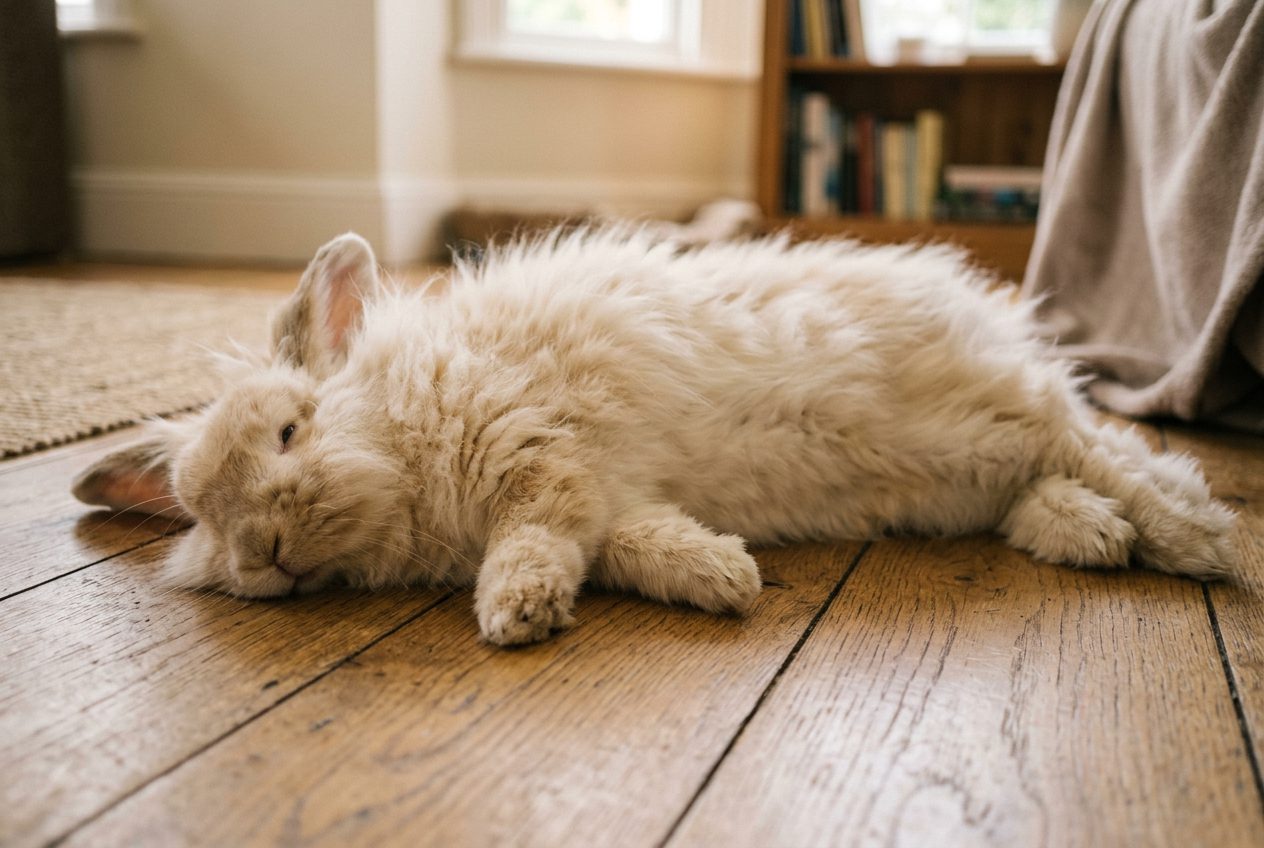
A flop is when a rabbit drops suddenly onto its side from a standing, sitting, or moving position — typically with a degree of drama that appears completely inconsistent with the casual, relaxed state the rabbit was in a moment before. The movement is fast and deliberate. The rabbit does not lie down gradually, the way a dog or cat settles. It simply goes from upright to horizontal, often with enough force that a small thud is audible on the floor.
Once flopped, the rabbit typically:
- Lies completely on its side with legs extended or loosely tucked
- Closes its eyes partially or fully
- Shows a still, deeply relaxed body — no muscle tension, no alertness
- Breathes slowly and evenly
- May twitch slightly as it drifts toward sleep
- May allow the whites of the eyes to become partially visible as the eye muscles relax
The rabbit is not unconscious. It is not in distress. It is in a state of deep physical relaxation that, in prey animal terms, represents the maximum possible expression of felt safety. Understanding why this matters requires understanding what rabbits are.
Why Rabbits Flop: The Prey Animal Context
Rabbits are prey animals. Every behavioral system they have evolved over millions of years is calibrated around one priority: not being caught and killed. This shapes everything — their near-panoramic vision, their explosive acceleration, their extraordinary hearing, their instinct to freeze rather than vocalize, and their default body posture.
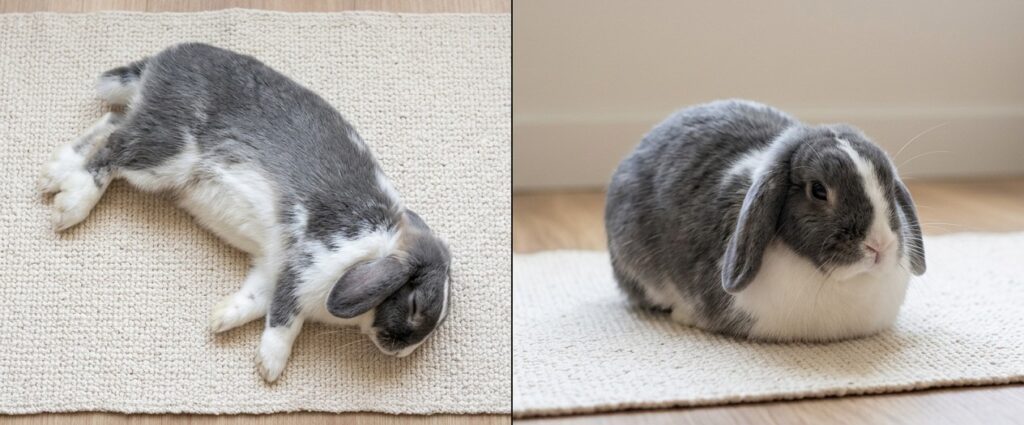
The default resting posture of a prey animal that is merely resting but still monitoring for threats is a loaf — the rabbit sits with feet tucked under its body, weight distributed for rapid departure, and sensory systems active. Even a resting rabbit in a loaf position can be airborne and running within a fraction of a second.
A flopped rabbit has abandoned this posture entirely. It has exposed its belly — the most vulnerable part of its body, where the organs are unprotected by the spine and ribcage. Its legs are extended in a position from which rapid escape is not possible. Its eyes are partially or fully closed, reducing visual monitoring of the environment. Every survival mechanism has been voluntarily suspended.
For an animal wired at every level for predator avoidance, this is not a casual choice. It is the behavioral equivalent of putting down every defensive instrument and declaring complete trust. When your rabbit flops near you — or in your presence — it is communicating that it perceives you as safe, your home as safe, and its current situation as so thoroughly non-threatening that the survival posture is simply not necessary.
A rabbit that flopped during an interaction with you has just given you an extremely high rating as a keeper.
The Different Types of Rabbit Flop
The Classic Dead-Drop Flop
The most dramatic version — the rabbit is moving or sitting, gives no warning, and simply drops sideways onto the floor with enough force to make a noise. New owners frequently mistake this for a seizure, a sudden injury, or cardiac arrest. The dramatic speed and apparent absence of warning make it alarming until the context is understood.
The classic dead-drop flop typically occurs during or immediately after a peak positive experience — free-roam time, a favorite treat, a grooming session, owner interaction, or simply a moment of spontaneous contentment. It is the physical culmination of a relaxation arc — the rabbit has been in a positive state, that state has peaked, and the body expresses it by releasing all held tension at once.
The Gradual Melt Flop
Less dramatic — the rabbit transitions from a loaf position through a slow sideways lean into a full side-lying position over several seconds. Often preceded by a few slow head bobs or a characteristic side-to-side look as the rabbit assesses the environment one final time before committing to vulnerability. The gradual melt flop is more common in older rabbits and in rabbits that are settling into sleep rather than expressing peak contentment.
The Roll Flop
The rabbit begins on its side and continues rolling slightly as it settles — sometimes briefly exposing its belly before rolling back to a side-lying position. Some rabbits make a soft tooth-purring sound of contentment. Loud tooth grinding is different and can signal pain. The roll flop is particularly associated with post-grooming relaxation and may follow a calm, positive grooming session.
The Mini Flop
A partial flop — the rabbit leans sideways to approximately 45 degrees and then holds that position rather than completing the full drop. Often seen in rabbits that are content but not fully committed to complete vulnerability, or in rabbits in new environments where they are relaxing but not yet at maximum trust level. The mini flop is a positive signal — it means the rabbit is moving in the right direction toward full relaxation in its environment.
What Triggers a Rabbit to Flop?
The flop is triggered by a peak of felt safety and contentment. The specific circumstances most commonly associated with flopping include:
Post-activity relaxation: Free-roam time that has been satisfying — adequate space, interesting exploration, physical movement — often ends with a flop. The rabbit has expended energy in a positive context, and the body’s relaxation response follows.
Post-feeding contentment: Immediately after a satisfying hay session, a favorite treat, or a particularly good leafy green portion. The digestive comfort that follows adequate eating is a reliable flop trigger in many rabbits.
Owner presence: Many rabbits flop specifically in proximity to their owner — within the owner’s visual field, sometimes directly against the owner’s leg. This targeted proximity during flopping is among the clearest possible behavioral signals that the rabbit has bonded with the owner. The rabbit is not coincidentally flopping near you — it is choosing you as the safe anchor point in its environment.
Post-grooming relaxation: Particularly relevant for Angora rabbit owners. A rabbit that has been groomed with correct technique — starting on the underside, never exceeding tolerance, paired with positive reinforcement — often flops within minutes of the session ending. This is the rabbit communicating that the grooming experience was positive rather than stressful. See our Angora Rabbit Grooming guide for the technique that produces this response.
Ambient warmth and comfort: Rabbits in comfortably warm environments — not hot, which produces a different posture — sometimes flop on cool surfaces like tile or hardwood floor in a regulated temperature-seeking behavior. This warmth-related flop typically involves the rabbit stretching fully extended to maximize contact surface area with the cool floor.
Seemingly no trigger at all: Like the spontaneous binky, some flops appear to have no specific trigger — the rabbit simply reaches a contentment threshold and expresses it. This spontaneous flopping is among the strongest possible welfare indicators — it means the rabbit’s baseline contentment level is high enough to produce unprompted expressions of deep relaxation.
Why Does the Flop Look So Dramatic?
The alarming quality of the rabbit flop — particularly the dead-drop version — is a direct consequence of the prey animal’s physical design. Rabbits do not have a gradual transition from alert to relaxed, the way many predator species do. The survival value of the alert posture is its readiness — a rabbit half-committed to alertness is less safe than a fully alert rabbit. Similarly, full relaxation is an all-or-nothing state for a prey animal. The transition from monitoring to trusting is fast, and the physical expression of that transition is correspondingly sudden.
The result is a behavior that looks, to human eyes accustomed to the gradual settling of dogs and cats, like something has gone suddenly and badly wrong. Once the behavior is understood in its prey animal context, it reads completely differently — as one of the more emphatic positive statements a rabbit makes.
The Flop in Angora Rabbits: What Owners Need to Know
Reading the Flop Through the Coat
The same challenge that applies to reading binkies in Angora rabbits applies to reading flops — the dense wool coat obscures the body posture signals that make the flop immediately identifiable in short-haired breeds. Specifically:
A flopped English or French Angora can appear simply to be an unusually flat pile of wool rather than a rabbit lying on its side. The legs, which are the most visually obvious indicators of the side-lying position in short-haired breeds, may not be visible through the coat at all.
New Angora rabbit owners should learn to identify a flop by:
- The sudden change in the rabbit’s body silhouette from a rounded upright to a flat horizontal
- The absence of the characteristic nose twitch that continues even in a resting but alert rabbit, a deeply flopped rabbit will slow or stop nose twitching
- The relaxed ear position — flat to the side rather than upright or angled
- The absence of any response to quiet movement in the room — a flopped rabbit may not react to you moving gently nearby
The Post-Grooming Flop as Feedback
For Angora rabbit owners specifically, whether the rabbit flops after a grooming session is one of the most useful behavioral feedback signals available. A rabbit that consistently flops within a few minutes of a grooming session ending has associated grooming with a positive experience. A rabbit that retreats to the furthest corner of its enclosure after being put down following grooming has associated grooming with something to escape from.
Tracking this simple indicator over time — does the rabbit seek proximity and relax after grooming, or does it seek distance — tells you more about whether your grooming approach is working than almost any other observable signal.
What If My Rabbit Never Flops?
A rabbit that does not flop is not necessarily unhappy. Several factors reduce or eliminate flopping without indicating any welfare problem:
Personality: Some rabbits are constitutionally more watchful than others. A rabbit with a naturally alert, high-vigilance temperament may express contentment through other signals — voluntary approach to the owner, tooth purring during petting, settling into a loaf position near its owner — without ever performing dramatic flops. This is individual variation, not a welfare indicator.
Age: Senior rabbits often reduce flopping as joint mobility decreases. A rabbit over six years of age may find the drop-and-recover movement physically less comfortable and may express relaxation through extended loafing instead. This is a normal age-related behavioral change.
Environment: A rabbit that has not yet fully habituated to its living space — a recently rehomed rabbit, a rabbit that has been moved to a new room, a rabbit whose environment has changed significantly — will typically not flop until it has re-established its sense of environmental security. The flop requires complete trust in the environment. Give recently rehomed rabbits time, often several weeks, before expecting to see flops in a new setting.
Enclosure size: A rabbit that spends most of its time in a small enclosure may not have established a strong enough association between its living space and full safety to flop there. Rabbits are more likely to flop in larger, more explored spaces where they have confirmed the absence of threats through repeated safe experience.
How to Tell a Happy Flop From a Medical Emergency
This is the most important section of this guide. The happy flop and several genuine medical emergencies can look superficially similar to an owner who has not seen both. The distinction is critical and can be the difference between a moment of appreciation and a life-saving veterinary call.
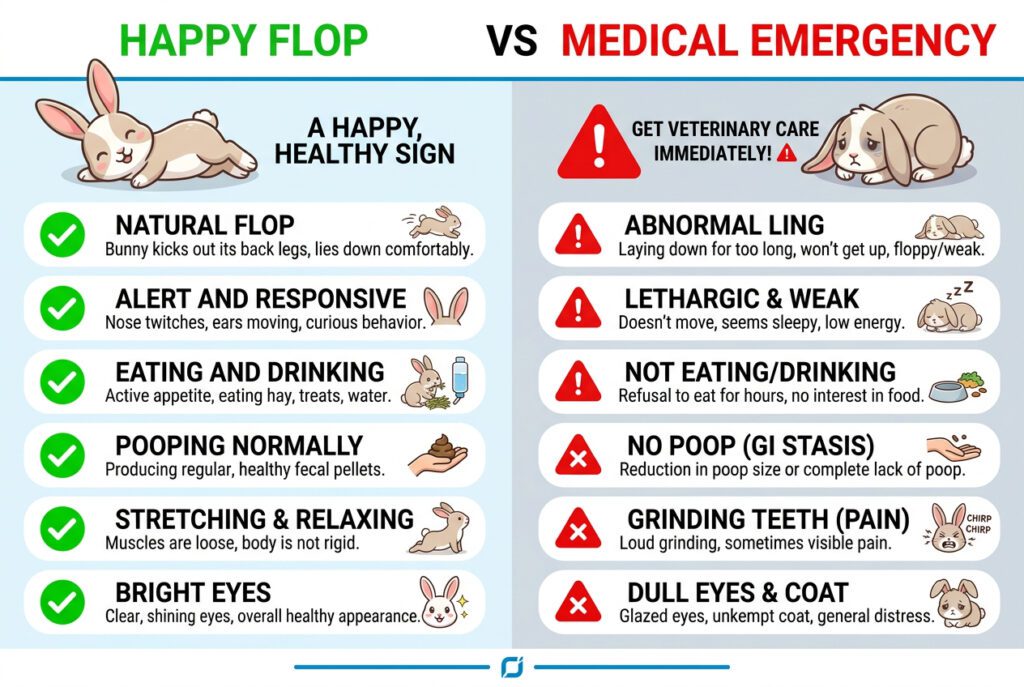
The Happy Flop — Checklist
All of the following should be present:
- The rabbit was in a normal, positive state immediately before the flop
- The drop was sudden and deliberate — not a gradual loss of control
- The rabbit is breathing normally — steady, even, visible chest movement
- Nose twitching, even if slow, is present or restarts within seconds
- The rabbit responds to a gentle sound or touch — it may be reluctant, but it can right itself
- When disturbed, the rabbit stands up and moves normally
- The rabbit resumes normal behavior — eating, grooming, exploring — within minutes
Emergency Warning Signs — Contact a Vet Immediately
Any of the following in combination with a rabbit lying on its side, requires immediate veterinary contact:
- The rabbit cannot right itself when disturbed — it tries but cannot stand
- Head tilt present — the head is persistently rotated to one side, and the rabbit cannot correct it
- Eye rolling (nystagmus) — rapid, uncontrolled eye movement
- Labored, irregular, or absent breathing
- The rabbit was not in a positive state before going down — it was huddled, hunched, or inactive
- Complete absence of response to touch or sound
- The rabbit went down gradually over minutes rather than in the sudden characteristic drop of a normal flop
- Loss of bladder or bowel control during the episode
- The rabbit has been unwell, not eating, or producing reduced droppings in the hours or days before this episode
Floppy Rabbit Syndrome — What Every Rabbit Owner Must Know
Floppy Rabbit Syndrome (FRS) is a genuine veterinary emergency that is occasionally confused with a dramatic normal flop by owners who have not seen it before. It is not the same thing as a happy flop. The distinction is critical.
FRS presents as acute-onset generalized muscle weakness — the rabbit loses the ability to stand, hop, or lift its head. Unlike a happy flop, the rabbit with FRS cannot right itself, does not respond normally to stimulation, and shows a progressive inability to move that is clearly distressing. Associated causes include Encephalitozoon cuniculi infection, low calcium, low potassium, spinal cord damage and toxins, though often no single cause is found.
The practical distinction from a happy flop in a single observation:
| Feature | Happy Flop | Floppy Rabbit Syndrome |
|---|---|---|
| Onset | Sudden, deliberate | May be gradual over hours |
| Context | During/after positive state | No positive context — rabbit was already quiet |
| Response to touch | Moves, rights itself readily | Cannot right itself — weakness is apparent |
| Head position | Normal | May show head tilt or be unable to lift the head |
| Eye appearance | Normal, may be half-closed | May show nystagmus or abnormal gaze |
| Recovery | Stands and moves normally within seconds | Does not recover independently |
| Breathing | Normal | Maybe labored |
If you have any doubt, contact a rabbit-experienced veterinarian immediately. A happy flop does not need a vet call. A rabbit that cannot stand up absolutely does.
The Flop as a Welfare Indicator
For Angora rabbit owners who monitor their animals daily as part of the fiber production routine, flop frequency is one of the most useful informal welfare indicators available. A rabbit that flops regularly — several times per week during free-roam time, after feeding, near its owner — is a rabbit operating at a high baseline welfare level. A rabbit that has never flopped, or that previously flopped regularly and has stopped, is worth watching more carefully.
Sudden cessation of flopping, particularly combined with reduced activity, change in droppings, or decreased appetite, is an early behavioral indicator that something is wrong. The flop requires the rabbit to feel completely safe. Anything that disrupts that feeling — pain, illness, environmental stress — will suppress it before obvious clinical signs develop.
FAQs
Why do rabbits flop so dramatically?
The dramatic quality of the rabbit flop is a direct consequence of prey animal behavioral design. Rabbits do not have a gradual alert-to-relaxed transition — the survival value of alertness requires full commitment. When a rabbit releases from alert posture into complete relaxation, it does so suddenly and completely, producing the characteristic dead-drop appearance that alarms new owners. It is not a cause for concern — it is the rabbit communicating maximum trust in its environment.
Is it normal for a rabbit to flop suddenly?
Yes. The sudden, apparently unprovoked flop is the most common form of the behavior. It typically reflects a peak of contentment following a positive experience — free-roam time, food, owner presence — and the suddenness is characteristic, not alarming. If the rabbit can be gently disturbed and stands up and moves normally, the flop was a normal behavioral expression.
Why does my rabbit flop near me specifically?
A rabbit that chooses to flop in your direct proximity, particularly against your leg or within arm’s reach, is using you as its safety anchor. It is expressing trust specifically directed at you — not just trust in the environment generally, but trust in you as a safe presence within it. This is one of the clearest bonding signals a rabbit makes toward a specific person.
Do Angora rabbits flop?
Yes. All five Angora breeds — English, French, Satin, Giant, and German — flop in the same way as short-haired breeds. The flop may be harder to identify through the dense wool coat since the body posture indicators are obscured, but the behavior is identical. Some well-handled Angora rabbits flop after grooming and are among the best available indicators that the grooming relationship is positive.
My rabbit flopped and its eyes rolled back slightly. Is this normal?
Often, yes, if the rabbit is otherwise relaxed and breathing normally. A deeply relaxed rabbit may partly close its eyes, and the inner eyelid can briefly show. If you are unsure, check that the rabbit wakes and moves normally when gently disturbed. It is alarming to see for the first time but is a sign of deep relaxation, not distress. If the eye rolling is persistent, rapid, and uncontrolled (nystagmus) and the rabbit cannot right itself, this is a different situation entirely — contact a veterinarian immediately.
How is a flop different from GI stasis collapse?
A rabbit in GI stasis does not typically flop in the normal sense. A rabbit experiencing severe GI pain typically adopts a hunched, tense posture — weight shifted forward, belly pressed toward the ground, eyes wide and anxious, nose twitching rapidly. A rabbit in a happy flop has a completely relaxed body, relaxed eyes, and normal breathing. If your rabbit is on its side and appears tense, distressed, or cannot right itself, this is a medical emergency. The happy flop involves complete body relaxation and the ability to recover immediately when gently disturbed.
Conclusion
The rabbit flop is one of the highest-value behavioral signals in the rabbit owner’s vocabulary — not because it is complex or subtle, but because of what it represents in the context of what rabbits are. A prey animal that abandons its survival posture and makes itself completely physically vulnerable in your presence is communicating something clear and unambiguous: it trusts you and it is happy.
For Angora rabbit owners, the flop takes on additional significance as a grooming feedback signal and a daily welfare indicator. A rabbit that flops regularly is a rabbit whose fundamental needs — space, safety, correct diet, positive social interaction, and appropriate grooming — are being met. Tracking flop frequency informally over time gives you one of the most sensitive behavioral welfare indicators available for an animal that is otherwise skilled at masking its condition.
The only thing to add is the medical literacy to know when a rabbit on its side is expressing joy and when it is in genuine trouble. The checklist in this article makes that distinction manageable. Once learned, it is never forgotten.
For the closely related behavior that often accompanies or precedes a flop, see our Why Do Rabbits Binky? guide. For the complete behavioral vocabulary of Angora rabbits, see our Angora Rabbit Behavior guide.
This article is for general educational purposes and does not constitute veterinary advice. If your rabbit cannot right itself, shows head tilt, or is unresponsive, contact a rabbit-experienced veterinarian immediately. See our disclaimer for full details.
Sources
- Petplan. Rabbit body language: How do I know if my rabbit is happy?, checked October 2026.
- The Unusual Pet Vets. Floppy Bunny Syndrome, checked October 2026.
- Rabbit.org. Gi Stasis – The Silent Killer, checked October 2026.
- Wabbitwiki. Understanding your rabbit, checked October 2026.
This guide is for general information and is not a substitute for advice from a vet. Read our disclaimer.