Are Rabbits Good Pets? The Honest Answer for 2026
Yes — rabbits are excellent pets for the right owners. They are intelligent, social, genuinely bonding companion animals that express affection, recognize their owners, have distinct personalities, and live 7 to 12 years. They are quiet, odor-controlled when litter-trained, and do not require outdoor exercise like dogs.
But rabbits are frequently acquired by people who expect a low-maintenance cage animal and discover a demanding, emotionally complex prey species whose needs are substantially greater than popular culture suggests. The third most popular pet species in the United States is also the third most euthanized animal in US shelters — a statistic that reflects an ownership expectation mismatch, not a flaw in the animal.
This article gives you the complete, honest answer: what rabbits are actually like as pets, what they genuinely require, who they are right for, and specifically what Angora rabbit ownership involves beyond standard rabbit care.
What Makes Rabbits Good Pets
Genuine Intelligence and Personality
Rabbits are cognitively more sophisticated than the typical cage-animal stereotype suggests. They can be litter trained reliably, learn to come when called, respond to their own names, solve spatial problems to access food or companionship, and develop strong individual preferences for certain people, locations, toys, and foods.
Individual rabbits have genuinely distinct personalities. Some are bold and exploratory — approaching everything new immediately, initiating contact, seeking attention. Others are more measured — observing from a distance before engaging, selective about who they approach. A rabbit that has been correctly socialized expresses its personality clearly and consistently.
Long Lifespan and Deep Bonding
At 7 to 12 years, a rabbit’s lifespan is longer than that of most small mammals typically kept as pets. A rabbit that arrives as a kit at 10 weeks of age will still be a companion when children in the household are teenagers. This longevity enables the kind of deep, sustained bonding that produces a genuinely meaningful human-animal relationship — not the brief ownership arc of shorter-lived small animals.
Quiet and Apartment-Compatible
Rabbits are almost entirely silent animals. They do not bark, meow, or vocalize in ways that disturb neighbors, wake household members, or create noise issues in apartment or condo living. The only sounds a rabbit regularly produces are the soft tooth-purring of contentment, the occasional thump of displeasure, and sometimes light grunt vocalizations. This makes rabbits compatible with living situations that exclude dogs or cats due to noise.
Litter-Trainable and Clean
A litter-trained rabbit — which most rabbits become within two to four weeks with correct training — confines its urination to a litter box and scatters dry fecal pellets in a limited area during free-roam time. Litter-trained Angora rabbits can be safely given free-roam access to rabbit-proofed rooms without creating hygiene problems. For the complete training guide, see our How to Litter Train an Angora Rabbit article.
No Outdoor Exercise Requirement
Unlike dogs, rabbits do not require outdoor walks or yard access for exercise and mental stimulation. Daily free-roam time in a rabbit-proofed indoor space — minimum one to two hours — provides adequate exercise. This makes rabbits appropriate for owners without outdoor access, particularly in urban environments.
What Rabbits Actually Require — The Honest Picture
Daily Time Investment
A rabbit kept as a companion requires a minimum daily time investment that surprises many prospective owners:
| Daily Care Task | Time Required |
|---|---|
| Morning feeding, hay check, water change | 10–15 minutes |
| Free-roam supervision | 1–2 hours |
| Litter box spot clean (every 1–2 days) | 5–10 minutes |
| Interaction and socialization | 30–60 minutes |
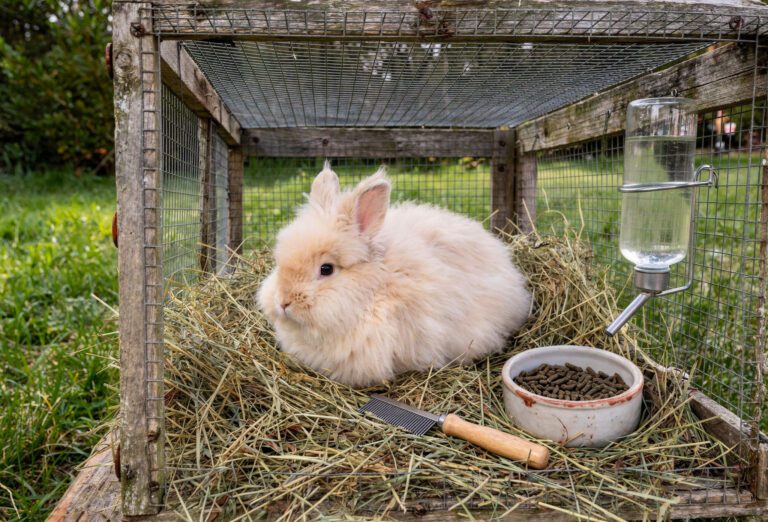
| Grooming (Angora breeds only) | 30–90 minutes, 2–3 times per week |
The free-roam supervision requirement is often underestimated. A rabbit that spends its entire life within an enclosure develops behavioral stereotypies — repetitive, purposeless behaviors indicating psychological distress from an impoverished environment. Daily enclosure exit time is not optional.
For Angora rabbit owners, the grooming sessions add a significant additional time commitment on top of standard rabbit care. See our Angora Rabbit Grooming guide for the full schedule.
Veterinary Care
Rabbits require a rabbit-experienced veterinarian — not all veterinary practices have rabbit-competent staff. Finding one before you need one is essential. Annual wellness examinations are the minimum standard; twice-yearly from age five onward as dental and systemic disease risk increases.
Veterinary costs for rabbits are comparable to those for cat ownership. A GI stasis emergency — the most common rabbit medical crisis — costs $200 to $1,500 depending on severity and location. A spay surgery for a doe costs $150 to $300. Budget for these eventualities before acquiring a rabbit.
Rabbit-Proofing
Free-roam time requires a rabbit-proofed space. Rabbits chew continuously — it is a physiological need for dental wear, not a behavioral problem to be corrected. They will chew electrical cords (immediately life-threatening), baseboards, furniture legs, books, and anything else within reach. Rabbit-proofing means:
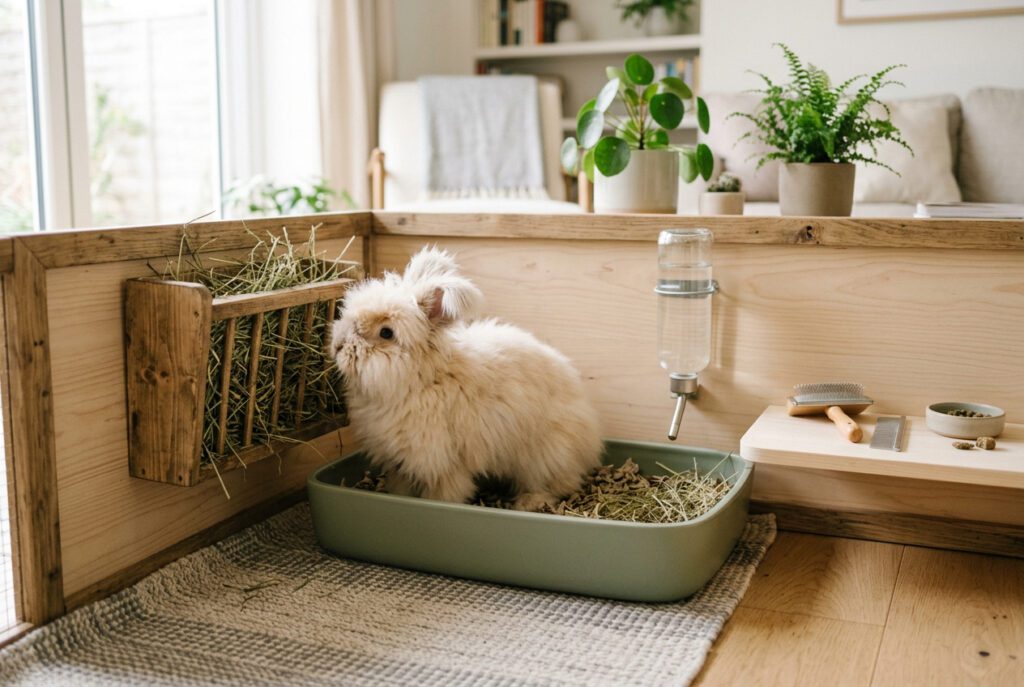
- All electrical cords are enclosed in plastic cable conduit or raised entirely out of reach
- Baseboards and furniture legs are protected with cord covers or physical barriers
- Toxic houseplants removed or placed entirely out of access range
- Open spaces under and behind furniture are either blocked or left fully accessible for retrieval
This is a one-time setup that, once completed, requires minimal ongoing attention.
Are Rabbits Good Pets for Children?
The nuanced answer: rabbits are good pets in households with children who are old enough to understand and consistently apply correct handling techniques — typically age eight and older. They are not appropriate as “starter pets” for young children for several specific reasons:
Prey animal stress response: Rabbits are prey animals. Being grabbed, restrained, or held forcefully triggers an acute stress response — elevated heart rate, muscle tension, and the panicked scrambling that frequently results in the rabbit falling, the child being scratched, and both parties being traumatized. This is not the rabbit being “mean” — it is a hardwired survival response to perceived capture by a predator.
Fragility: Rabbits have a light skeletal structure relative to their muscle mass. A rabbit dropped from a child’s arms, or one that scrambles free and falls from a height, can sustain fractures — including spinal fractures — that are life-threatening. The posterior spinal fracture from a dropped rabbit is one of the most common veterinary emergencies in young rabbit owners.
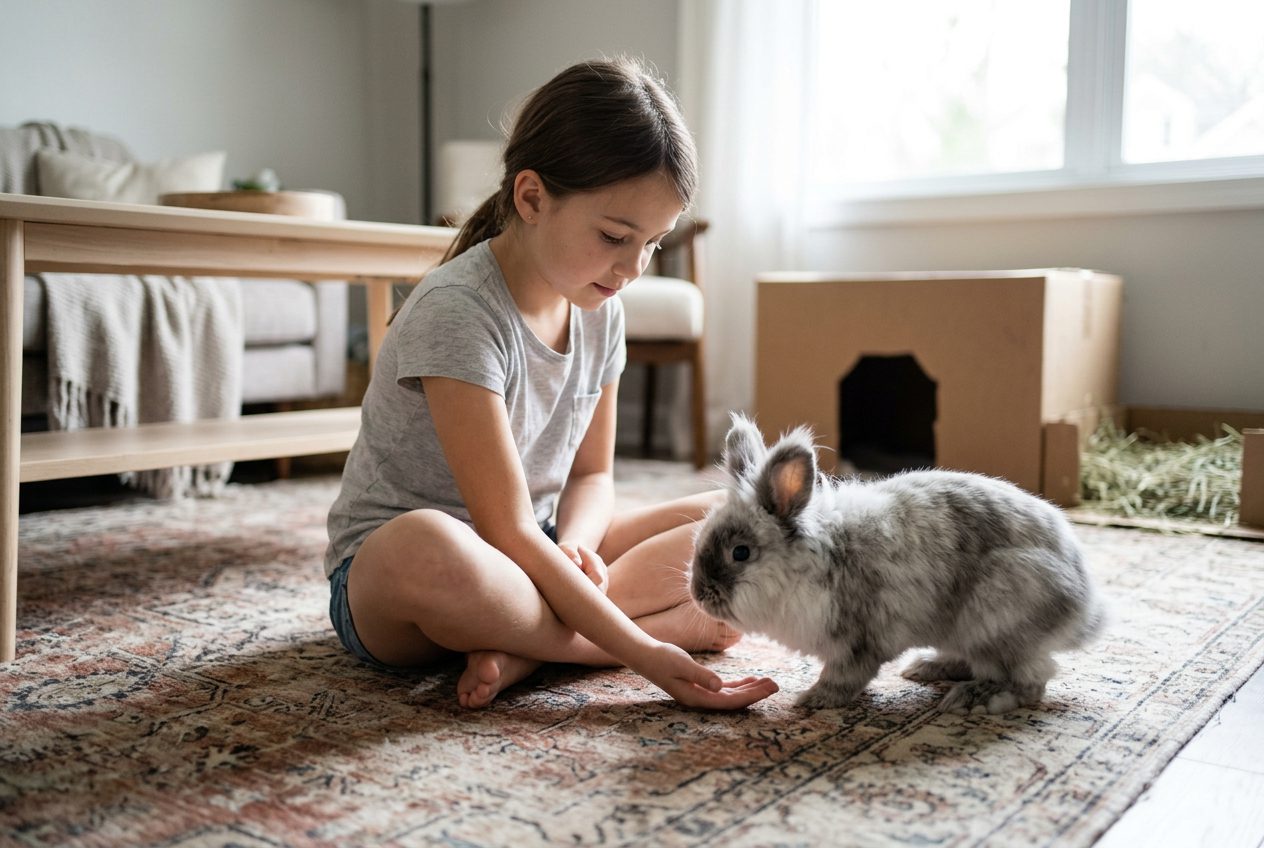
Correct handling requirement: Children under approximately eight years old typically lack the motor control and impulse management to consistently apply the correct handling technique — full body support from beneath, rabbit held against the body, no sudden movements. Until these skills are developed and reliable, all child-rabbit interactions should be at floor level, with the child sitting and the rabbit approaching voluntarily.
In households with children who are old enough to handle correctly and are taught the rabbit’s behavioral vocabulary — understanding what a thump, a flat posture, or a lunge communicates — rabbits are excellent family animals.
Are Angora Rabbits Good Pets, Specifically?
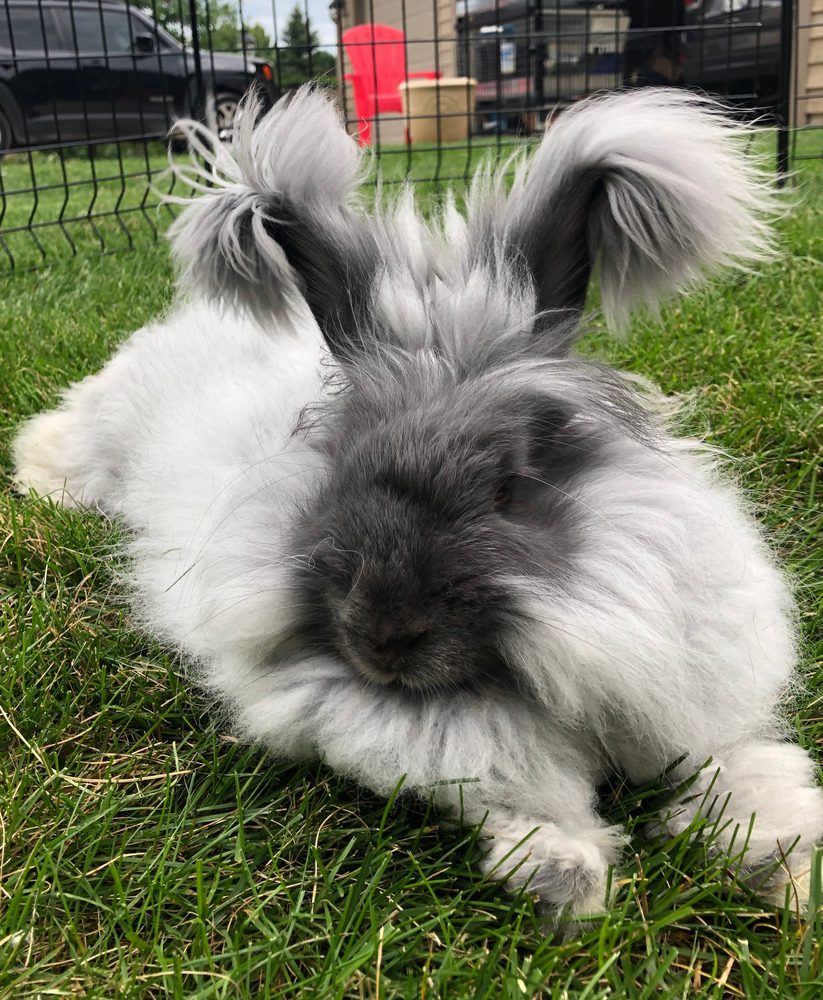
Angora rabbits are exceptional pets for owners who are fully informed about and committed to the grooming requirement. They have a reputation for calm, docile temperament — the French Angora particularly — and the grooming relationship, when built correctly, becomes a genuine bonding activity rather than a management task.
They are not good pets for:
- First-time rabbit owners who underestimate the grooming commitment before acquiring the animal
- Households where the primary caregiver travels frequently without reliable alternative grooming coverage
- Owners who expect a low-maintenance cage animal
- Households with very young children who cannot yet reliably apply the correct handling technique
They are excellent pets for:
- Fiber enthusiasts who want to spin or work with the fiber their rabbit produces
- Owners who find the grooming relationship itself rewarding
- Experienced rabbit owners adding a specialist breed
- Households that can make the consistent 2 to 3 grooming sessions per week commitment
The cost of Angora rabbit ownership — both financial and time — is documented in detail in our How Much Are Angora Rabbits guide.
Rabbits vs. Other Common Pets: Honest Comparison
| Factor | Rabbit | Cat | Dog |
|---|---|---|---|
| Lifespan | 7–12 years | 12–18 years | 8–15 years |
| Daily exercise requirement | Indoor free-roam 1–2 hrs | Indoor only possible | Outdoor walks required |
| Noise | Near-silent | Moderate | Significant |
| Apartment suitability | Excellent | Good | Variable |
| Veterinary complexity | Requires rabbit-specialist vet | Standard | Standard |
| Annual cost | $620–$1,370 | $500–$1,000 | $1,000–$3,000+ |
| Child suitability (under 8) | Requires supervision | Variable | Variable |
| Bonding depth | Strong — requires investment | Variable | Strong |
| Grooming (Angora breeds) | 2–3 sessions per week | Self-grooming | Variable |
FAQs
Are rabbits high-maintenance pets?
More than most people expect. They require daily interaction, supervised free-roam time, litter box maintenance, a precise diet built on unlimited hay, and annual veterinary care. Angora breeds add 2 to 3 grooming sessions per week of 30 to 90 minutes each. They are not cage animals — they are companion animals with significant social and physical care needs.
How long do pet rabbits live?
7 to 12 years with proper care. This is a decade-long commitment that should be planned for, including who will care for the rabbit if the primary owner’s circumstances change.
Can rabbits be left alone during the workday?
Yes — rabbits sleep during the middle of the day (crepuscular species) and manage well with an owner absent for a standard workday of 8 to 10 hours, provided they have unlimited hay, water, and adequate enclosure space. The critical need is the daily free-roam and interaction time before and after the owner’s absence.
Do rabbits smell?
A litter-trained rabbit in a clean enclosure cleaned every one to two days has minimal odor. The rabbit itself is a naturally clean, self-grooming animal. The odor associated with rabbit keeping almost always comes from neglected litter boxes or damp/soiled bedding — both preventable with correct management.
Are rabbits good first-time pets?
Rabbits are manageable as a first pet for owners who have thoroughly researched their requirements before acquisition. They are frequently a poor first pet for owners who acquire them impulsively based on their appearance, without understanding the care commitment. The high US shelter euthanasia rate for rabbits reflects this expectation gap more than any inherent difficulty with the species.
Are Angora rabbits good pets for apartment living?
Yes — their near-silence and lack of outdoor exercise requirement make them well-suited to apartment living. The grooming requirement can be managed in a small space. The primary consideration is ensuring adequate free-roam space within the apartment — one rabbit-proofed room is sufficient.
Conclusion
Rabbits are genuinely excellent pets — for owners who are informed, committed, and realistic about what the species actually requires. They are intelligent, long-lived, bonding, quiet, litter-trainable companions that adapt well to apartment and urban living and form deep relationships with their owners over a 7 to 12 year lifespan.
The ownership expectation gap that drives the high rabbit shelter surrender rate is entirely bridgeable with accurate information before acquisition. The rabbit in the shelter being surrendered by an overwhelmed owner and the rabbit happily binkying around its owner’s living room are the same species — the difference is preparation, not the animal.
For the complete guide to acquiring an Angora rabbit from a reputable source, see our Where to Buy an Angora Rabbit guide. For the full cost and time commitment picture, see our How Much Are Angora Rabbits guide.
This article is for general educational purposes. See our disclaimer for full details.