Short Haired Bunnies: The Best Breeds, Care Guide, and How They Compare to Angoras
Short-haired bunnies are the most commonly kept domestic rabbits in the United States. Their low-maintenance coats, manageable grooming demands, and wide availability make them the natural first choice for new rabbit owners, families, and apartment dwellers. The American Rabbit Breeders Association currently recognizes 53 rabbit breeds — the vast majority of which have short coats — giving prospective owners an exceptionally wide field to choose from.
This guide covers the seven most popular short-haired rabbit breeds in the US, their key characteristics, care requirements, and temperament. It also addresses one question that comes up regularly among people researching rabbits: how do short-haired breeds compare to Angoras, and who is each type best suited for?
All weight data and ARBA recognition information are sourced from the American Rabbit Breeders Association.
What “Short Haired” Means in Rabbit Breeds
Short-haired rabbit breeds carry one of three standard fur types recognized by ARBA:
Flyback fur is the most common type. When stroked against the direction of growth, flyback fur springs immediately back to its normal position. It is dense, close-lying, and very low-maintenance. The Dutch rabbit and New Zealand rabbit are classic flyback breeds.
Rollback fur returns to its normal position more slowly and gently when stroked against the grain — rolling back rather than flying back. Holland Lops are a well-known rollback breed.
Rex fur is a genetic mutation that shortens the guard hairs to the same length as the undercoat, producing a plush, velvety texture unlike any other rabbit coat. Mini Rex rabbits are the most common example. Rex fur feels distinctly different from flyback or rollback fur — the closest comparison is dense velvet or plush fabric.
All three coat types require only weekly brushing in normal conditions, with more frequent attention during seasonal shedding periods when loose fiber should be removed to prevent ingestion.

The 7 Best Short-Haired Rabbit Breeds for US Owners
1. Netherland Dwarf
- Weight: 1.1 to 2.5 pounds (0.5 to 1.1 kg) — one of the smallest rabbit breeds in the world
- ARBA recognized: Yes — since 1969
- Fur type: Normal flyback
- Grooming: Low — weekly brushing, more during seasonal molt
- Best for: Adults, apartment dwellers, experienced rabbit owners; not recommended for households with young children
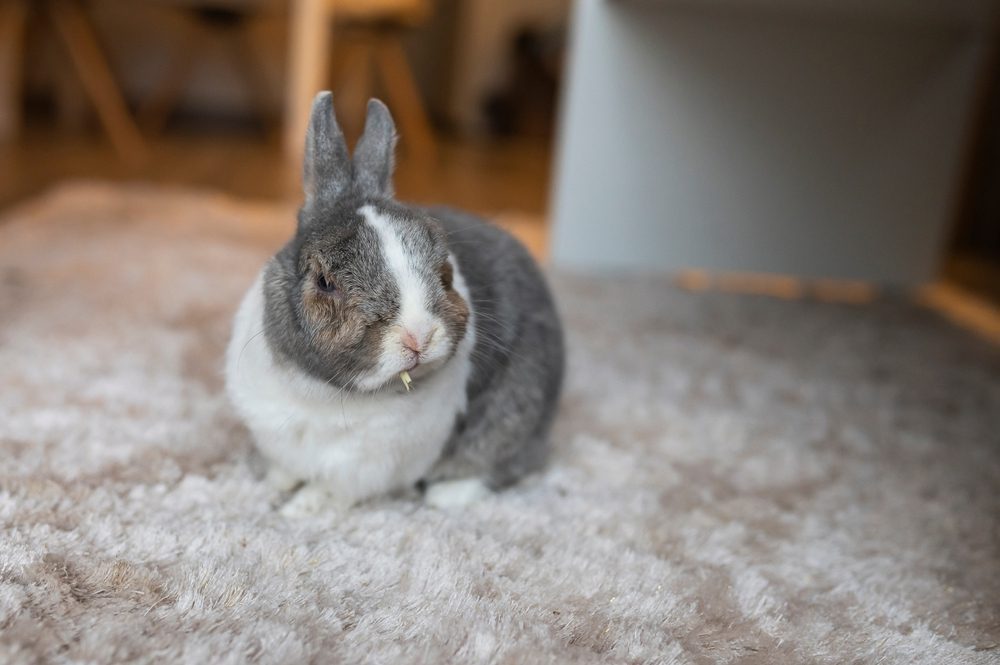
The Netherland Dwarf is one of the most recognizable rabbit breeds in the world, known for its compact body, disproportionately large round head, prominent wide-set eyes, and short upright ears. The rounded, baby-faced appearance is a result of the dwarf gene — the same gene that produces the compact proportions also produces a brachycephalic skull structure that gives the breed its characteristic look throughout its life.
Despite their small size, Netherland Dwarfs have active, inquisitive personalities. Early generations of the breed had reputations for nervous temperament due to their proximity to wild rabbit genetics, but decades of selective breeding have produced modern Netherland Dwarfs that are generally gentle and personable when properly socialized. They are intelligent, can be litter trained, and respond well to consistent, calm handling.
Their small bone structure means they are fragile and not well-suited to households with young children who may handle them roughly. They are excellent companions for adults and older children who understand proper rabbit handling.
The coat requires only weekly brushing and increased attention during the twice-yearly shed. It comes in more than 25 recognized color varieties across five color groups.
2. Dutch Rabbit
- Weight: 3.5 to 5.5 pounds (1.6 to 2.5 kg)
- ARBA recognized: Yes
- Fur type: Flyback
- Grooming: Low — weekly brushing
- Best for: First-time owners, families, children, apartment dwellers
The Dutch rabbit is among the most recognizable breeds worldwide due to its distinctive coat pattern — a white blaze on the face, white chest and front feet, and a solid color covering the back, sides, and rear. Despite the name, the breed actually originated in England. It is one of the oldest established rabbit breeds and one of the most consistently recommended for first-time rabbit owners by ARBA rabbit judges.
The Dutch is calm, friendly, intelligent, and easy to handle — qualities that make it genuinely suitable for households with supervised children. Its flyback coat needs only weekly brushing and produces minimal grooming challenges. It adapts well to indoor living and is generally tolerant of gentle handling and interaction.
The Dutch rabbit comes in six ARBA-recognized color varieties: black, blue, chinchilla, chocolate, gray, and tortoise — each combined with the characteristic white pattern.
3. Mini Rex
- Weight: 3 to 4.5 pounds (1.4 to 2 kg)
- ARBA recognized: Yes — since 1988
- Fur type: Rex — short, dense, velvety
- Grooming: Very low — the Rex coat does not require regular brushing
- Best for: First-time owners, families, and anyone who wants an exceptionally soft coat with minimal grooming
The Mini Rex is one of the most consistently recommended beginner rabbit breeds in the United States, and for good reason. Its defining characteristic — the Rex coat — is the softest of any short-haired rabbit breed, with a plush, velvety texture resulting from guard hairs that have been shortened to the same length as the undercoat. Running your hand over a Mini Rex’s coat is often compared to touching dense velvet.
The Rex coat is also one of the lowest-maintenance rabbit coats available. Because the guard hairs are short and close-lying, the coat does not mat, does not tangle, and requires no regular brushing outside of shedding periods. The trade-off is that the shortened guard hairs provide less protection to the rabbit’s hind feet, making Mini Rex more susceptible to sore hocks than breeds with longer guard hairs. Solid flooring or resting mats in the enclosure are important for this breed.
The Mini Rex has a friendly, calm temperament and is widely regarded as one of the most personable of all rabbit breeds. It is consistently one of the top five most popular breeds exhibited at ARBA shows and makes an excellent companion for virtually any household.
4. Holland Lop
- Weight: Maximum 4 pounds (1.8 kg)
- ARBA recognized: Yes — since 1979
- Fur type: Rollback
- Grooming: Low — weekly brushing
- Best for: First-time owners, families, apartment dwellers, anyone who wants a small, characterful companion
The Holland Lop is one of the most popular rabbit breeds in the United States and has consistently ranked among the top five ARBA show breeds for decades. Developed by Dutch breeder Adriann de Cock through crosses of French Lops and Netherland Dwarfs, it was recognized by the ARBA in 1979 and has remained among the most sought-after companion rabbits ever since.
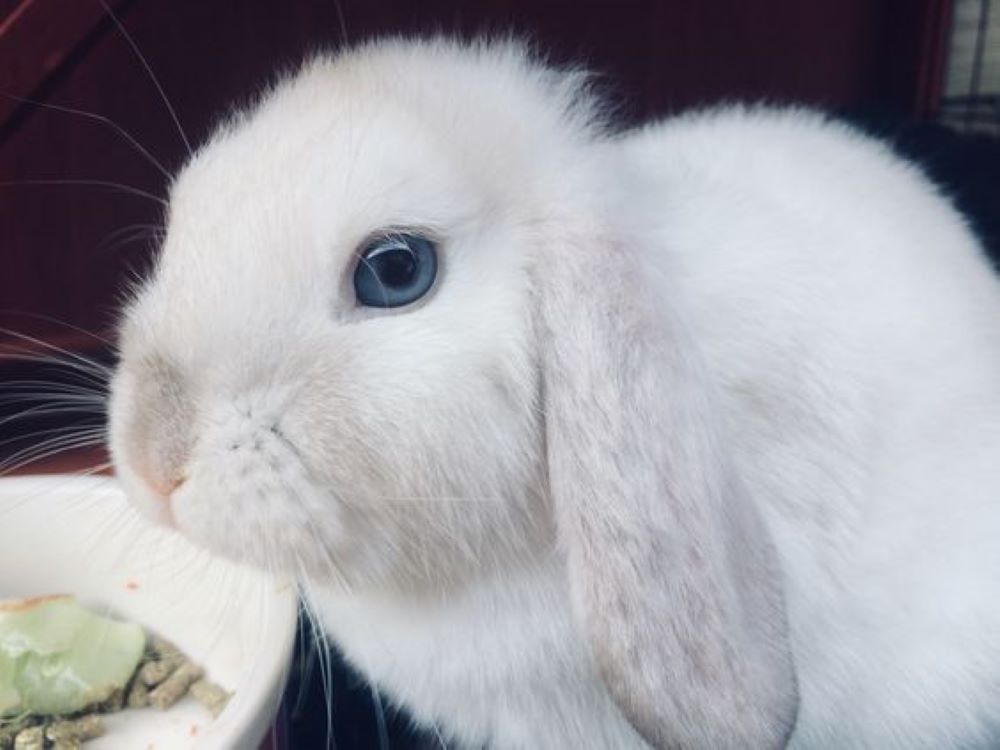
The Holland Lop’s appeal combines its distinctive lopped ears — which hang close to the face rather than standing upright — with a compact, rounded body and a wide variety of coat colors and patterns. The rollback coat is dense and plush, requiring only weekly brushing to maintain it in good condition.
Holland Lops are known for a friendly, social temperament. They enjoy human interaction and bond readily with their owners. They suit a wide range of households and are among the most adaptable of all popular rabbit breeds. Note that Holland Lops bred from poor lines can be more susceptible to dental malocclusion due to the compact skull structure from the dwarf influence — a consideration when selecting a breeder.
5. Dutch Lop (Mini Lop)
- Weight: 4.5 to 6.5 pounds (2 to 2.9 kg)
- ARBA recognized: Yes — since 1980
- Fur type: Rollback
- Grooming: Low — weekly brushing
- Best for: Families, owners who want a medium-sized lop breed with easy care
The Mini Lop — known in Europe as the Klein Widder — was introduced to the United States in the 1970s and received ARBA recognition in 1980. It occupies the space between the smaller Holland Lop and the larger French Lop in the lop rabbit size spectrum. It has a stocky, compact body and the characteristic lopped ears of all lop breeds.
The Mini Lop is known for its intelligence and trainability — it can be litter trained, learns its name, and some individuals can be trained to simple tricks with consistent, positive reinforcement. Its rollback coat requires only weekly brushing. It is a strong choice for a family wanting a medium-sized rabbit with a manageable coat and an active, engaged personality.
6. New Zealand Rabbit
- Weight: 9 to 12 pounds (4 to 5.4 kg)
- ARBA recognized: Yes
- Fur type: Flyback
- Grooming: Low — weekly brushing
- Best for: Owners wanting a larger, calm companion; homesteaders; 4-H projects
Despite its name, the New Zealand rabbit was developed entirely in the United States in the early 20th century. It is a large, commercial-type rabbit with a well-muscled body and a dense flyback coat that comes in white, red, black, blue, and broken varieties. The New Zealand White — with its white coat and characteristic pink or ruby eyes — is the most commonly recognized variety and one of the most widely kept rabbits in the country.
New Zealand has a calm, even temperament and tolerates handling well. Its large body requires more space than dwarf breeds, but its coat is among the easiest to maintain of any rabbit breed — thick, short, and self-maintaining outside of shedding periods. It is a popular breed for 4-H projects, homesteaders, and owners who want a substantial, manageable companion animal.
7. Himalayan Rabbit
- Weight: 2.5 to 5 pounds (1.1 to 2.3 kg)
- ARBA recognized: Yes — one of the oldest recognized breeds
- Fur type: Normal flyback — very thin, fine
- Grooming: Very low — the thinnest, lightest coat of any domestic rabbit breed
- Best for: First-time owners, older children, adults seeking a calm and low-maintenance companion
The Himalayan is one of the oldest established rabbit breeds in the world, recognized as an ancient breed across multiple countries. It is immediately recognizable by its Himalayan or pointed white color pattern — a pure white body with dark points on the nose, ears, feet, and tail in black, blue, chocolate, or lilac. Its eyes are pink or ruby.
Christine Toering, a rabbit judge for the ARBA, describes the Himalayan as her top recommendation for new rabbit owners in an interview with Chewy, specifically citing the breed’s docile, laid-back personality and extremely thin, low-maintenance coat. The coat is the lightest and least dense of any short-haired breed, requiring minimal grooming and producing very little shed. The Himalayan’s calm temperament and willingness to be handled make it genuinely suitable for careful older children and first-time adult owners alike.
Short Haired Breeds vs. Angora Rabbits: Key Differences
People researching short-haired bunnies often ask whether an Angora rabbit might suit them better — or vice versa. The answer depends entirely on what a person is looking for.
| Feature | Short Haired Breeds | Angora Breeds |
|---|---|---|
| Grooming frequency | Weekly brushing | 2–3x per week minimum |
| Coat harvest required | No | Yes — every 90–120 days |
| Wool block risk | Low | High — primary health concern |
| Fiber production | None | Yes — spinnable wool 4x per year |
| Grooming time per week | 5–10 minutes | 30–60+ minutes |
| Best for beginners | Most breeds, yes | French Angora only |
| Show options (ARBA) | Wide range of breeds | English, French, Giant, Satin |
| Space requirements | Small to large by breed | Moderate to large by breed |
| Typical lifespan | 7–12 years | 7–12 years |
If you want a rabbit primarily as a companion with minimal grooming demands, a short-haired breed is the right choice. If you are drawn to fiber arts, want to produce your own yarn, or are specifically interested in the Angora breeds as a rabbit-keeping specialty, the Angora is the right direction — but requires a significantly higher grooming commitment from day one.
For a full guide to Angora rabbit breeds, start with our Types of Angora Rabbits guide. For the easiest entry point into Angora keeping, see our French Angora Rabbits page.
Care Essentials for All Short-Haired Rabbits
Regardless of breed, all short-haired rabbits share the following core care requirements.
Diet: Timothy hay must be available at all times and forms the foundation of every rabbit’s diet. It provides essential fiber for gut motility, supports dental wear, and prevents the digestive stasis that is the most common serious health risk for all domestic rabbits. Supplement with rabbit pellets (15–16% protein for short-haired breeds), fresh leafy greens, and unlimited fresh water. Carrots and fruit are treats — offered occasionally in small amounts, not as dietary staples.
Housing: The enclosure must allow the rabbit to take at least three full hops in any direction, stand fully upright, and stretch out completely. A minimum of 12 square feet of living space is recommended for most adult rabbits, with daily free-roam time in a rabbit-proofed room. For apartment dwellers, most short-haired breeds — particularly the Netherland Dwarf, Dutch, Mini Rex, Holland Lop, and Himalayan — are well-suited to indoor living in moderate-sized spaces.
Grooming: Weekly brushing is sufficient for most short-haired breeds outside of seasonal shedding. During the twice-yearly heavy molt — typically in spring and autumn — daily brushing is needed to remove loosening fiber before the rabbit ingests it. Even short-haired rabbits can develop digestive problems from ingesting excessive shed fiber.
Veterinary care: Annual health checks are recommended for all rabbits. Find a veterinarian with rabbit or small exotic animal experience — general practice veterinarians vary significantly in their familiarity with rabbit medicine. The House Rabbit Society maintains a state-by-state directory of rabbit-savvy veterinarians across the United States.
For a full rabbit care guide, see our Angora Rabbit Care Guide — most of the care principles covered there apply equally to short-haired breeds, except for the coat-specific requirements.
FAQs
Which short-haired rabbit is best for a first-time owner?
The Dutch rabbit, Mini Rex, and Himalayan are the most consistently recommended breeds for first-time owners by ARBA rabbit judges. All three have low-maintenance coats, calm temperaments, and are manageable in a wide range of living situations.
Are short-haired rabbits easier to keep than Angora rabbits?
Yes — significantly. Short-haired rabbits require only weekly brushing and no coat harvesting. Angora rabbits require a minimum of two to three grooming sessions per week, coat harvesting every 90 to 120 days, and ongoing management of wool block risk. The difference in time commitment is substantial.
Can short-haired rabbits live in apartments?
Yes. Most short-haired rabbit breeds are well-suited to apartment living, provided they have an adequate enclosure size and daily free-roam time in a rabbit-proofed area. Smaller breeds — Netherland Dwarf, Dutch, Mini Rex, Holland Lop, Himalayan — are particularly practical for apartment environments.
Do short-haired rabbits shed?
Yes. All domestic rabbits shed, regardless of coat length. Most short-haired breeds go through two heavier shedding periods per year — typically in spring and autumn — during which daily brushing is needed. Outside of these periods, weekly brushing is sufficient.
What is the lifespan of a short-haired rabbit?
Most short-haired rabbit breeds live 7 to 12 years with proper care. Smaller breeds, like the Netherland Dwarf, tend toward the lower end of this range. Larger breeds, like the New Zealand, are often comparable at 7 to 10 years.
What is the softest short-haired rabbit?
The Mini Rex is widely considered the softest short-haired rabbit breed. Its Rex coat — in which guard hairs are shortened to the same length as the undercoat — produces a plush, velvety texture that is distinctly different from any other rabbit coat. For the softest overall rabbit regardless of coat length, the English Angora — with its ultra-fine, all-underwool coat — surpasses even the Mini Rex.
Conclusion
Short-haired bunnies offer a wide range of options for every type of owner — from the tiny, active Netherland Dwarf to the calm, large-framed New Zealand, and from the velvet-coated Mini Rex to the distinctive Dutch with its classic markings. All share the practical advantage of low-maintenance coats that require only weekly attention under normal conditions.
If you find yourself drawn to the idea of a rabbit that also produces fiber — something a short-haired rabbit cannot offer — Angora breeds are worth exploring seriously. The French Angora is the most accessible starting point for anyone interested in making that transition, combining good fiber production with a more manageable coat than the English Angora. Our Types of Angora Rabbits guide covers the full range of options in detail.
Whichever direction you go, the foundation of successful rabbit keeping is the same: unlimited hay, adequate space, consistent handling, and a veterinarian who knows rabbits. Get those four things right, and the breed becomes secondary.