
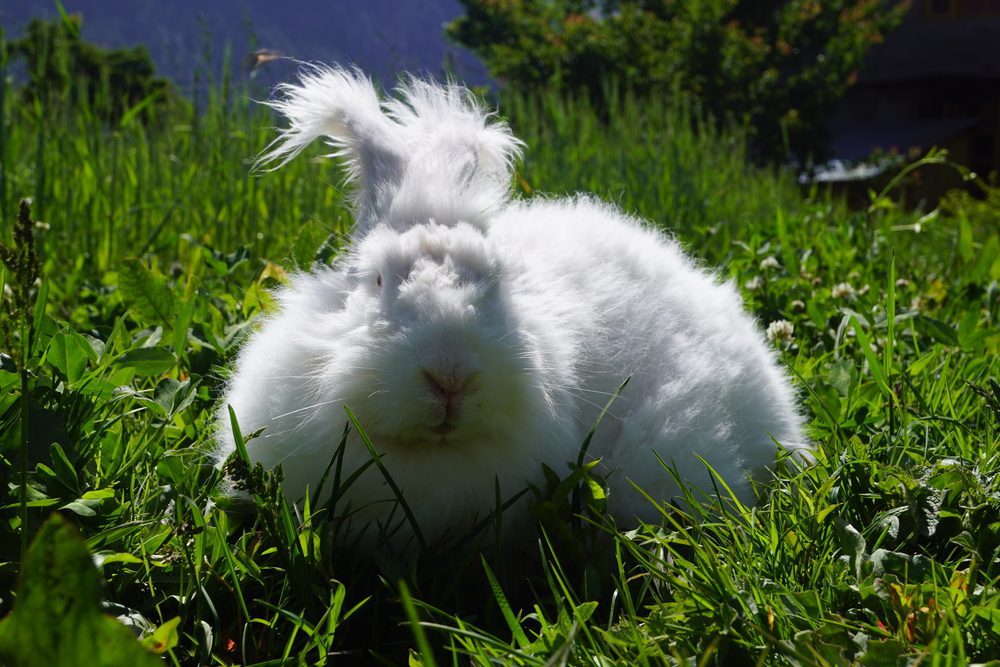
German Angora Rabbit: Complete Breed Profile, Care Guide, and What US Owners Need to Know
How we researched this guide: Breed facts come from the published standard, registration rules and Standards of Care of the International Association of German Angora Rabbit Breeders (IAGARB). Health facts come from the Merck Veterinary Manual and the PDSA veterinary charity. Where we could not find a published figure, we left it out. Every source is listed at the end. See our editorial policy. Last reviewed: October 2026.
German Angora Rabbit: The Short Answer
The German Angora is a wool rabbit bred for one job: a high yield of usable wool with little labor. Its coat is sheared every 90 days.
It is not an ARBA breed. The American Rabbit Breeders Association’s Breed ID Guide lists the English, French, Satin and Giant Angora, but not the German. Instead, the IAGARB keeps the breed standard and the registry in North America.
To be registered, a German Angora must score at least 80 points and grow at least 325 grams of wool in one 90-day coat. That projects to 1,300 grams (about 2.9 lb) a year, according to IAGARB registration rules.
| Fact | German Angora | Source |
|---|---|---|
| Recognized by | IAGARB (not ARBA) | ARBA, IAGARB |
| Weight | Minimum 2.5 kg (5.5 lb); average about 3.5 kg (7.7 lb) | IAGARB standard |
| Coat | Three fiber types: underwool, awn fluff, guard hair | IAGARB standard |
| Furnishings | Ears, forehead, cheeks and feet | IAGARB standard |
| Colors | White and colored; bi-colored animals are not accepted | IAGARB standard |
| Harvest | Shearing every 90 days | IAGARB Standards of Care |
| Registration minimum | 325 g per 90-day coat (1,300 g a year projected) | IAGARB |
| Ideal temperature | 58 to 68°F; cool the rabbit above 75°F | IAGARB Standards of Care |
Not a beginner rabbit: The German Angora needs shearing every 90 days, cool housing and daily checks. If you are new to rabbits, start with our Angora rabbit care guide first.
Breed History and Origin
German breeders built this rabbit through decades of performance testing. IAGARB reports that the first testing stations opened in 1934. They let breeders compare wool output under controlled conditions.
The gains were large. Wool output started at about 250 grams (half a pound) a year. By 1935 the average rabbit gave about 422 grams, per IAGARB. A record of 2,232 grams was set in 1990, and a new record of over 2,800 grams came ten years later.
Today, certified shearing totals above 2,000 grams a year are “not uncommon” in Europe and North America, IAGARB says. Colored German Angoras were later allowed into the registry.
IAGARB Breed Standard: How a German Angora Is Judged
The IAGARB breed standard scores each rabbit out of 100 points. Wool traits carry 45 of those points.
| Category | Points | What judges look for |
|---|---|---|
| Weight | 20 | Minimum 2.5 kg; full points above 3.5 kg |
| Body type | 20 | Medium length, cylindrical, good depth and width; “great oversize is undesirable” |
| Wool density and length | 15 | Skin fully covered; ideal staple 2.5 inches (6.35 cm) |
| Wool uniformity | 15 | Even length and texture over the whole body, belly included |
| Wool texture | 15 | Silky, crimped underwool; guard hair present in bucks |
| Furnishings | 10 | Tufts on ears, forehead, cheeks and feet that need little care |
| Condition | 5 | Clean legs, ears and vent; trimmed claws |
There is no Champion or Grand Champion title in the IAGARB system. The association says it does not award these designations.
Physical Characteristics
Body
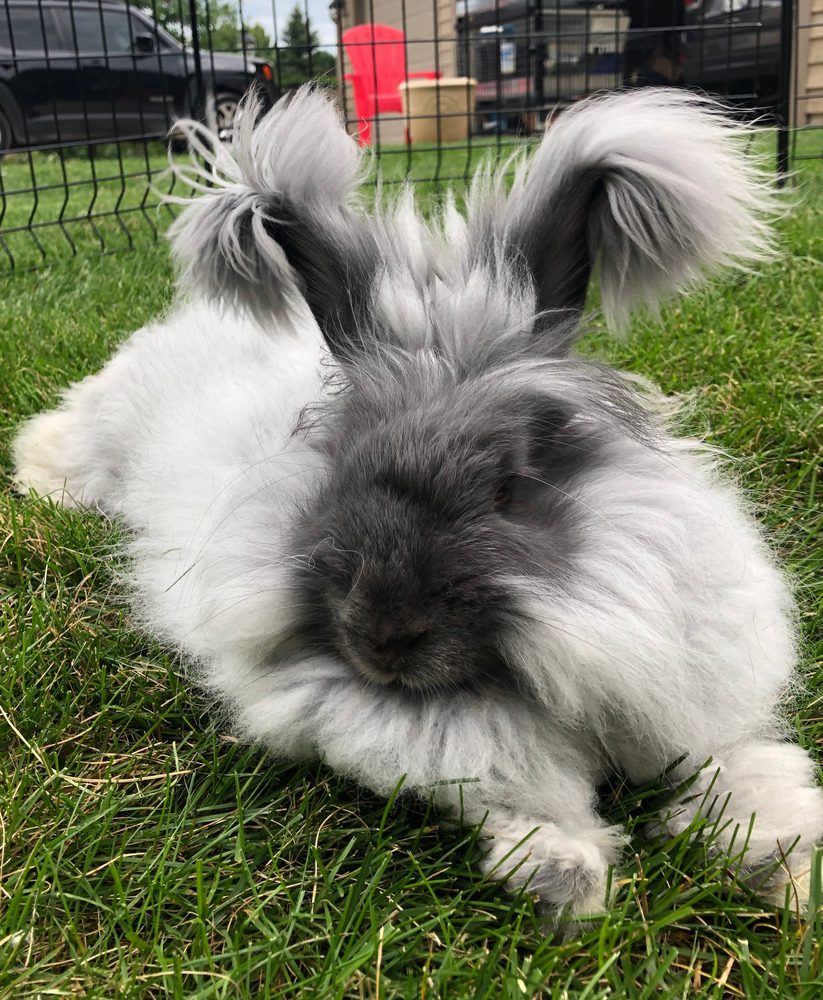
The standard calls for a medium-length, cylindrical body. Shoulder width should equal depth, and body length should be about three times that measure. The hind legs are strong, and the ears are carried erect.
Coat and Furnishings
The coat has three fiber types, per the IAGARB standard:
- Underwool: the main layer. It is fine, crimped and silky.
- Awn fluff: an in-between fiber with curved tips.
- Guard hair: stronger fibers with straight tips. It must be present in bucks and should not be too heavy in does.
The German Angora is not clean-faced. The standard asks for furnishings on the ears, forehead, cheeks, front feet and hind feet. “Wool blind” furnishings are not wanted.
Colors
White German Angoras are the best known, but colored animals are accepted. The standard rejects bi-colored rabbits. In colored animals, the short-haired areas should be darker than the wool. See our Angora rabbit colors guide for more.
Registration: Proof of Wool Output
IAGARB registration is a performance test, not just a pedigree. A rabbit must pass two checks, according to IAGARB:
- Score at least 80 points against the breed standard.
- Grow at least 325 grams of wool in a certified 90-day coat.
The 90-day total is multiplied by four to project yearly output. So 325 grams becomes 1,300 grams a year.
The harvested wool is graded before it counts:
| Wool grade | Counted at |
|---|---|
| Prime (first grade) | 100% of its weight |
| Second grade | 75% of its weight |
| Third grade | 25% of its weight |
| Stained or soiled bits | Not weighed |
This rewards rabbits whose coats stay clean and usable, not just heavy.
The 90-Day Shearing Schedule
The IAGARB Standards of Care recommend shearing a German Angora every 90 days. Breeders time it this way for a reason.
After 90 days, the wool begins to shed. Webby wool and mats then form, per IAGARB grooming guidance. Loose wool in the coat can also be swallowed during self-grooming.
Grooming Between Shearings
A well-bred German Angora should need little or no grooming between shearings. IAGARB breeders concluded that grooming “was not necessary” if good conditions were kept.
Those conditions are good nutrition, a clean cage and freedom from mites. IAGARB names mite infestation as “a leading cause of matting.”
IAGARB sets a simple test. Wool lost to matting on a 90-day coat should not exceed one ounce. If it does, review care first. If matting continues, question the rabbit’s place in a breeding program.
The 45-Day Midpoint Trim
IAGARB suggests a light trim halfway through the cycle:
- Trim the furnishings on the face.
- Cut back the wool between the rear legs.
- Clip the area under the tail. This can “dramatically reduce” urine burn and stained wool, especially in summer.
For tools and step-by-step methods, see our Angora rabbit grooming guide and our guide to the best brushes for Angora rabbits.
German Angora Wool for Spinners
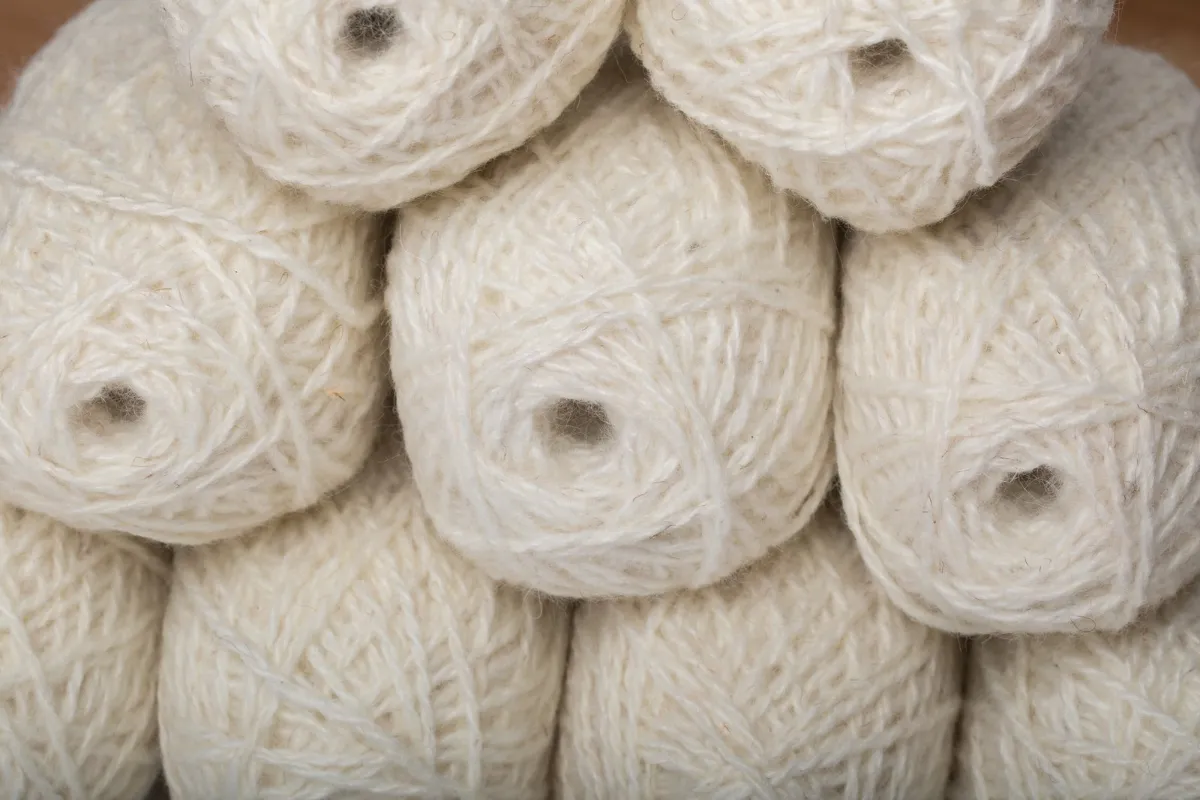
The breed standard sets an ideal staple length of 2.5 inches (6.35 cm). That is the length a 90-day coat is bred to reach.
Crimp matters too. IAGARB says “crimped wool is desirable as it creates a lively yarn.” The standard also asks for wool that is strong and not prone to felting.
Density is the breed’s strength. In lab samples, high-producing German Angoras showed clusters of more than 20 fibers. Lower producers showed clusters of 2 to 6, per IAGARB.
Learn more in our guides to raising Angora rabbits for wool and Angora rabbit yarn.
Diet
Wool growth runs on good feed. The IAGARB Standards of Care set these basics:
- Grass hay every day. It supplies fiber for hindgut health.
- Fresh, balanced pellets. Do not buy feed milled more than six months ago.
- Clean water every day. Rabbits will not eat if they are thirsty. Keep water thawed in freezing weather.
- Treats in moderation. They should never replace a balanced feed.
How much? IAGARB describes a normal ration as 1 cup of pellets by volume per adult Angora per day. That is roughly 6 ounces, per its feed-to-wool article. Adjust for your rabbit’s size and condition with your vet.
Protein: The Merck Veterinary Manual lists rabbit protein needs from 12% for maintenance to 17% for nursing does. Wool is made of protein. So this site recommends pellets with at least 17% protein for any Angora in full coat. Check the label before you buy.
Hay matters for health as well as wool. Merck says gut stasis often follows a diet with “too little dietary fiber.” It advises unlimited hay. See our complete Angora care guide for a full feeding plan.
Housing
These are the minimums from the IAGARB Standards of Care:
| Requirement | IAGARB minimum |
|---|---|
| Single rabbit (5.5 to 12 lb) | 30 in deep × 36 in long × 24 in high, or 24 × 48 × 24 in |
| Floor space, single rabbit | 7.5 sq ft, not counting food and water dishes |
| Doe with litter | 30 × 48 × 24 in; 10 sq ft |
| Wire | 14-gauge wire, galvanized after welding |
| Tops and sides | 1 × 1 in or 1 × 2 in wire |
| Floor | ½ × 1 in wire |
| Sharing | Caged alone, except does with litters |
Wire floors carry a risk. Merck lists wire flooring among the causes of sore hocks. It recommends soft bedding and solid resting surfaces. A solid resting board in the cage gives the feet a break from the wire.
Housing should also be kept clean, with shade from direct sun. IAGARB asks owners to check rabbits daily for changes in behavior and health. More ideas are in our Angora rabbit habitat guide.
Temperature: Keep Them Cool
IAGARB gives the ideal range for German Angoras as 58 to 68°F. Above 75°F, it calls for cooling. Options include fans, misting, frozen water bottles or air conditioning. Provide shade whenever sun could overheat the rabbit.
Cold needs care too. Recently shorn rabbits “may require coats and supplemental heating regardless of the temperature,” IAGARB says. Add bedding or shelter below freezing.
Thinking of outdoor housing? Read can Angora rabbits live outside? first.
Health
Gut Stasis and Wool Block
Rabbits swallow hair when they groom. Normally it passes out in the droppings, says the Merck Veterinary Manual. True hairballs that block the gut are “uncommon but serious,” and a blockage usually needs surgery.
Gut stasis is more common. Food movement slows, gas builds, and the rabbit becomes bloated and painful. Merck links it to too little dietary fiber or dental disease.
For a German Angora, prevention means unlimited hay, fresh water and shearing on time. A rabbit that stops eating or passes fewer droppings needs a vet promptly.
Fur Mites
Fur mites cause “walking dandruff,” a flaky, itchy coat. Merck notes they can also mildly irritate people’s skin. In German Angoras they matter more, because IAGARB calls mites a leading cause of matting. Ask your vet about diagnosis and treatment.
Flystrike
Flystrike happens when flies lay eggs on damp, dirty fur and the maggots burrow into the skin. The PDSA says it is most common in warm months.
Check your rabbit’s rear end every day in summer. If you find even one maggot, the PDSA says to call your vet for an emergency appointment.
Sore Hocks
Sore hocks are pressure sores on the feet. Merck lists wire flooring, dirty housing, obesity and poor mobility among the causes. Heavier rabbits are more prone. Solid resting surfaces help.
Heatstroke
The PDSA lists these warning signs:
- Red ears that are hot to the touch
- Fast, shallow or open-mouth breathing
- Weakness, low energy or collapse
- Shaking, wobbliness, confusion or seizures
First aid: move the rabbit somewhere cool and wet its ears with cold tap water. Then call your vet. Do not cover the rabbit with a wet towel, which traps heat.
Safety first: Gut stasis, flystrike and heatstroke can all turn serious fast. Find a rabbit-savvy vet before you bring a German Angora home. The House Rabbit Society keeps a vet finder. Read more in our Angora rabbit health guide.
German Angora vs Giant Angora
The two breeds are often confused. Both have a three-type coat. The key difference is who sets the standard.
| Feature | German Angora | Giant Angora |
|---|---|---|
| Standard set by | IAGARB | ARBA (club: NARBC) |
| ARBA shows | Not eligible | Eligible |
| Weight | Minimum 2.5 kg (5.5 lb) | Seniors: bucks 9.5 lb+, does 10 lb+ |
| Colors | White and colored (not bi-colored) | Ruby-eyed white and chestnut |
| Coat | Underwool, awn fluff, guard hair | Underwool, awn fluff, awn (guard) hair |
| Judged on | Conformation plus certified wool output | Conformation at ARBA shows |
Sources: IAGARB standard, ARBA Breed ID Guide, National Angora Rabbit Breeders Club. Read our full Giant Angora guide or compare every breed in types of Angora rabbits.
Is a German Angora Right for You?
A German Angora may suit you if:
- You want wool more than show ribbons.
- You can shear every 90 days, without fail.
- You can keep the rabbit near 58 to 68°F and cool it above 75°F.
- You have room for a 7.5 sq ft cage per rabbit.
- You can check the rabbit every day.
It may not suit you if you are new to rabbits, live somewhere hot without cooling, or want an ARBA show rabbit. In that last case, look at the English, French, Satin or Giant Angora.
Lifespan
We found no published lifespan study for the German Angora. For pet rabbits in general, the Merck Veterinary Manual says they “can live 10–12 years or longer” with a proper diet and good living conditions. See our Angora lifespan guide.
Where to Buy a German Angora
Start with breeders in the IAGARB network. IAGARB-registered rabbits have passed a wool performance test, not just a pedigree check. Ask to see the parents’ shearing records.
For questions to ask and red flags, read where to buy an Angora rabbit. For costs, see how much Angora rabbits cost.
Frequently Asked Questions
Is the German Angora recognized by ARBA?
No. The ARBA Breed ID Guide lists the English, French, Satin and Giant Angora only. The German Angora is registered by the International Association of German Angora Rabbit Breeders (IAGARB).
How much wool does a German Angora produce?
To be registered, a German Angora must grow at least 325 grams in one 90-day coat. That projects to 1,300 grams a year. IAGARB says yearly totals above 2,000 grams are not uncommon.
How often should a German Angora be sheared?
Every 90 days, per the IAGARB Standards of Care. After 90 days the wool starts to shed and can mat. IAGARB also suggests a light trim of the face and rear at 45 days.
Does a German Angora need daily grooming?
No. IAGARB breeders found that a well-bred German Angora needs little or no grooming between shearings. That holds if its diet is good, its cage is clean and it has no mites.
What colors do German Angoras come in?
White is the best known, but the IAGARB standard accepts colored German Angoras too. Bi-colored rabbits are not accepted.
What temperature is best for a German Angora?
IAGARB gives an ideal range of 58 to 68°F. Above 75°F, the rabbit needs cooling, such as fans, frozen water bottles or air conditioning.
What is the difference between a German and a Giant Angora?
The Giant Angora is an ARBA breed shown at ARBA shows. The German Angora is registered by IAGARB, which tests each rabbit for wool output as well as conformation.
Sources
- International Association of German Angora Rabbit Breeders. About the German Angora.
- IAGARB. Breed Standard.
- IAGARB. IAGARB Testing and Registration.
- IAGARB. IAGARB Standards of Care.
- IAGARB. German Angora Wool.
- IAGARB. Grooming the German.
- IAGARB. The All-Important Feed to Wool Ratio.
- American Rabbit Breeders Association. Breed ID Guide, January 2023.
- National Angora Rabbit Breeders Club. Giant Angora Rabbits.
- Merck Veterinary Manual, Pet Owner Version. Digestive Disorders of Rabbits.
- Merck Veterinary Manual, Pet Owner Version. Skin Disorders of Rabbits.
- Merck Veterinary Manual, Pet Owner Version. Disorders and Diseases of Rabbits.
- Merck Veterinary Manual. Nutrient Requirements of Rabbits (table).
- PDSA. Heatstroke in Rabbits.
- PDSA. Flystrike in Rabbits.
- House Rabbit Society. Finding a Local Rabbit Veterinarian.
This guide is for general information. It is not a substitute for advice from your veterinarian. Read our disclaimer.